The Commodity Futures Trading Commission handed out approvals for prediction markets with surprising speed last year. Is that going to continue under new leadership?
Recent reporting from Bloomberg gave some interesting color around the agency and PMs.
An underlying theme in the story (paywall) is that approvals for designated contract markets (DCM) and derivatives clearing organizations (DCO) — two registrations related to being a prediction market — sometimes came quickly under acting Chairman Caroline Pham. It happened in both the cases of Gemini and Polymarket, per Bloomberg. If we’re reading tea leaves, it’s not clear that things will happen as quickly under new Chairman Michael Selig.
Here’s some of the story:
In addition to the staff changes, Selig will have to chart his own course about how the agency interacts with companies. In the past year, some prediction markets and digital asset firms took some requests straight to the acting chairman’s office instead of going through career staff as they normally would, according to people familiar with the matter who asked not to be identified discussing agency deliberations. Pham’s office then at times urged rank-and-file staff to rapidly approve new applications, the people said.
Typically, exchange applications follow an iterative, back-and-forth process between agency staff and companies to demonstrate that their trading and surveillance systems meet core rules meant to prohibit manipulation, ensure resiliency during market stress, and other compliance measures. Generally, that process takes more than a year, particularly when staff are reviewing multiple exchange applications at the same time.
In one instance of an accelerated process, Pham’s office pressed staff to speed up its review of Gemini Space Station Inc.’s application, said some of the people familiar, who asked not to be identified discussing agency deliberations. The exchange, co-founded by Trump donors Tyler and Cameron Winklevoss, applied for CFTC approval in May and received it in December.
(A quick sidenote: Bloomberg is absolutely crushing reporting on prediction markets. If you aren’t subscribed, you’re missing the news in this space.)
So what’s all that mean if you are in process with the CFTC or haven’t even applied yet? Is the express lane for DCM/DCO approval going to slow down with the change in leadership? Or will things still speed along? If we are reading tea leaves, we’d guess the former. Obviously, time will tell.
Registrations for sweepstakes sportsbooks ProphetX and Novig are in the pipeline, as well as one for RSBIX, among others. And there are surely more on the way.
Regardless, I would rather already have the necessary approvals to operate a prediction market than not, if I wanted to get into the space.
Prediction markets roundup
Webull Introduces $0 Commission Trading on Pro Football Big Game Prediction Markets (press release): Webull, an online investment platform, offers sports prediction markets through its partnership with Kalshi, a CFTC-regulated prediction market exchange. Webull gives users access to event contracts across sports, economic indicators, cryptocurrency, and other markets, including the Big Game, allowing them to trade on market-implied probabilities for major live events. … Since the rollout in Q3 2025, Webull has seen significant quarter-over-quarter growth in prediction market trading.”
“Sports prediction markets represent a natural extension of how our users already interact with markets,” said Anthony Denier, Group President & U.S. CEO at Webull. “Users can now access regulated event-based markets in a way that feels intuitive to investors who already understand how prices reflect probabilities.”
Users can buy and sell positions at any time to change their mind or lock in gains before an event ends. Unlike traditional sports bets, prediction markets use probability trading and market-driven pricing, letting users follow sentiment shifts, trade Big Game and related contracts with $0 commission (exchange fees apply), and participate in community features that show aggregated market sentiment and enable discussions on the platform.
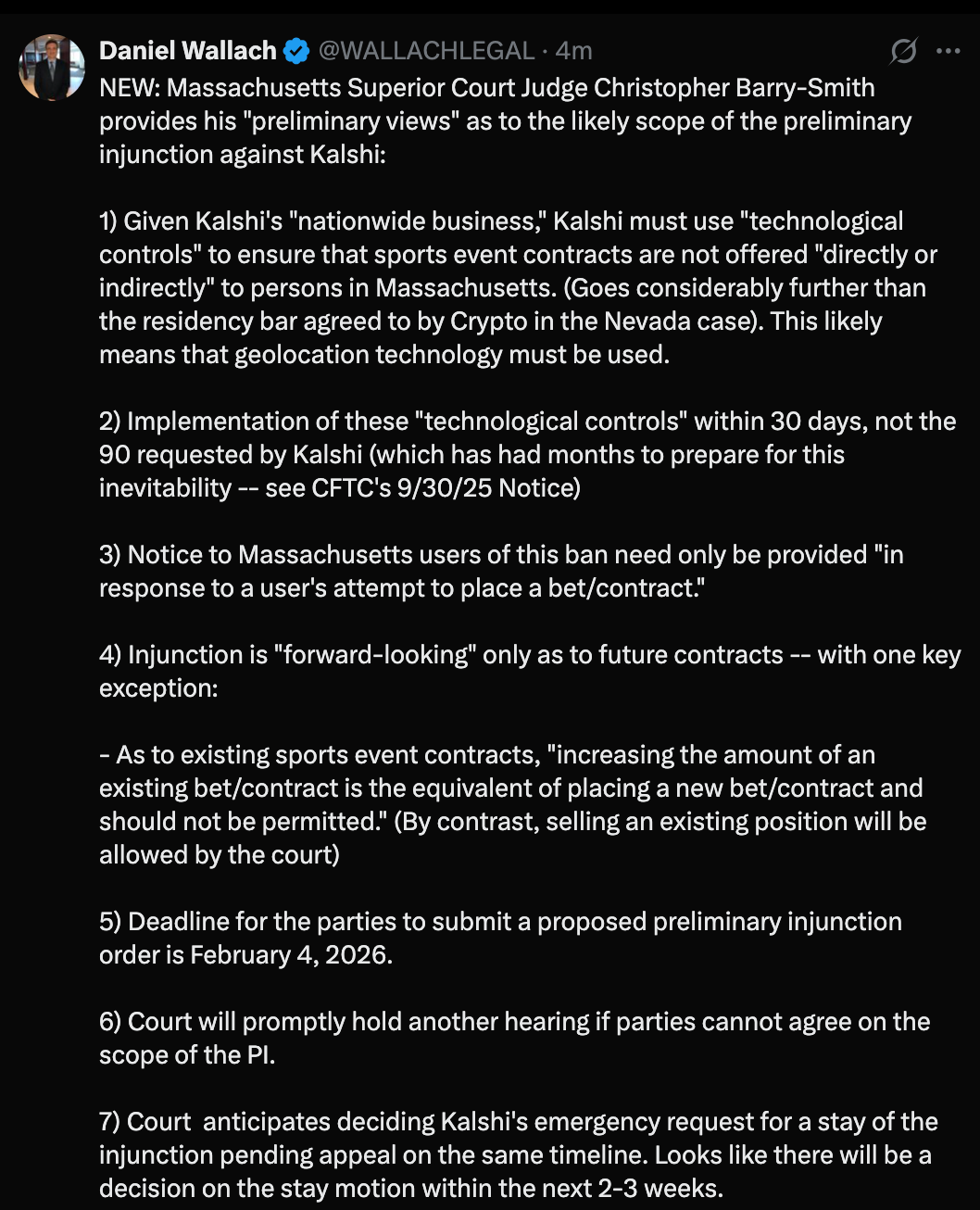
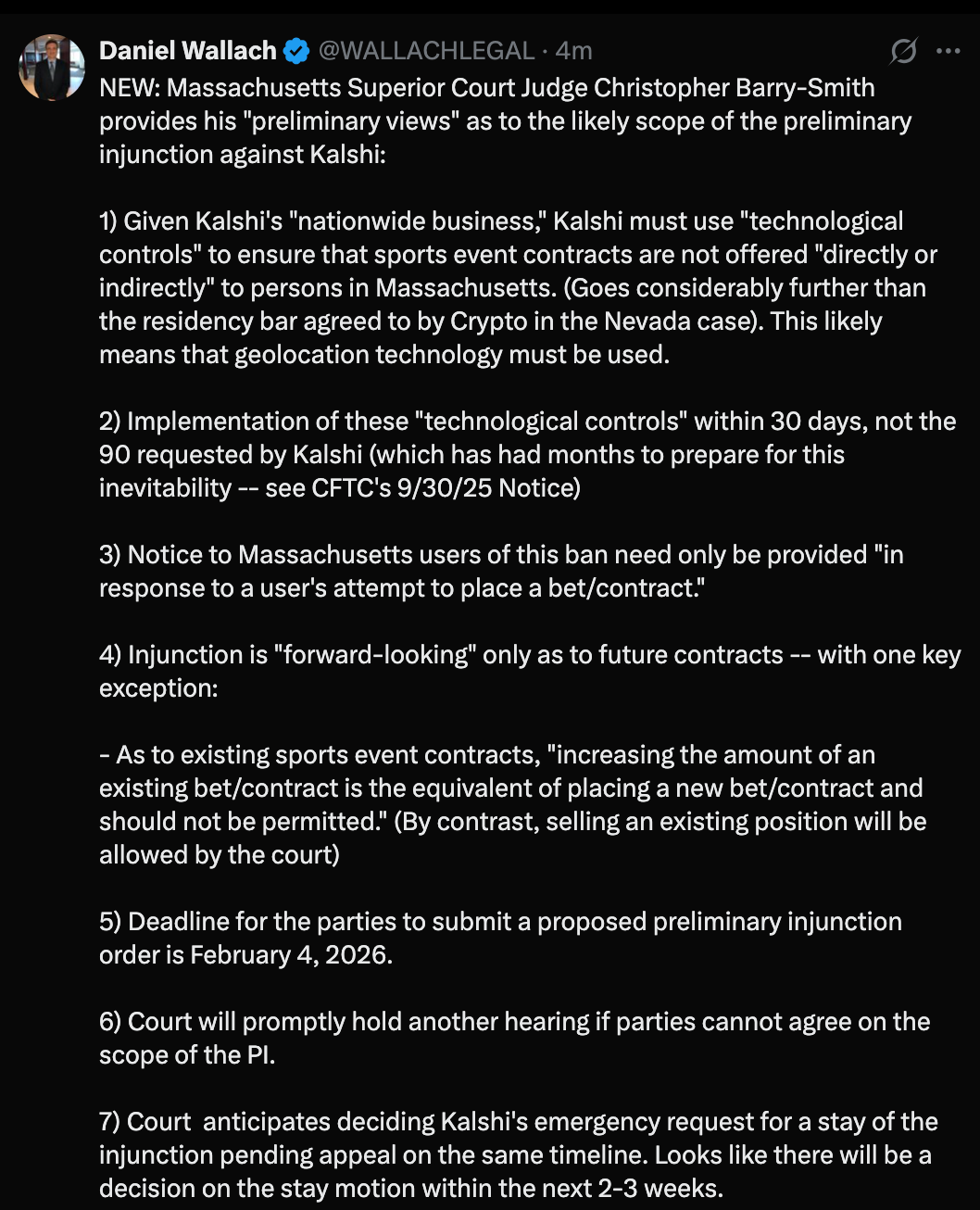
Legal update out of Massachusetts vs. Kalshi from attorney Daniel Wallach:
And from Nevada vs. prediction markets:
 Andrew Kim@akhoya87Robinhood's motion for an injunction pending appeal (in the Nevada case) has been referred to the merits panel. Like the Crypto dot com appeal, Robinhood's appeal has been calendared for an April argument.
 11:20 PM · Jan 27, 2026 · 62 Views1 Reply
Pivot to gambling (Bloomberg, Money Stuff): “Similarly, perhaps, the future of … maybe “the financial system,” or maybe just “individuals trading stuff for fun on their phones,” is prediction markets. I am personally skeptical of grandiose claims for prediction markets — when you read “prediction markets” you should generally just think “online sports gambling” — but people do keep making those grandiose claims. And certainly crypto prepared the way for prediction markets, in quite literal and straightforward ways. …Yeah I guess another way to put it is that young men naturally gravitate to sports gambling, and for a few years crypto was able to redirect that sports-gambling energy into another, more arcane form of gambling, but now everyone’s back to sports gambling.”
Gambling Isn’t News (Aftermath): “These partnerships and products are outlets throwing up their hands at the growing challenge of telling people the truth because they believe the truth matters, joining the fray they employ journalists to see through. The promise of gambling is the promise of a quick fix, and as nice as it might be to pretend otherwise, there isn’t one coming. But that doesn’t mean news outlets have to descend into the same desperate nihilism that fuels prediction markets, especially in a time when journalists’ duty to cut through the noise is more important than ever. I’m not going to pretend everyone, news outlets and bettors alike, doesn’t need money, but there has to be a better way to get it.”
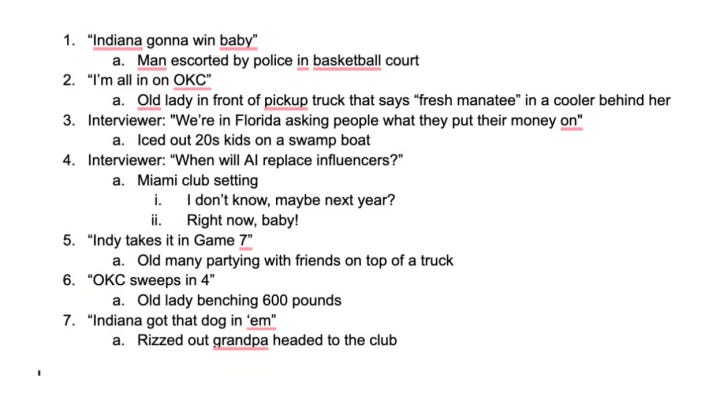
Prediction Markets Are Betting On A Grim Future (Defector, paywall, but free this month with sign-up): “During last summer’s NBA Finals, a fully AI-generated commercial featuring people in man-on-the-street interviews yelling towards the camera about all the things they were going to bet on (football games, the price of eggs, hurricanes, alien visitations) introduced the world to Kalshi. Tagline: “The world’s gone mad, trade on it.” The ad was made by “AI filmmaker” PJ Ace, who wrote a brief outline of the concept and then had ChatGPT convert it into a more detailed prompt which he then fed into Google’s VEO 3 video generator:”
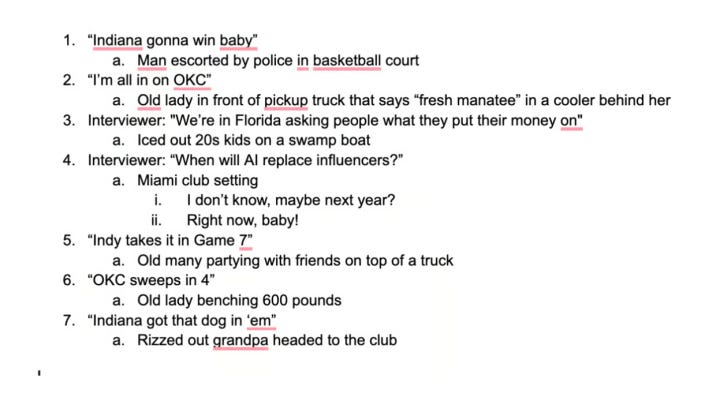
“The decision to rely on generative AI wasn’t about saving money — Kalshi is and was extremely well capitalized—but about flaunting a certain kind of trollish, accelerationist posture intended to locate their target audience — people on social media who are very certain about their ability to predict the future.”
Hawaii Lawmakers Seek To Ban Prediction Markets (InGame): “Hawaii lawmakers introduced legislation Monday that would explicitly ban prediction markets by defining them as illegal gambling under state law. House Bill 2198 would amend Hawaii’s gambling statute to make clear that financial speculation on real-world events is gambling, even when those contracts are structured as securities or commodities. The bill, if passed, would take effect July 1 of this year.”
💡 My take: A lot of people focus on the battle between states where there is already legal sports betting and the prediction markets. And there’s lots of litigation! The flip side is that there’s also betting via prediciton markets in places that have never had any gambling at all, like Hawaii and Utah. That’s arguably a more interesting dynamic. These states didn’t sign up for any type of sports betting, and now they have it.
Also, trying to pass legislative bans right now seems like wasted effort. I guess it could matter after the outcome of all those court cases, but a state-level ban is probably not going to stop much in the short-term.
Fact Sheet: Predictably, “Prediction Markets” Are Just Casinos (Better Markets): Benjamin Schiffrin, Director of Securities Policy for Better Markets, issued the following statement in connection with Better Markets’ new Fact Sheet entitled “Predictably, ‘Prediction Markets’ Are Just Casinos”:
“So-called ‘prediction markets’ operated by firms like Kalshi and Polymarket are not genuine markets. They’re unregulated gambling platforms that function like casinos. These firms disingenuously use the label ‘prediction markets’ to avoid longstanding state gambling laws designed to protect consumers, detect manipulative betting patterns, and prevent crime.
“Despite claims from these prediction market platforms, prediction markets also fail to predict the future. Their users are ordinarily no more likely to know who will win an election or a sporting event than anyone else. But because insiders can use these sites to profit from their knowledge, they lend themselves to manipulation and insider trading. Look no further than the recent Polymarket user who bet big – and won—on an unlikely trade predicting that Maduro would shortly be deposed. The incident bore all the hallmarks of an insider trade.
“For these reasons, prediction markets must be properly regulated. Yet Kalshi and Polymarket claim they should be regulated by the CFTC, the financial regulator for the derivates market. The CFTC is ill-suited to regulate what is essentially gambling activity. Recent federal court decisions bear this out, as several judges have found these sites indistinguishable from gambling. Policymakers should follow the lead of these courts. Prediction markets should be recognized for what they are—unregulated, 24/7 casinos. They must be regulated as gambling operations to protect the public before it’s too late.”
Read the fact sheet here.
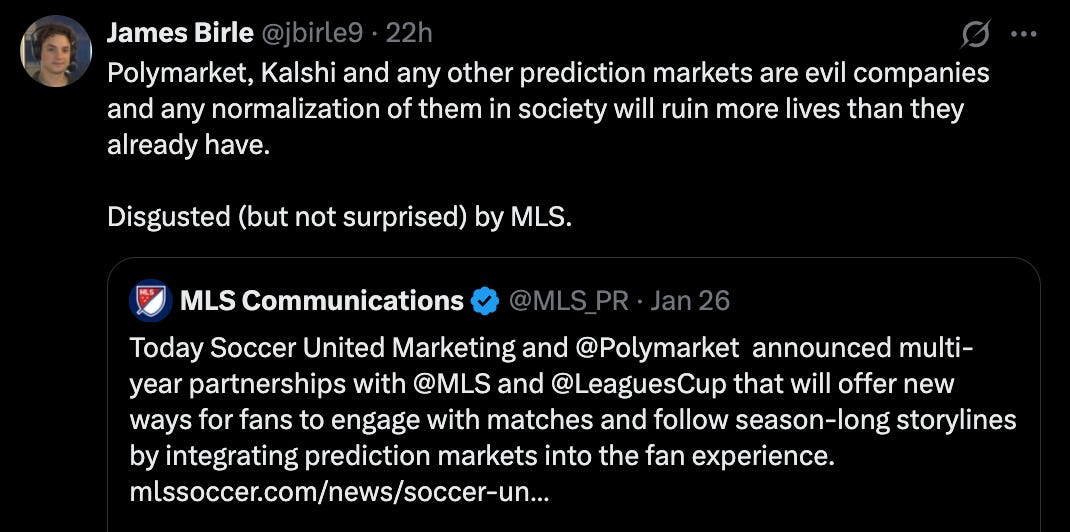
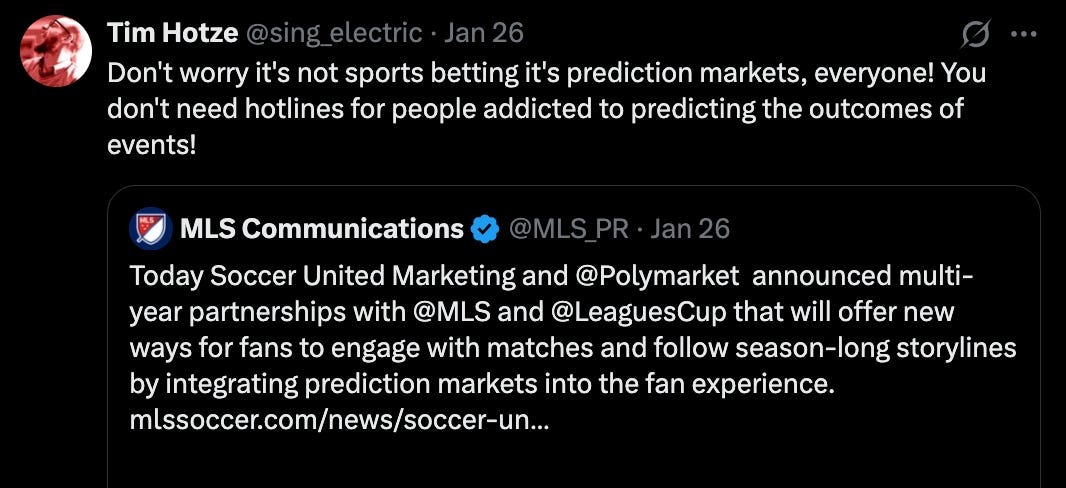
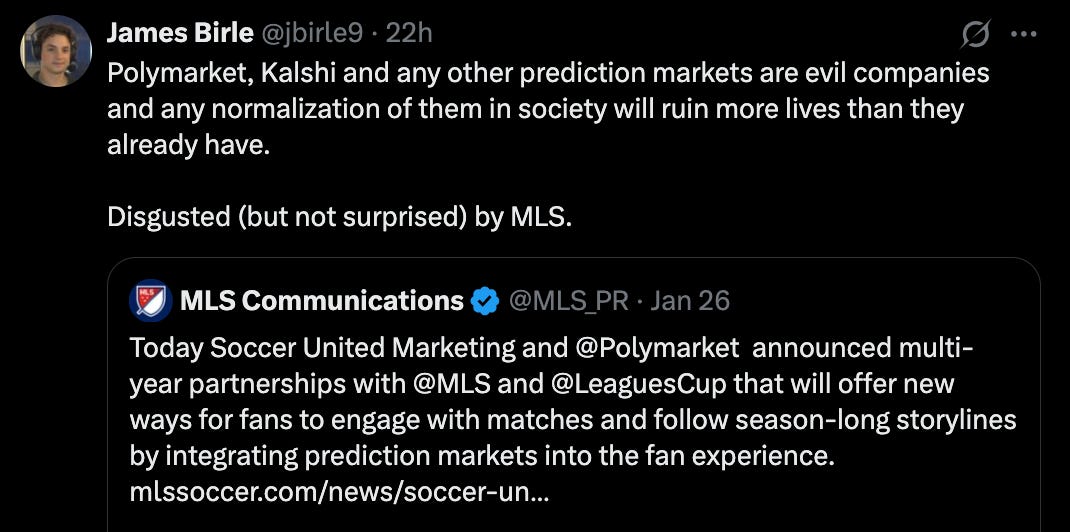
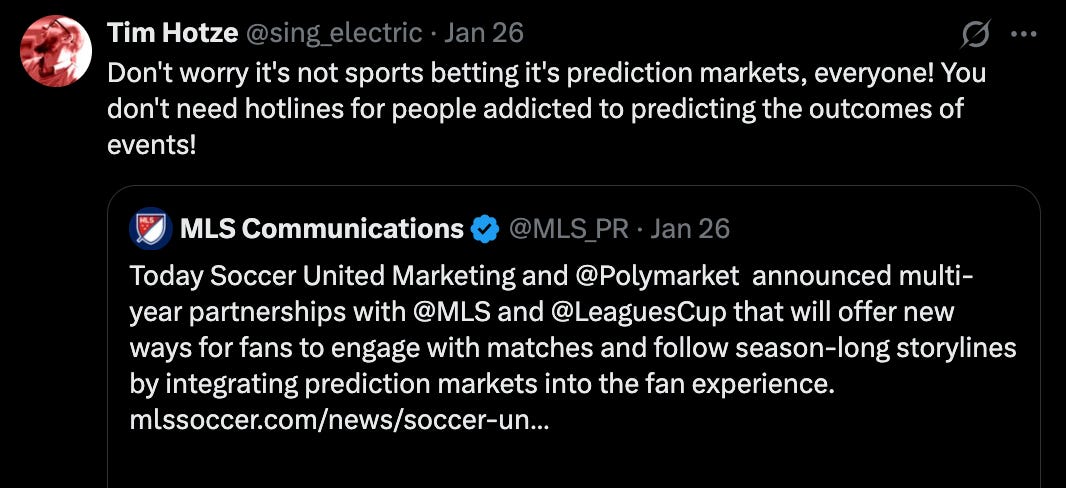
Negative reaction to MLS + Polymarket: The deal between Major League Soccer and the prediction market got some negative response in the former’s mentions on Twitter. For example:
Polymarket’s Volmex contracts open a new path to trading bitcoin, ether volatility (CoinDesk): “Decentralized betting platform Polymarket has listed contracts tied to Volmex’s bitcoin and ether volatility indices, opening the door for anyone to wager on market swings this year. The two contracts, “What will the Bitcoin Volatility Index hit in 2026?’ and “What will the Ethereum Volatility Index hit in 2026?” went live on Monday at 4:13 PM ET.”
To be betting, or not to be…: