

DraftKings and Genius Sports continued the trend of a lot of chatter about prediction markets during earnings season. FanDuel parent company Flutter spoke about the opportunity at length earlier this week.
DraftKings is holding its earnings call on Friday morning; I’ll include more details from that in Monday’s newsletter. For now, we have the earnings materials that came out on Thursday evening.
From the press release:
“We are off to a fantastic start to the year as our first quarter results exceeded our expectations,” said Jason Robins, DraftKings’ Chief Executive Officer and Co-founder. “Our core business is strong, and profitability is inflecting. That gives us the firepower to press our advantage in Predictions. With our Super App, market making capabilities, proprietary exchange, and combos coming together, we intend to establish a leadership position in Sports Predictions before year-end.”
Some insights into DraftKings’ prediction markets business from its letter to shareholders:
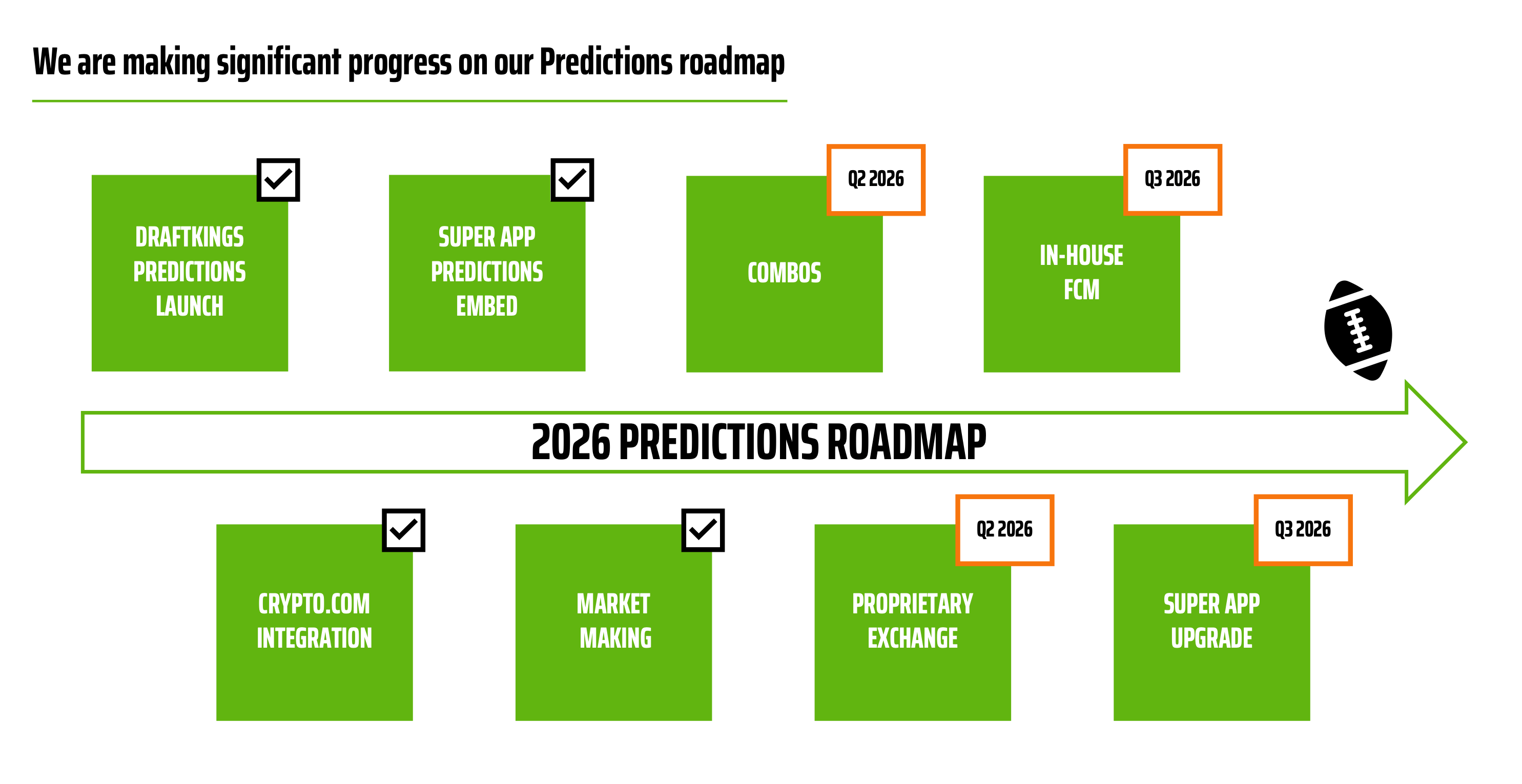
DraftKings expects to launch its own proprietary exchange “in the coming weeks.” To date, it has been dependent on markets offered by CME Group and Crypto.com.
It also expects to start offering combos, aka parlays.
It has started to engage in market making.
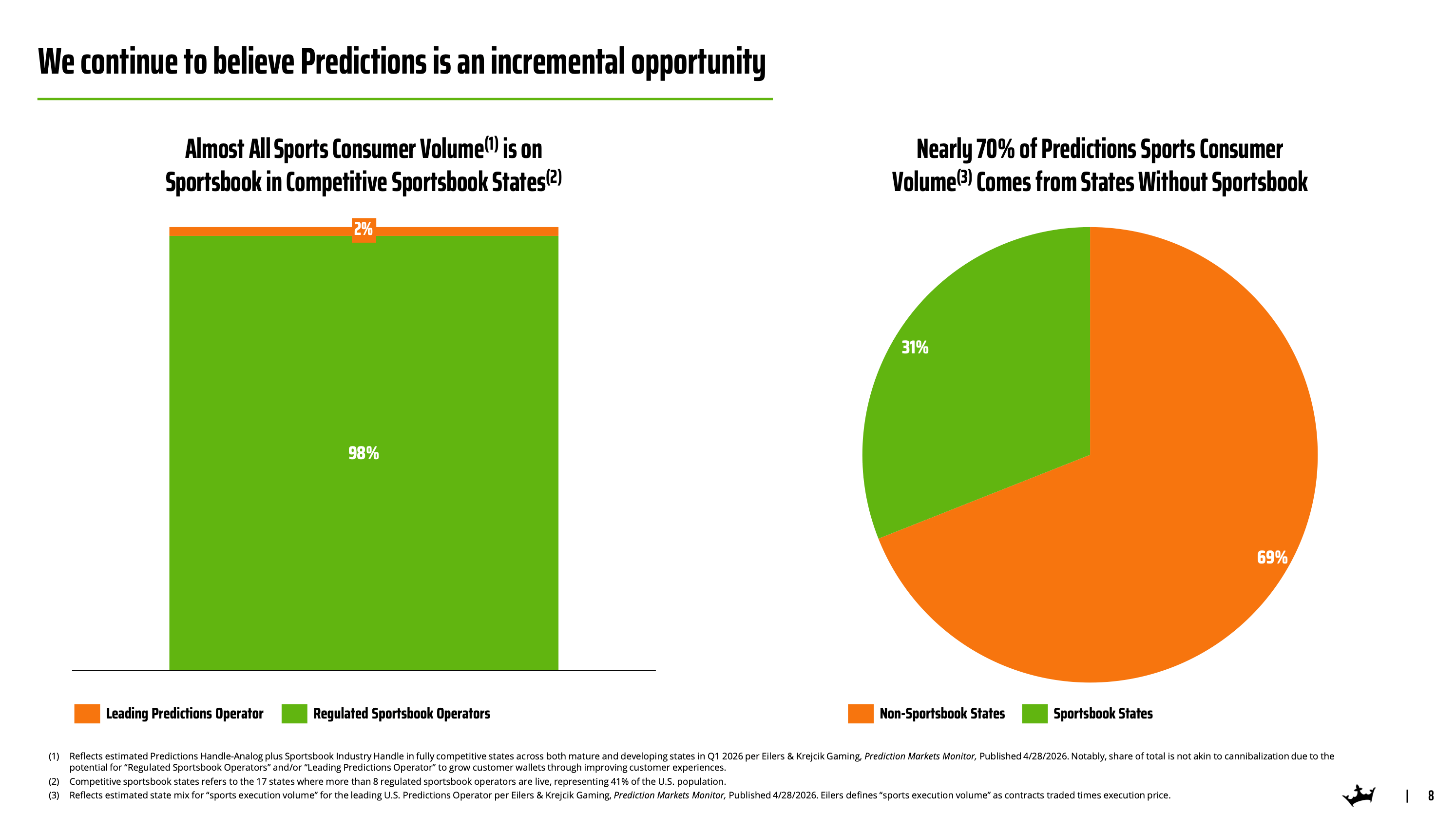
The company says it continues to see relatively little impact to sportsbook handle from prediction markets competition in states with legal sports betting.
Customer acquisition costs for prediction market customers have declined 80% now that Predictions is included in the Super App.
Some direct excerpts from the letter (emphasis added):
In the first quarter, revenue increased 17% year-over-year and surpassed $1.6 billion. Adjusted EBITDA increased 64% year-over-year to $168 million. If not for our significant investment in Predictions and the launch of Sportsbook in Arkansas, our Adjusted EBITDA would have exceeded $200 million.
Across all key metrics, our Sportsbook business remains strong. We continue to see no discernible impact from the rise of Predictions on our Sportsbook business. Internal and third-party data suggest Predictions is impacting Sportsbook industry handle only very slightly and primarily among low-margin wagers, resulting in a negligible impact to revenue. …
AI-first execution and streamlined teams are driving higher productivity than ever, with some teams operating at 2x to 3x last year’s output. Improving efficiency is driving inflecting profitability in our core business. That gives us the firepower to press our advantage in Predictions. Predictions, especially in Sports, is a strategic priority for DraftKings. This category is still in its first inning, and we believe DraftKings is best positioned to define it. We are planning significant investment in the coming months to improve our offering, build liquidity, and scale customer acquisition. We intend to execute with urgency and establish a leadership position in Sports Predictions before year-end.
At our Investor Day in March, we laid out a clear strategy: one nationwide Super App to win in Sports. Already, we are delivering on our plan. Predictions is now live in our flagship app, and as a result, our Predictions customer acquisition cost declined more than 80% in April. Within Predictions, we have more than doubled markets available to trade, which is driving Predictions volume per customer above Sportsbook handle per customer. In April, our annualized Predictions consumer volume exceeded $1 billion and our annualized total volume traded exceeded $2.3 billion, an increase of 38% and 43% month-over-month, respectively.
We have also launched market making, which unlocks access to an additional layer of the value chain. Market making is already generating a positive return for us. In the coming weeks, we expect to launch our proprietary exchange and to begin offering combos. Together, these moves will accelerate innovation, improve the customer experience, and strengthen our economics.
We are confident in Sports Predictions because we increasingly view our Sportsbook capabilities as a key advantage. Sports Predictions and Sportsbook serve the same customers in the same live moments and leverage a shared underlying infrastructure. Whether the customer experience is structured as a bet or a contract, success still comes down to compelling markets, pricing, liquidity, trust, and a seamless customer experience. That is why our sustainable advantages made us a leader in Sportsbook and position us to lead in Sports Predictions too. Beginning next quarter, we will report Sports revenue, which will combine Sportsbook and Sports Predictions. This best reflects how we plan to operate the business.
The opportunity ahead in Sports is massive. At Investor Day, we laid out a path to a $55 billion to $80 billion gross revenue opportunity by 2030, along with at least a 30% long-term Adjusted EBITDA Margin. Predictions is an important part of this opportunity, broadening our reach, strengthening our Sports platform, and driving meaningful incremental Adjusted EBITDA over time. …
Experience and discipline matter in this category. Early third-party data suggests that Predictions customers are experiencing losses more quickly than Sportsbook customers, reinforcing the importance of trust, consumer protections, and operator discipline. We have spent more than a decade building and managing these ecosystems, from Fantasy to Sportsbook and iGaming, and we will apply that same discipline to Predictions. We will grow Predictions the right way, through data-driven decisions, constructive engagement with industry stakeholders, and a focus on markets that uphold the integrity of sports, strengthen customer trust, and align with our standards for responsible engagement.
Our Super App, market making capabilities, proprietary exchange, and combos are coming together ahead of the World Cup. Our roadmap is clear, our execution is real, and we intend to establish a leadership position in Sports Predictions by year-end.
And from the earnings presentation:

You can’t pause current events when your payments can’t keep up. With every failed deposit or lengthy withdrawal process, customers lose trust in your brand. And when money doesn’t move fast enough, your liquidity suffers. PayNearMe’s PayXMTMplatform is purpose-built for Payment Experience Management, giving you the fast, familiar payment options your customers want while streamlining back-end operations for your team. Get real-time payments for real-time events—from one simple integration.
Genius Sports talked about prediction markets during Q1 earnings at length, both in prepared remarks and in Q&A.
Here are some transcriptions from the earnings call:
CEO Mark Locke in prepared remarks: While discussing our betting business, I want to spend a moment on prediction markets because, as we’ve mentioned before, this is a meaningful new ecosystem for Genius Sports. The regulatory framework is evolving. Leagues are establishing agreements with the CFTC and prediction market platforms, and well-funded operators are deploying significant new influxes of capital at scale. We are a beneficiary of this. Where we are different is that our position here is structural. We provide the data and the infrastructure that enables prediction market operators and the other stakeholders in the ecosystem to function at scale.
We expect this to translate into both incremental data revenue and advertising demand as those operators ramp customer acquisition. The way to think about this is simple. We are applying the same proven model in the U.S. online sports betting market to a new category. As a concrete example of revenue, during the quarter, we onboarded several high-profile market makers using our low latency data feeds to help them participate in prediction markets. That is the pattern. Our infrastructure becomes the foundation for new products as they emerge. And as the industry continues to evolve, we see a clear opportunity to execute that same proven strategy and effectively expand our addressable market. We are at the very early stages of that journey today and are excited about our pipeline.
CFO Bryan Castellani (talking in prepared remarks about the recent acquisition of Legend, a media and affiliate marketing company): One specific synergy worth calling out separately: prediction markets. As Mark covered, the ecosystem requires both official data and high-value audiences, capabilities we uniquely combine. Together, Genius and Legend create the only platform in our industry that delivers both at scale. We see this as one of the most attractive incremental revenue opportunities ahead, and only the very early stages of this opportunity are reflected in today’s guidance.
Q: Could you maybe just talk a little bit more about the prediction opportunity right now. I don’t believe the NFL has reached an agreement at this point. Just curious what the opportunity is and then what you’re sort of waiting on to proceed once you get more buy-in from the NFL or any other leagues.
Locke: It’s a good question and clearly a hot topic at the moment. I think it’s probably best to break it into three buckets because already the prediction markets are driving a lot of value for us. The first one we touched upon a minute ago with the market makers, we’re generating good revenues there. Early days, but we’re seeing real positive opportunities there. You’ve got the second part or the second bucket, if you like. I’m sure you’ve all watched the valuations and some of the raises that have been going on at the moment, which, you know, frankly, is gonna be for marketing and for product. We see a lot of that raise coming through to Genius and Legend as part of customer acquisition and the marketing. There’s a significant opportunity there, which we are already starting to capitalize on.
Finally, on the data side, look, we’ve got to have a very close eye on the regulators, and the regulatory environment is something that we are obviously very sensitive to and our partners are very sensitive to. You’re seeing positive moves from the CFTC towards official data. A lot of our partners outside of the NFL are showing strong interest in engaging. We expect that those sorts of deals will come in on a short-term basis.
On a medium-term basis, the NFL and the US sports leagues, I’m sure, are considering their positions. I think it’s fair to say that for the prediction markets to have a long and rosy future, they’re going to want to work very closely with those leagues and with the CFTC. So as a result of that, we expect in the medium term some progress on that front.
Q: Mark, I know it’s early days, but is official data holding that same demarcation that it had in online sports betting? Meaning, are you and your competitors staying in your own lanes in terms of selling data to prediction market stakeholders that only you have official data for, or is it, you know, more of the Wild West out there at this moment in time?
Locke: Yeah, I mean, it’s certainly not the Wild West. It’s much more, you know, the market’s evolved. It’s much more rational than it used to be. I think you’re seeing that in the results. You know, we’re pretty clear, and I think our competitors are pretty clear about what rights we hold, and we’re engaging with not only the rights holders, but the prediction markets on that basis. I think the most important thing that people need to think about in terms of prediction markets is as they evolve and mature and become, you know, move towards a sort of stronger regulatory framework, they’re going to need to fall much more in line with the way that the more traditional sports betting markets work.
They’re going to look to mirror those, that type of framework, which provides them, you know, significant opportunity for us and also, you know, other players in the market who have access and the control over that data. Again, and I think I mentioned this before, you look at what the CFTC have said about the need to move towards official data and the fact that the leagues are starting to align, you’re just going to see more adoption on that basis. Again, we’re very well-placed for that.
Q: I think when you acquired Legend, you were kind of calling for like 20% growth for the full year. You know, it seems like two of the largest sportsbooks are increasing the amount they’re willing to invest in prediction markets. You know, Kalshi has gotten funding. It seems like we’re ramping up for what one would call maybe a 2022, ‘23 advertising spend that we saw in OSB in prediction markets. Just how should we think about the back half advertising ramp for Legend.
Locke: Look, obviously, we love that comparison and we agree with it as well. We’re seeing a lot of the sort of excitement that we saw in those early days. You know, the back half is gonna be seasonal. They’re still gonna be rational spenders and even though they’ve raised a lot of money and they’re being aggressive with their acquisition. However, it’s gonna be based around sports events and, you know, we would think it would likely to follow that calendar. Albeit, it’s a big opportunity for us. As I said for a while, we’re extremely well-placed, especially, well, even more so now with Legend and the distribution network that they have.
Q: …The CFTC, it just wrapped up an engagement process for some potential rulemaking. We know there’s some understandably mixed responses regarding whether or not the CFTC should require the use of official data. I think it’s specifically from the exchanges. Mark, can you just help us think about sort of sensitivity to the addressable customer mix and the TAM here for your data if the CFTC does require the usage of official data versus a scenario where it’s really more a function of latency that determines official versus non-official data?
Locke: I think the key thing is that quality of data. You need to have an official result to settle by, otherwise you’ve got the Wild West, and I think that’s well understood. You’re only gonna get the official result from the official holder of data, and that’s fundamentally the leagues and Genius or the leagues and, you know, whoever holds those rights. I think that’s a fairly clear relationship, that’s out there.
In terms of the TAM, the way I think about or the way we think about it and the way we model it is we think of each of the major prediction markets being like one of the top US sportsbooks. We see the economics, of, you know, Flutter or DraftKings or Kalshi or Polymarket or Robinhood, we see all of them being, you know, equal in terms of their size. When we think about the TAM, and then we think about the opportunity for revenue from us, that’s our sort of base case.
You’ve then got marketing around the edge. You’ve got the addition of Legend, which obviously over-indexes on customer acquisition, which in the current market is extremely good for us because they’ve got the opportunity to go outside of the current states where you’re seeing potential saturation from the existing OSBs. We see an outsized opportunity in the prediction market. Ultimately, we think that the underlying data piece will settle down, as I said, around the large OSB players’ size.
Q: You mentioned being flexible with respect to market maker contracts and them being fairly shorter term relatively as a result. I was wondering if you could maybe explain how you expect those contract terms to evolve over time as prediction markets mature.
Locke: …Look, you’ve got a couple of levers, right? You’ve got liquidity, and you’ve got breadth of market, and then you’ve also got regulatory change. We’ve gotta be focused on all three of those. Taking short-term contracts gives us a bit of a view and flexibility around that. As liquidity in those markets grow, clearly the value of our data and the need for low latency, high quality specific data becomes more valuable, and that’s something that we’ve got a very clear eye on. So we see a very clear path to revenue, significant revenue growth in that space as the natural evolution of that market values the higher quality data that’s available.
Prediction markets roundup
🚨 The important stuff
Kalshi Raises $1 Billion at a $22 Billion Valuation as Institutional Adoption Accelerates (press release): Prediction market Kalshi today announced a $1 billion Series F round at a $22 billion valuation, led by Coatue, with participation from Sequoia Capital, Andreessen Horowitz, IVP, Paradigm, Morgan Stanley, and ARK Invest. This raise comes amid accelerating institutional demand. Over the past six months, institutional trading volume has increased 800%.
Kalshi has emerged as the clear leader in the category, with over 90% of U.S. prediction market activity, as well as the majority of global volume. Over the past six months, annualized trading volume has more than tripled, growing from $52 billion to $178 billion. …
“Kalshi is building the leading platform for trading in real-world events,” said Philippe Laffont, Founder of Coatue. “Consumers have already embraced it, and we believe institutions will follow.”
“There are few categories in recent history that have scaled this quickly outside of AI,” said Tarek Mansour, co-founder and CEO of Kalshi. “Event contracts could become a trillion-dollar market, and we’re still in the early stages of that transition.”
🔍 This would be bigger news, but the WSJ and Bloomberg reported this news in March!
Why Investors Are Still Betting Big on Kalshi (NYT, DealBook): “Literally, outside of A.I., you don’t see anything growing like that,” Lucas Swisher, Coatue’s co-lead of growth investing, told DealBook.
Campaign staffers tell NPR they make ‘thousands’ betting on their own candidates (NPR): “Myself and others started placing bets before that poll came out,” the staffer, who was working on a statewide campaign in the South, told NPR on the condition of anonymity over fear for their future employment. “And then, sure enough as soon as that poll came out, the stock went up and everybody made money.”
“This is one of the first publicly reported instances of a campaign staffer betting and winning thousands on their own candidate on prediction markets — emerging financial exchanges where billions are bet each week on future events like sports, culture and even elections.”
Justice Dept. investigating trades in oil futures and prediction markets ahead of major Iran war news (NBC News): “ABC News first reported the investigation earlier Thursday, although the oil trades themselves were first reported by Reuters in mid-April. In addition to examining the oil markets for potential insider trading, the source told NBC News that investigators are also pursuing a separate probe into suspicious activity on prediction market platforms, also related to Iran war developments.”
JPMorgan Clears the Way for Employees to Trade on Prediction Markets, With a Few Rules (Barron’s): “CEO Jamie Dimon has likened prediction markets to gambling, and the company is urging caution around how its 320,000 employees use them. New internal guidelines stop short of a ban, though, potentially allowing employees to trade on markets involving the company itself.”
The guidance, circulated to staff this spring, emphasizes that ‘you must be cautious’ when using prediction markets and warns against insider trading. It doesn’t require employees to pre-clear prediction market trading activity with the firm.”
Kalshi Does No Better Than Experts on Key Jobs Forecasting Test (Bloomberg): “Last month, when the Labor Department reported that the economy added 178,000 jobs, the final aggregate estimate from bettors on Kalshi Inc. was off by over 90,000 jobs, after close to $1 million in wagers were placed.”
“That was slightly closer than the median forecast of 79 economists polled by Bloomberg. But over the last three years of monthly estimates, both Kalshi and the experts have generally missed the actual number by a similar, and relatively significant amount, according to a Bloomberg analysis of the data.”
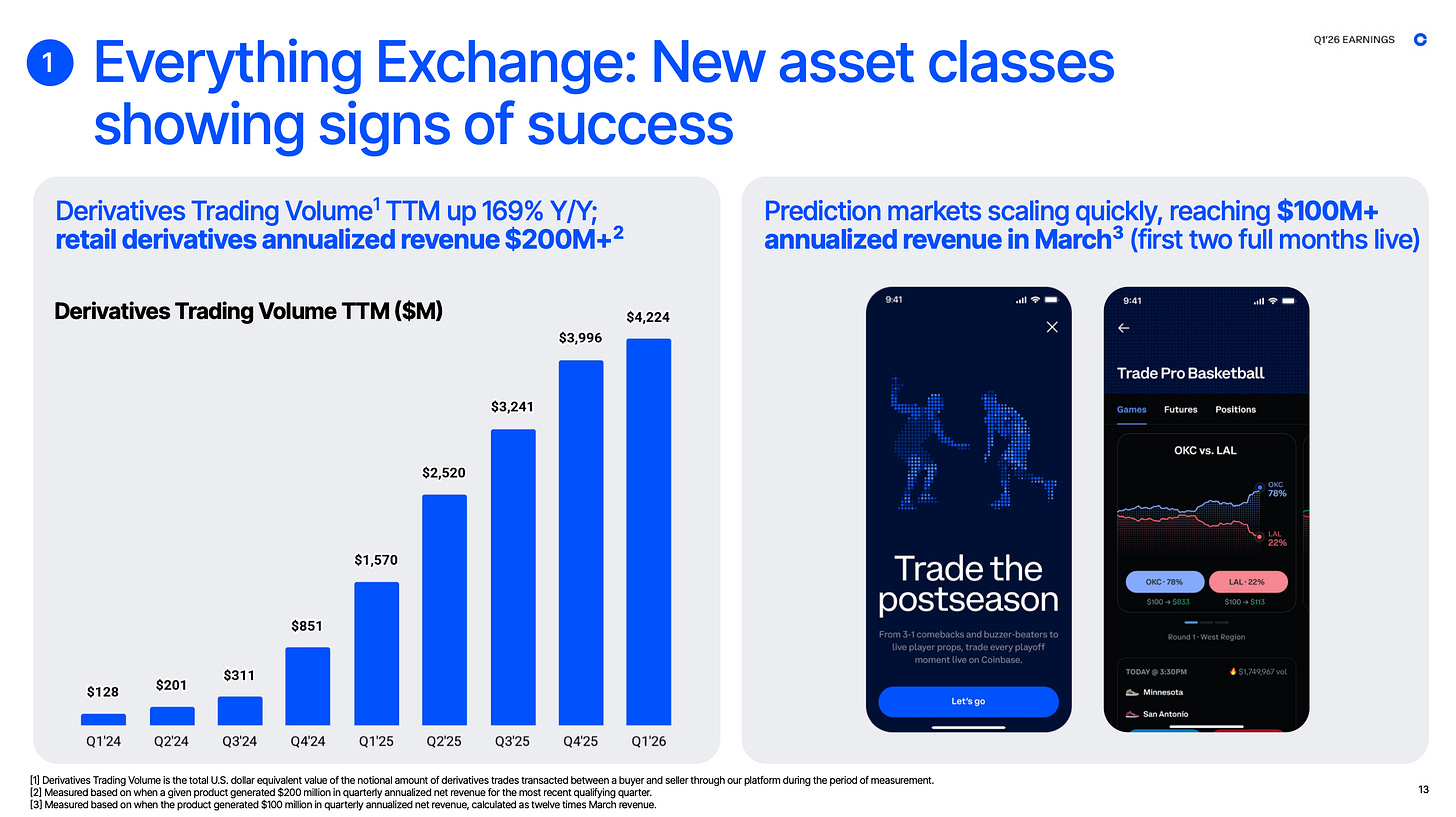
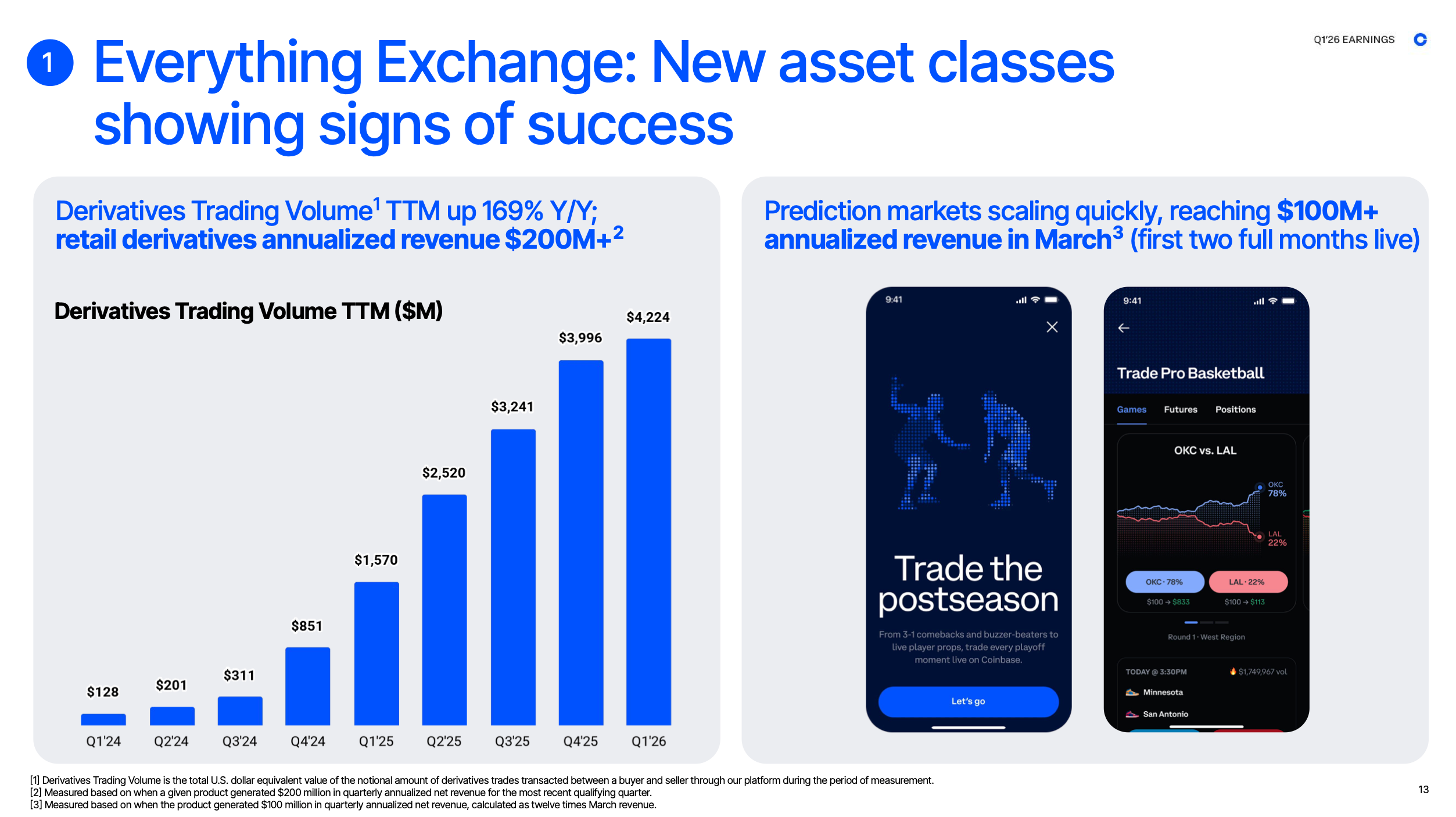
Coinbase reports Q1: The results weren't good in the macro, but we’ll stick with the prediction markets angle here. And while the PM business came up frequently on the earnings call, we didn’t get much in the way of new information. The only detail we really got is that Coinbase is at $100 million in annualized revenue:
⚖️ Legal and regulatory news
Kalshi’s Contracts, CFTC Action Draw Scrutiny in Maryland Appeal (Bloomberg Law): “Kalshi Inc. was met by federal appellate judges who appeared willing to listen to its argument that sports-event contracts don’t amount to gambling, but the panel raised concerns about the US agency the prediction market platform says is its sole regulator.”
“That’s also the root of Maryland gaming regulators’ misgivings, Kalshi’s counsel told the US Court of Appeals for the Fourth Circuit at oral arguments Thursday: They simply don’t like how the Commodity Futures Trading Commission is regulating the company, even though the CFTC’s self-certification process for listing sports and other event contracts was meant to be passive.”
Baltimore Sun: “Maryland urged a court Thursday to allow it to block sports-event contracts offered by Kalshi, arguing the company’s prediction market products are effectively sports bets — and drawing a colorful comparison from a judge on the panel.”
“If it quacks, you know, it’s a duck, right? It’s gambling,” Judge Roger Gregory said during oral arguments before the 4th U.S. Circuit Court of Appeals in Richmond, Va. “Derivatives and all that, but it’s gambling.”
InGame: “Fourth Circuit judges may feel that Kalshi is not operating within the spirit of the law, but their questioning Thursday suggests they may believe the letter of the law is on the prediction market’s side.”
Some opinions on how it went on the Twitter machine:


Hinson Introduces House Rules Change to Ban Members from Participating in Prediction Markets (press release): Today, Congresswoman Ashley Hinson (IA-02) introduced legislation to amend House Rules and prohibit Members of Congress, congressional staff, and House officers from entering into agreements tied to the outcome of specific events—effectively banning participation in prediction markets.
Led by Senator Bernie Moreno (R-OH), the Senate has already taken action to prohibit similar conduct under its own rules, and this legislation would ensure the House follows suit. This measure builds on Hinson's broader push to promote accountability in government by supporting the bipartisan PREDICT Act.
"Members of Congress shouldn't be able to use insider knowledge to make a profit. We should take immediate action to ensure DC politicians can't make money off of policies they are influencing. I am calling on our House Republican leadership to bring this to the floor immediately — it should receive unanimous support." — Congresswoman Ashley Hinson
Read the full bill text here.
Kalshi is losing Washington, D.C. (Florida Politics): “The regulatory free ride is over. Congress, the courts, the states, the leagues, and now the President’s own circle have all landed in the same place at the same time: this isn’t a market. It’s a casino with a lobbyist.”
🤔 I am not sure I agree that the stars are aligned against prediction markets. There is definitely more scrutiny, and how the Supreme Court might rule is an unknown. But I am not sure the “free ride is over.”
Kalshi Lawsuit Says Refer-A-Friend Texts Violate Washington Law (ClassAction.org): “A proposed class action lawsuit claims that Kalshi unlawfully initiates and assists the sending of ‘Refer a friend’ text messages to Washington residents who have not consented to receive commercial texts from the prediction market operator. The 18-page lawsuit contends that Kalshi has violated the Washington Commercial Electronic Mail Act (CEMA) by enabling its users to act as agents on its behalf to send promotional texts containing sign-up links and offering rewards without obtaining a recipient’s consent.”
Texas leaders want lawmakers to close loophole that allows for prediction markets (Spectrum News): State Sen. Bob Hall, R-Edgewood, is against prediction markets and says, “The Texas Penal Code defines a ‘bet’ as an agreement to win or lose something of value solely or partially by chance. By state law, whether the ‘bet’ is in a game room, sports event, or derivative market it is illegal in Texas.”
Regulatory lawyer Jay Stewart says Hall’s analysis is correct, but federal regulations protect prediction markets from being banned.
📣 Industry news
Cboe, home of the VIX, boosts its corporate brand and sets to launch its first prediction-market product (Business Insider): “Cboe’s products is also making new inroads into prediction markets with a framework based on traditional financial markets. The first prediction-market product will launch in June.”
XO Market bets on user-generated prediction markets to rival Polymarket and Kalshi (CoinDesk): “XO Market is betting that the future of prediction markets won’t be dictated by centralized teams deciding what people can trade on, but by users themselves.”
The startup, which just closed a $6 million seed round led by 20VC, Picus Capital, Coinbase Ventures, Venture Together and a group of angels including Australian cricket captain Pat Cummins, is positioning itself as the ‘YouTube of prediction markets,’ according to co-founder Ali Habbabeh. …
“The model appears to be gaining traction. Since starting its mainnet beta in mid-November, XO has generated more than $150 million in trading volume, attracted over 30,000 users and seen more than 600 user-created markets. An earlier pilot began in April 2025 with a testnet rollout.”
Predictor By Slotegrator: Prediction Markets Without Limits (press release): Driven by the growing public interest in real-world events and new forms of user engagement, the global betting industry is evolving beyond conventional formats. Prediction markets — once a niche concept — are gaining popularity as a new monetization model and a forecasting tool, attracting the attention of operators, investors, and regulators worldwide. Over the past few quarters, the trading volumes and participation levels have more than doubled, signaling accelerating adoption of prediction-based models.
Against this backdrop, Slotegrator announces the launch of Predictor, a new solution designed to bring event-based prediction mechanics directly into operators’ platforms. It introduces a prediction market model into the betting realm, where players don’t wager against the house; instead, they bet on different outcomes by buying shares in potential events. Demand sets prices in real time: the more capital flows into one outcome, the higher its probability and value.
📖 Everything else you should know/read
The rise of prediction markets: Level playing field or rigged game? (Brookings Institution event): On May 12, Brookings Center on Markets and Regulation will hold the second in a series of events examining the rise of prediction markets. Senator Adam Schiff (D-Calif.), author of bipartisan legislation on this subject, will share his perspectives. A panel of experts, including the Council on Foreign Relations’ Sam Henry Lazarus, Georgia State University’s Todd Phillips, and Kalshi General Counsel and Chief Regulatory Officer Rick Heaslip, will continue the debate. Krystal Hur of the Wall Street Journal will moderate their conversation.
The Tonight Show had some fun with Kalshi:
 The Tonight Show@FallonTonightKalshi just released a commercial for their new feature to keep kids away 😂 #FallonTonight5:00 PM · May 7, 2026 · 53.3K Views8 Replies · 13 Reposts · 116 Likes
Gaming Executives Remain Optimistic as Industry Growth Continues; Sports Event Contracts Drive Rising Industry Concern (American Gaming Association, press release): Despite strong fundamentals, prediction markets offering sports event contracts have emerged as a leading concern, with 81 percent of executives identifying them as a “very significant” risk to the regulated gaming industry.
“Illegal sports betting through sports event contracts is increasingly encroaching on legal, state-and tribal-regulated operators,” said AGA President and CEO Bill Miller. “It’s clear the legal, regulated industry views this is a threat, and will continue to fight back and protect the integrity of our industry.”
Panama!:
 Bobby Allyn@BobbyAllynLawmakers in Panama pointed to our story on Polymarket on the floor of the country's National Assembly to rally support for a bill cracking down on corporate shell companies, subjecting them to a 15% income tax unless they open a real physical office and hire local staff, with8:40 PM · May 7, 2026 · 2.19K Views5 Reposts · 20 Likes
Suspicious bets on a US-Cuba war raise eyebrows in prediction markets (USA Today): “Analysts of prediction markets are on high alert for insiders, so-called ‘sharps,’ and trades that stand out as suspicious. One trader on the future of Cuba has their attention.”
“An anonymous trader with the username JeffHK joined Polymarket in February and laid out $57,500 in only one market: Will the U.S. invade Cuba in 2026? The ‘yes’ bet was so large in the young market about Cuba that it actually moved the odds against him, and resulted in what experts call ‘slippage.’”
SOF Insider Trading Case Spotlights Troops and Prediction Markets (Air & Space Forces Magazine): “While experts interviewed agreed that Van Dyke’s alleged conduct crossed an ethical line, they varied on whether it was illegal or a violation of official policy. Existing policies may not cover prediction markets, which are relatively new, Vokey said. It’s also debatable whether placing a bet on such a market constitutes disclosing classified information, lawyers said.”
Marco Rubio favored on Kalshi to win presidency in 2028 (Florida Politics): “Secretary of State Marco Rubio has surged in Republican Presidential Primary polls, and prediction market investors are taking notice of the Hialeah Republican’s appeal. Rubio, who ran for President in 2016, has now nudged ahead of the field on Kalshi with 19% odds of becoming the next President. Conventional wisdom has held that Vice President JD Vance would be best positioned to succeed President Donald Trump, and Vance is still strong here, with 17%.”
A Bet Is Not a Poll | Polymarket and Kalshi offer to predict the future. Journalists should be wary, especially during elections.(Columbia Journalism Review): “G. Elliott Morris has worked on political forecasting—the process of predicting election winners through polls and other information—for much of the past decade. Most recently, he led the now-defunct FiveThirtyEight. Now he runs his own polling and analysis site, Strength in Numbers. As news organizations strike partnerships with betting markets and use their odds to forecast events, Morris knows as well as anyone that it’s dangerous to claim to predict the future—especially during election season, when readers and journalists are especially susceptible to misinterpreting data.”
“When you give people probabilities for electoral outcomes, you’re giving them something to play with,” Morris told me. “We do degrade part of the political process when we do that.” Betting markets such as Polymarket and Kalshi, he said, increase that degradation. “I think it is incredibly irresponsible,” he said. “I find this uncritical wholesale acceptance of their numbers as the true probabilities for the world very bad.


