

Volume Doesn't Pay The Bills
Roundup: How big was State of the Union betting?; Senators call for CFTC to rein in war and death markets; Democratic donor says he was blocked from betting on California governor's race.

Editor’s note: This article was republished from LinkedIn with permission from its author, TxODDS Chief Commercial Officer Alan Casey.

Prediction markets are having a moment.
Capital is flowing in. Platforms are scaling quickly. Adoption is accelerating.
Growth is visible.
How these businesses make money sustainably is not.
What ultimately determines who survives isn’t volume. It’s win pool management.
By win pool management, I mean the deliberate structuring of pricing, fees and incentives so that professional winners can exist, recreational customers get a fair and enjoyable experience, and the exchange retains enough from consistent winners to sustain the ecosystem.
I’ve spent over a decade working in and around exchanges, thinking about exactly these commercial trade-offs.
In expansion phases, growth tends to run ahead of monetisation discipline. That imbalance creates opportunity.
Fees Are the Surface. Monetisation Discipline Is the Substance.
The UK exchange model charges commission on net market profit. Win, and you pay. Lose, and you don’t.
Most US prediction markets charge per transaction. Every trade incurs a fee, win or lose. That structure feels familiar to US traders because it mirrors equity markets.
But fee mechanics are only the surface. What matters is how effectively an exchange monetises consistent winners without damaging the ecosystem that feeds them.
A simple way to evaluate this is: what percentage of a winner’s net profits does the platform retain?
Assume a professional stakes $1,000,000 across thousands of trades and generates a 9% ROI — $90,000 in net profit.
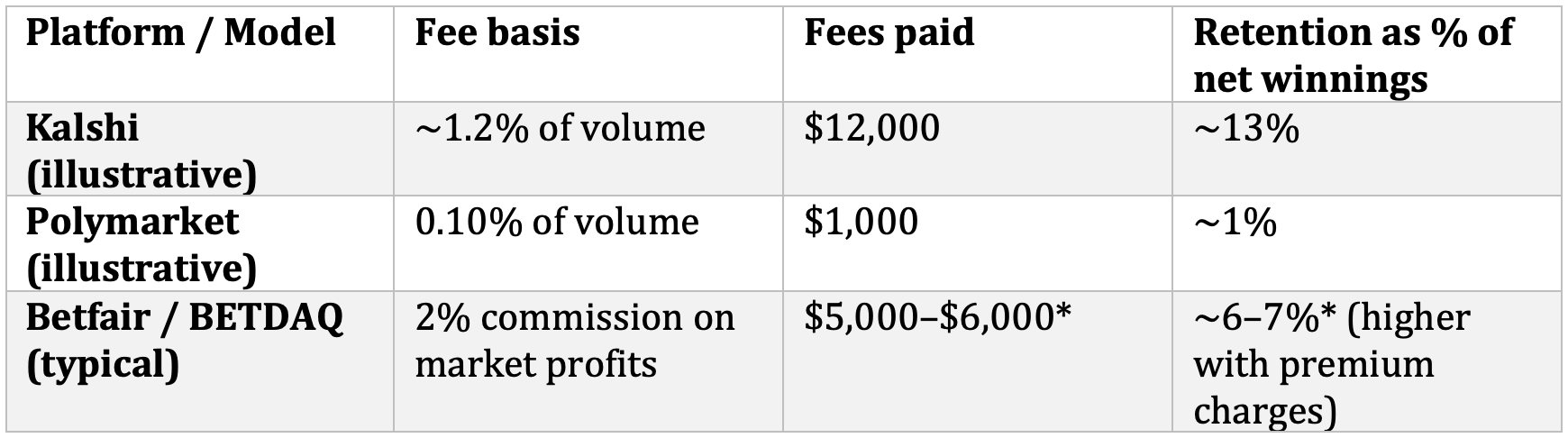
*Commission is charged on profits per market (winning markets), not on overall net P&L. If a trader has both winning and losing markets, the effective commission as a % of net profit can be higher than 2%.
These figures are illustrative and simplify blended pricing structures, but the structural differences are directionally clear.
Now consider a more sophisticated participant — 80% maker / 20% taker — turning over the same volume at 5% ROI (net profit $50,000).

Maker-heavy profiles are common among sharp syndicates and market makers. Under low maker fees, platform retention can fall materially as the make-rate rises.
In my experience, sustainable exchange ecosystems tend to retain somewhere in the region of 20% to 35% of net winnings from most profitable participants. Below that, there is insufficient funding for product development, acquisition and incentives. Above that, professionals leave and liquidity deteriorates.
Most prediction markets are currently operating below that sustainable range.
The 13.5% Man
Towards the end of my time at BETDAQ, we had a horse racing customer — let’s call him Phil Connors.
He was already a significant winner across exchanges. He approached us to negotiate terms.
Most such conversations are about lowering commission. This one was different. He offered to pay 40% of his winnings. He also paid an upfront minimum guarantee.
Then he told us what his win rate would be: 13.5% return on stake.
Not a target. Not an ambition. A statement of fact.
He had calibrated his strategy to win at exactly that rate because he believed it was the maximum sustainable level the ecosystem could tolerate — high enough to justify his capital, low enough not to destabilise the pool he depended on.
Over the next two years, he delivered 13.5%. Exactly as stated.
It remains the clearest example I’ve seen of win pool awareness from a professional participant.
Most traders will extract as much as the market allows. Exchanges need to be structured for that reality.
Incentives Decide Outcomes
Every exchange has two broad behaviours: providing liquidity and taking it. The same participant can do both within minutes.
The commercial structure determines how those behaviours are rewarded.
There are broadly three models:
An open exchange, managing participants through differentiated commercial terms as it matures.
A preferred liquidity partner model, concentrating liquidity among selected market makers.
A single market maker model — effectively a bookmaker operating through an exchange wrapper.
Each can function. None function sustainably without disciplined incentive design.
I learned this directly.
We once moved a consistently profitable soccer market maker from 1% commission to 0% on a revenue share arrangement. On paper, both sides benefited. What changed was behaviour. Without commission drag, they could show more aggressive prices. Those prices became some of the best available globally. Predictably, sharp and arbitrage flow concentrated against them. Variance did the rest. The market maker flipped from profitable to losing, which meant commission revenue disappeared and the revenue share never triggered. We had replaced a reliable income stream with a speculative one — and the deal itself changed the conditions that made the profits possible.
On the other side, we reduced commission to 0% for matched bettors — high-volume participants hedging bookmaker promotions. Volume increased. More importantly, the win pool expanded. Over time, they lost slowly and predictably into the exchange. Lower commission strengthened the ecosystem rather than weakening it.
Blanket pricing rarely works. Win pool management is dynamic. It requires understanding participant behaviour and aligning incentives accordingly.
Premium charges in the UK were an imperfect but logical attempt to address this at scale. Some form of equivalent mechanism is inevitable as prediction markets mature.
The Golden Moment
Prediction markets are currently prioritising growth and user acquisition. Monetisation discipline comes later.
We’ve seen this before. In daily fantasy, the land-grab phase rewarded scale first and monetisation later.
In the current environment, growth is outpacing win pool management discipline. That imbalance favours sophisticated professionals — whether providing liquidity or taking it. Conditions are attractive.
They will not remain static.
As platforms mature, they will need to monetise consistent winners more effectively while preserving a fair and compelling experience for recreational participants. The exchanges that strike that balance will justify their valuations. The rest will discover that volume alone is not enough.
Exchanges don’t ultimately compete on how much they trade. They compete on how intelligently they manage and monetise their win pool.
These dynamics aren’t theoretical. They show up daily in pricing behaviour and liquidity flows. At TxODDS, we supply pricing and live data to the market makers, professionals and operators competing in this environment. If you’re trading this space seriously and want the right infrastructure behind you, we’re ready to help.

I am helping Next.io with its new Emerging Verticals event on March 9 in New York City, ahead of the main conference. I’ll be there and speaking! You can get tickets and learn more here. Use code F0EVTCL0L10 for a 10% discount. Reach out if you have any questions about the event or getting tickets.
Prediction markets roundup
The ‘Mentions’ Market Tries to Predict the Unpredictable: Trump’s Next Words (WSJ, paywall): “Hunkered down in a dark room, Max Carozza watched riveted as President Trump gave a speech on the U.S. economy. “Hottest, hottest, come on,” Carozza pleaded to his screen. Then it came: “We’re the hottest country anywhere in the world,” the president declared.
Polymarket, Kalshi Gamify Truth With Bets on Politics, News (Bloomberg, video): “Mention markets are the high-octane, fast-twitch speed competitions of the prediction market world. But they’re just one corner of it. Users of Kalshi and its primary rival, Polymarket, can bet on events major and minor, from politics to sports to culture to the weather. Recent markets on Kalshi have included whether certain words would be used during a Palantir Technologies Inc. earnings call, whether Elon Musk would win his court case against OpenAI and whether the highest temperature in Seattle on Feb. 4 would be within a certain range. Polymarket users have bet on whether the US would strike Iran on a particular date, whether a given Trump cabinet member would be the first to leave office and whether Jesus Christ would return before 2027. Bloomberg Businessweek Contributor Chris Beam joins Bloomberg Businessweek Daily to discuss.”
How the ‘Mentions’ Prediction Markets Let You Bet on Trump’s Next Word (WSJ, video)
💡My take: The State of the Union was dubbed the “Super Bowl of mention markets.” And there was more than $50 million traded across all SOTU markets at Kalshi, including $28 million on what President Donald Trump would say during the speech. The total amount wagered was comparable to the volume on some higher-profile NFL and college football games this past season.
And here’s this from a sitting Senator:
 Chris Murphy 🟧@ChrisMurphyCTJust insane that we don't regulate rigged markets like this out of existence. This is not the outcome of a game. This is a question with an answer that already exists. Trump's inside circle KNOW THE ANSWER and can make a mint. So corrupt. polymarket.com/event/how-long…11:44 PM · Feb 24, 2026 · 336K Views138 Replies · 738 Reposts · 6.28K Likes
Sen. Schiff Urges CFTC Chair Selig to Uphold Law, Prohibit Prediction Markets Incentivizing Physical Injury, Death or War (press release): Today, U.S. Senator Adam Schiff (D-Calif.), a member of the Senate Agriculture Committee, led five Senators in urging Commodity Futures Trading Commission Chair Michael Selig to uphold U.S. law and take action to halt prediction contracts that involve betting on physical injury, death or war, and to vigorously enforce the law through oversight and regulation of this market.
“These contracts present dangerous national security risks, including creating incentives to incite violence, foment geopolitical conflicts, and disclose classified information,” the Senators wrote in a letter to Chair Selig. “Under 17 CFR 40.11, the CFTC categorically prohibits contracts that involve, relate to, or reference terrorism, assassination, war, or similar activity contrary to the public interest from being listed. You must clearly reiterate that the CFTC will categorically prohibit any contract that resolves upon or closely correlates to an individual’s death—and vigorously enforce the law through oversight and regulation.”
Schiff and the Senators highlight to Selig their concerns over recent proliferation of these contracts on exchanges, despite the Commodity Exchange Act expressly prohibiting the listing of contracts that are contrary to the public interest, including in the following categories: war, terrorism, and assassination. The Senators point to recent examples of Polymarket’s offshore exchange offering dangerous prediction contracts on whether Artemis II would explode, if Maduro would be removed from power, and whether the Ukrainian town of Myrnohad would be captured by Russian forces.
“These recent events highlight the lack of internal controls and safeguards to prevent insiders from profiting off of non-public information, and direct profiteering off of human suffering…Troublingly, they also underscore the dangerous incentives directly or indirectly tied to offering contracts related to prohibited categories under the CEA. Government officials, regulated entities, consultants who may be in close communication with those effectuating policy change, and other similar parties can easily act on confidential or operationally sensitive information to personally profit in markets that operate with minimal oversight or transparency, or share this information with contacts who can similarly profit,” continued the Senators.
This letter is signed by Senators Catherine Cortez Masto (D-Nev.), Richard Blumenthal (D-Conn.), Cory Booker (D-N.J.), Tim Kaine (D-Va.), and Jacky Rosen (D-Nev.).
💡My take: Generally these markets are appearing on Polymarket international, and not on the CFTC-regulated sites. However, Polymarket does operate a US-facing exchange and the CFTC (and FBI) closed investigations into Polymarket last year. It’s not clear that the CFTC can or would want to do anything about this.
Also, another take from a member of Congress:
 American Gaming Association@AmericanGamingAs @RepCasten makes clear: the CFTC was never meant to regulate nationwide sports betting or interfere with state and tribal gaming authority. It’s critical for Washington to respect established state and tribal frameworks.
 7:00 PM · Feb 24, 2026 · 593 Views2 Replies · 1 Repost · 4 Likes
Polymarket Lawyer Says ‘We Are The Regulator’ In Joint Hearing With Kalshi On Nevada Enforcement (InGame): “A lawyer for Polymarket argued that the platform is ‘a regulator,’ while Kalshi’s lawyer argued that Nevada gambling laws already include a carve-out for federally registered exchanges, in a federal hearing that could prove crucial to both prediction markets’ operations in the Silver State. Judge Miranda Du held a joint hearing Tuesday to hear oral arguments for both Kalshi and Polymarket’s arguments to move state-court enforcement cases into federal court, and the state’s argument to have the cases sent back down to the First Judicial Court of Carson City. In Polymarket’s case, the state has already won a temporary restraining order (TRO) against the business, which forced Polymarket to exit the state. Kalshi remains active in Nevada, but the state is aiming to win a similar injunction.”
Protracted legal fight expected in Nevada v. Kalshi (Nevada Current): “The Nevada Gaming Control Board’s legal effort to preserve the state’s golden goose – a flourishing gambling industry devoid of federal intervention – is expected to be a multi-year endeavor that could bounce among Congress, federal court, state court, and the court of public opinion, experts say.”
“Courts will move slowly even as the popularity of prediction-market platforms increases rapidly,” says Steven Light, a visiting professor of Indian Nations Gaming and Governance at UNLV’s Boyd Law School. “What happens in court and what happens in the real world often take divergent paths.”
Prediction market exchange Kalshi sues Utah over proposed prop betting ban (Utah News Dispatch): “Asked about the federal lawsuit during an availability with reporters on Tuesday, Senate President Stuart Adams said, ‘I’m standing with the governor on this.’”
“I also believe in the 10th Amendment,” Adams said, pointing to the part of the Utah Constitution that bans gambling. “We’ll probably fight to protect our state rights.”
KALSHI SUES TO BLOCK UTAH FROM CRACKING DOWN ON PREDICTION MARKETS (Utah Politics): “As Dustin Gouker noted in his Event Horizon newsletter, prediction markets have sued after cease‑and‑desist letters before, but this is the first time Kalshi filed suit before a state pulled the trigger.”
Buzz of the Week: How should Utah handle online sports betting through ‘prediction markets’? (Salt Lake Tribune): “Sports betting is illegal in Utah. But apps like Kalshi found a loophole by calling it a ‘prediction market,’ and now Utahns can bet on games legally — for now. How should Utah handle online sports betting through ‘prediction markets’?”
And finally, an interesting tweet from a candidate for Congress in Utah:
 Nate Blouin@NateForUtahban kalshi
 Utah Political Watch @utahpoliticsUtah says online prediction markets violate the state's ban on gambling. Kalshi calls it "trading" and is suing Utah to prevent officials from taking steps to regulate them or to force them out of the state. #utpol #utleg https://t.co/GdLQxkfTfG10:01 PM · Feb 24, 2026 · 12.4K Views7 Replies · 18 Reposts · 285 Likes
Election betting boom sparks midterm brawl in California (Politico): “Eric Swalwell has made a habit of posting and sending out screenshots of his betting odds in the race for California governor. The Bay Area Democrat has every reason to keep at it, holding frontrunner status on the most popular prediction markets, Kalshi and Polymarket, for months. But he’s hardly alone in tracking performance on the platforms, where millions of dollars are flowing, and politicians are starting to promote wagers — alongside more traditional metrics like polling and fundraising — to demonstrate momentum in the midterms.”
Swalwell ally blocked from prediction market in California governor’s race (Politico): “Major Democratic donor and former candidate Stephen Cloobeck has been blocked by the prediction market Kalshi from trading on the California governor’s race. The suspension, first reported here, came after the wealthy businessman tried to put money this weekend on gubernatorial hopeful, Democratic Rep. Eric Swalwell, a close friend of Cloobeck’s whose candidacy he has been actively supporting since exiting the race in November.”
“Cloobeck was able to bet on his own campaign months earlier, without facing the same restrictions, he told POLITICO. He confirmed the bets, sharing screenshots that showed the attempts to place about $1,000 on Swalwell’s victory and $2,000 on the defeat of another candidate, San Jose Mayor Matt Mahan. Neither trade went through, and the platform informed Cloobeck, ‘you are currently restricted from trading this market,’ according to the screenshots. The businessman said he contacted Kalshi and has yet to receive an explanation of why it took action against him.”
What soybeans have to do with online betting (Politico): “The Commodity Futures Trading Commission is leaning into a peculiar argument: placing bets in online prediction markets is just another form of commodities investing."…”
“The idea of using prediction platforms to purchase contracts relating to energy or agricultural commodities is a bit counterintuitive, given that Kalshi and its peers are widely known for sports betting. If the CFTC’s argument wins the day, it would be a radical departure from the traditional understanding of gambling regulation as a state issue, according to legal experts.”
“Look, this is a joke, and I can’t believe [Selig] tried to say this with a straight face,” Cox said of the CFTC’s position at POLITICO’s 2026 Governors Summit last week. He added, “This is not soybeans and natural gas. This is gambling.”
Sidebar: Predicting the future (Courthouse News Service, podcast): “These markets often beat traditional polling by aggregating real-time data and financial incentives, but are they free from their users’ biases?”
Court Filing Claims Fanatics Is Buying A DCM — Who Could It Be? (InGame): “Among those pieces of information is a claim that Fanatics has already agreed to purchase a designated contract market (DCM) — an exchange that could offer its own contracts. Currently, Fanatics’ prediction market product offers users access to contracts made by Crypto.com. …However, there are not many registered exchanges out there. The CFTC website lists only 25 exchanges as having ‘designated’ status. Some of them are long-established businesses, often in traditional commodity futures, and unlikely to shift their entire business model. Others have been acquired for prediction market purposes recently.”
ZachXBT’s Mysterious Post Sparks $2 Million Polymarket Bets (Yahoo Finance): “A cryptic post from blockchain investigator ZachXBT triggered a surge of betting activity on Polymarket, with more than $2.2 million traded on a market asking which crypto company he will expose in an upcoming insider-trading investigation.”
And here that market is!
Prediction markets on virtual sporting events?: I am including this because it’s definitely something I think we could see coming to prediction markets in the US, even though that’s not brought up in the piece below. Virtual sports are not allowed as a form of legal sports betting here, but what would stop prediction markets from trying it?
This is also not a Substack specifically about prediction markets, but it’s interesting as betting/trading on weather grows:
The latest Substack from Polymarket:


as a professional, i have to agree with you that this is a golden moment for PM's