


Another day, another case of insider trading at prediction markets.
This time, a US attorney and the Commodity Futures Trading Commission are alleging that a Google employee used inside information to bet on Google search markets at Polymarket.
The big takeaway I have: Prediction markets are creating an environment where inside information is much more valuable, or is at least easier to monetize, because there is trading that didn’t exist previously. And it’s not clear the benefits outweigh the problems — certainly in this case, and likely in a variety of others.
I’ll get to that. First, let’s run down the news and some of the particulars.
The basics of the Google insider trading case
Here’s the story from ABC News:
A Google employee fraudulently made more than $1 million by using inside information to place Polymarket bets on what users were searching for on Google, according to a federal criminal complaint unsealed Wednesday in New York.
For Michele Spagnuolo, these were sure bets because, as a Google information security engineer, he had access to company data that tracked user searches, according to the complaint, which said Spagnuolo “misappropriated confidential and valuable nonpublic information from his employer and used that information to place a series of Google-related bets on Polymarket, a prediction market platform.”
Spagnuolo, 36, is charged with commodities fraud, wire fraud and money laundering.
And here’s the press release from the United States Attorney for the Southern District of New York:
“Today’s charges reinforce a decades-old message: corporate insiders cannot use confidential business information to turn a profit in our markets,” said U.S. Attorney Jay Clayton. “As alleged, Spagnuolo violated the duties he owed to his employer and used Google’s confidential business information to make more than $1.2 million in trading profits on Polymarket. Insider trading compromises the integrity of our markets, and the American people want this greed-driven conduct investigated and prosecuted.”
“Michele Spagnuolo allegedly abused his elevated access to confidential trends to place bets with nonpublic information and receive more than one million dollars in unlawful profits,” said FBI Assistant Director in Charge James C. Barnacle, Jr. “The FBI remains dedicated to searching for fraudsters who betray their employer for personal financial gains.”
You can see the whole complaint here.
And finally, here’s the CFTC:
CFTC Charges Google Employee with Insider Trading in Search Result-Related Event Contracts
WASHINGTON — The Commodity Futures Trading Commission today announced it has filed a complaint in the U.S. District Court for the Southern District of New York against Michele Spagnuolo, a resident of Switzerland. The complaint alleges that Spagnuolo, a Google employee, engaged in insider trading on Polymarket.com using sensitive nonpublic information regarding Google’s official Year in Search list for 2025.
In the complaint, the CFTC seeks restitution, disgorgement, civil monetary penalties, trading and registration bans, and a permanent injunction against further violations of the Commodity Exchange Act and CFTC regulations, as charged.
“As I have said repeatedly, the Commission will not tolerate fraud, manipulation, or insider trading, regardless of the technology or platform that is used,” said Chairman Michael S. Selig. “Today’s action further underscores our commitment to rooting out insider trading and promoting market integrity in prediction markets.”
“Employees who are entrusted with confidential business information cannot misappropriate that information for personal financial gain,” said Director of Enforcement David I. Miller. “As this and other enforcement actions show, the Division is a cop on the beat in policing the illegal use of inside information in the prediction markets and other markets within the CFTC’s jurisdiction. We will continue to take action to protect markets from insider trading and other forms of fraud, abuse, and manipulation.”
So this was at Polymarket…
It’s important to note this did not happen at a regulated prediction market in the US. While Polymarket does have a CFTC-registered exchange that operates in America, this happened at the international site that is not supposed to be available to US users.
It feels kind of strange that the CFTC kind of glosses over or ignores this fact in handling it publicly. After all, the CFTC is now investing resources in policing alleged trading activity on a platform that is not operating as a CFTC-registered US prediction market.


The trading apparently involved a person based in Switzerland, and the CFTC complaint does not appear to allege that he was physically in the US when he traded.
Polymarket was taking a victory lap for playing a role in rooting out the insider trading; more on that in a bit:

While Polymarket apparently helped in the case, it also appears the US attorney’s office found the identity of the Google employee because of other companies involved in cryptocurrency transactions conducted by Spagnuolo. From the SDNY complaint:
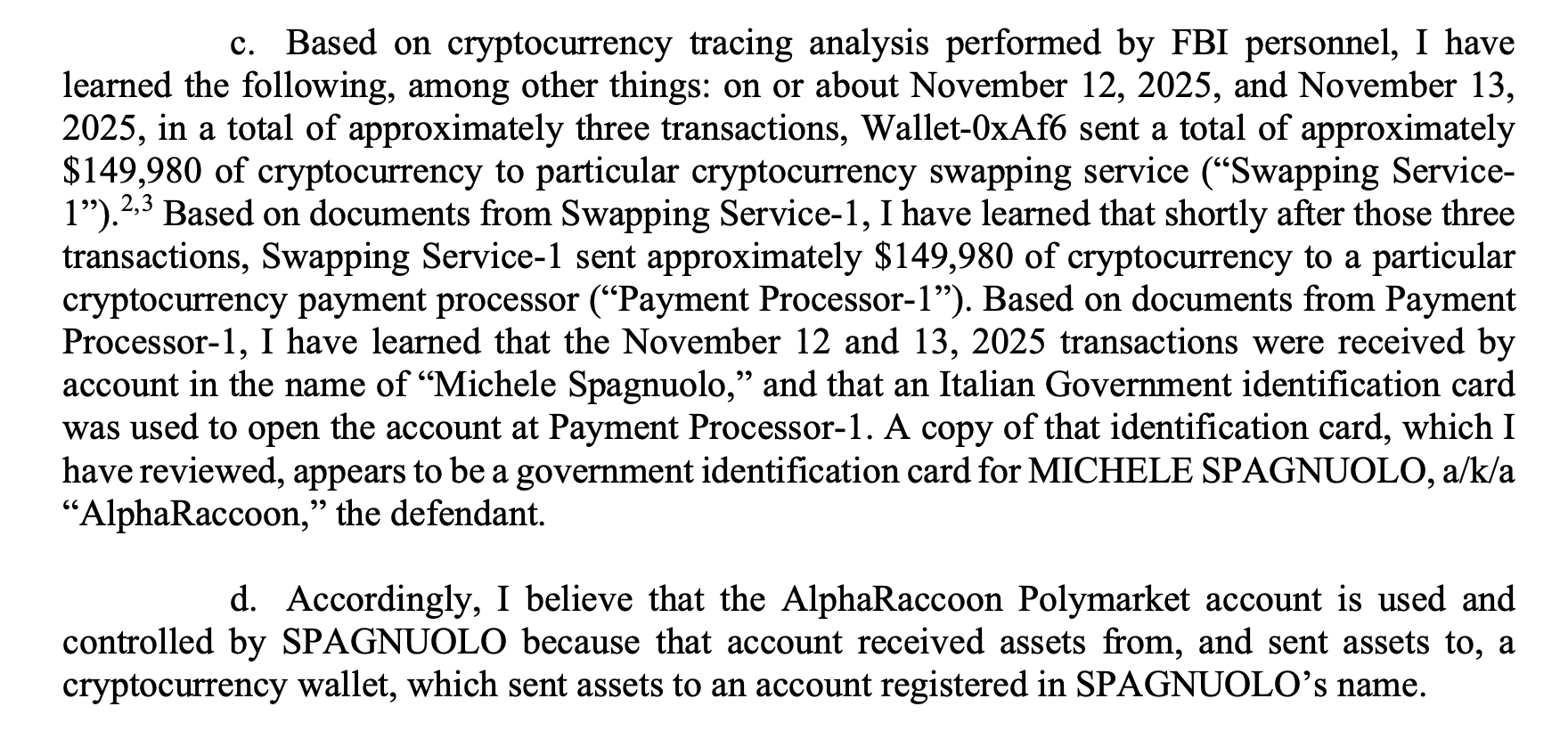
And Kalshi was using the day’s events to again differentiate itself from Polymarket. From Kalshi’s head of enforcement:


The data about the Google trades was public, and surfaced months ago
One benefit of Polymarket is that trades are public, even if you might not know who the person is who is making said trades. So anyone could see the AlphaRaccoon account trading the Google Search markets.
Interestingly, a Polymarket affiliated account on Twitter/X flagged the fishiness of the trades soon after they happened.


It seems kind of obvious in retrospect that this was likely insider trading. And honestly, it was probably hard to believe this wasn’t insider trading even back in December, with none of the information we have today.
The “market integrity infrastructure” is great and all, but this was flagged months ago, and it was flagged very publicly on social media. To wit:


I’d argue that prediction markets themselves are creating insider information incentives
Let’s again go back to the basics of the case before getting more into the weeds on the larger issues at play.
The case is about markets related to Google search. Is data about search via Google valuable? Absolutely! How brands, websites, and people get views via search — and how they rank on Google — is extremely valuable.
Is the data about what was searched the most in the past year valuable? Again, yes. That’s even laid out in the SDNY complaint. I’ll include a long excerpt because I think it’s important:
Google’s search data — including data reflecting which terms, topics, people, and events trend on its platform — is commercially valuable proprietary information central to that business, the product of Google’s significant ongoing investment in technology, infrastructure, and personnel, and it directly informs Google’s advertising products, marketing strategy, and relationships with content partners and brand advertisers. Each year, Google invests substantial financial and personnel resources in a coordinated marketing campaign called “Year in Search,” in which it publicly releases curated data reflecting the top trending searches from that year. The campaign involves driving user interest and engagement by building momentum before announcing the top searches of the year and making a “splash” with the announcement. The release of the top trending search results serves multiple commercially significant functions: it drives substantial user traffic to Google’s platforms; it generates media coverage and brand engagement that Google monetizes through increased advertising demand; it reinforces Google’s market position as the authoritative barometer of public interest and cultural trends; and it serves as a high-profile vehicle through which Google demonstrates the reach of its search platform to advertisers and partners.
Because the commercial impact of the campaign depends on the element of surprise and the coordinated nature of its public reveal, the top-trending search information is valuable, and maintaining its confidentiality is important to Google’s ultimate commercial objective. Accordingly, Google maintains strict confidentiality over its Year in Search results—and the underlying search trend data from which those results are derived—until the moment of public release. Even within the company, access to Year in Search results is restricted to only a limited number of employees. Premature disclosure of Year in Search data could reduce or eliminate anticipated user engagement, undercut the media interest that drives brand value, diminish advertiser revenue tied to the launch, and deprive Google of the competitive benefit of a coordinated release. As in prior years, the 2025 Year in Search results were confidential until they were publicly released.
But therein lies the rub. The data is valuable to Google as part of a coordinated marketing campaign, but it is not obviously valuable to outsiders before release except as something that can be traded on.
If you have information about the “Year in Search,” there’s really no incentive to leak that information. Outside of prediction markets, there is probably a limited market for this information; few people are dying to know the results beforehand so much that they would pay money for it, or risk jail time. The value of the inside information here — and in some subset of prediction markets more broadly — is almost entirely tied up in the existence of a market to trade this information.
In the Google case, prediction markets are arguably responsible for creating the conditions where inside information becomes vastly more monetizable.
Here’s Alex Goldenberg, who is a fellow at Rutgers University and an affiliate with the New York University Institute for the Study of Emerging Threats. He has been leading the charge on covering this particular aspect of prediction markets via outlets like the Wall Street Journal. From Twitter.
“Every company whose data, decisions, or actions can resolve a prediction market contract now has a new insider threat surface. Not just trading on what you know but also doing things to make your bets pay out.
Go back to one of the few other public cases about insider trading that came to light: the MrBeast editor that allegedly traded using inside information. It’s kind of the same thing, and arguably even worse. The information the editor was using is not really valuable in any setting other than a prediction market.
It’s all a bit of a chicken-and-the-egg conundrum. There’s inside information in lots of things in the world, but there’s not much to be gained from releasing or using that information in a lot of cases… except where a prediction market exists that makes said information valuable.
There is a spectrum here; some markets provide valuable information and signal, and the benefits can outweigh the insider trading concerns. However, that feels like it’s not the case with the Google search, MrBeast, and Survivor markets, among others.
The question is not whether confidential information exists without prediction markets. Of course it does. The question is whether prediction markets are creating new incentives for insiders to exploit information that previously had no obvious market value. In the Google case — and some other markets — the answer appears to be yes.
📊 The Ticker
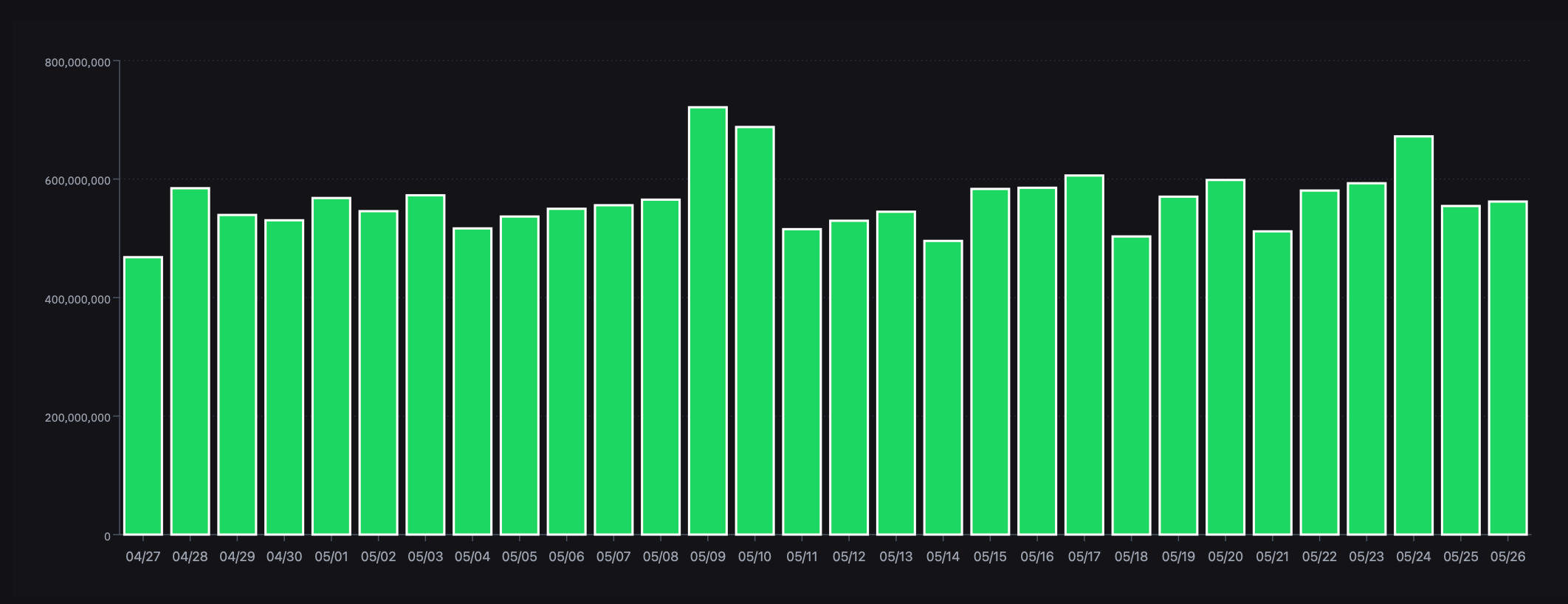
For Tuesday, May 26, at Kalshi:
Volume: $562.1 million
Sports + parlays: 83.2% of volume
Crypto markets: 13% of volume
Trend line for daily volume:
Polymarket US volume on Tuesday: $48.9 million
Prediction markets roundup
🚨 The important stuff
White House Reviews CFTC Plan to Supervise Prediction Markets (Bloomberg): The White House is reviewing a new US Commodity Futures Trading Commission proposal that would lay out guidelines for event contracts, the agency’s latest move to mark its turf as it battles with states over who gets to regulate the exploding prediction markets. The plan is under review by the Office of Management and Budget, according to a notice posted on a US government website. The notice includes no details about what’s in the proposal, which would be subject to public comment.”
Stein order bans NC workers from insider betting on prediction markets (NC Newsline): Gov. Josh Stein signed an executive order Wednesday banning North Carolina state employees from using insider knowledge to bet on prediction markets. …”
“When people use non-public information they have gained at work for unfair gain, we run into trouble,” he said. “People need to have faith that the public servants are working on their behalf, not leveraging their knowledge unfairly to win a bet and make money.”
Executive order here.
⚖️ Legal and regulatory news
Tennessee Attorney General Skrmetti Fights to Protect Tennessee’s Authority to Regulate Sports Wagering (press release): Attorney General Jonathan Skrmetti announced his office filed an opening brief in the United States Court of Appeals for the Sixth Circuit, asking the court to reverse a lower court ruling that blocked Tennessee from enforcing its sports wagering laws against KalshiEX LLC. …
“Kalshi can call their bets ‘swaps’ all they want, but everyone who so much as glances at the platform understands that this is sports gambling,” said Attorney General Skrmetti. “Tennessee has laws governing wagering on sports—laws that Kalshi is desperately trying to avoid—that ensure sportsbooks provide protections for problem gamblers, pay taxes to support our education system, and provide a fair and transparent service to users. We’re going to keep fighting to protect Tennesseans from operators who want all the benefits of this market and none of the accountability.”
Prediction markets go all in on PA elections (City and State PA): “I believe that what these markets offer is sports wagering – and it’s illegal under the laws of the commonwealth,” Pennsylvania Gaming Control Board Chief Counsel Steve Cook told City & State in an interview, noting that Pennsylvania’s chief gaming law requires anyone offering sports bets to be licensed by the state. “The CFTC and the various companies that make these markets available take the position that all state laws, including Pennsylvania’s, are preempted by federal law, which authorizes this under the Commodities Exchange Act.”
Final Determination Yet to Be Made In Arizona’s Notice of Intent to Revoke Underdog’s DFS License (Sports Betting Dime): “No final determination has been made on the Arizona Department of Gaming’s potential decision to revoke Underdog’s daily fantasy license. … The Arizona Department of Gaming and Underdog are still embroiled in discussions regarding the department’s consideration of revoking the company’s daily fantasy license due to its relationship with Crypto.com.”
U.S. CFTC files request to erase Gemini settlement that it no longer considers fair (CoinDesk): “The U.S. Commodity Futures Trading Commission wants to tear up the remnants of an old dispute with crypto exchange Gemini, with the agency insisting that its own staff’s assertions about Gemini making misleading statements weren’t handled properly.”
The CFTC filed a request alongside Gemini in federal court to negate a settlement secured at the start of last year, with the current agency essentially disputing the conclusions of the previous agency. After a review of the case, the CFTC ‘concluded the complaint should not have been filed — and would not have been under current enforcement standards,’ it said in a Wednesday statement.”
🤔 This isn’t really a prediction markets story, although Gemini does operate a designated contract market under the CFTC. More interesting is that the Winklevoss twins — the founders of Gemini — were reportedly not very happy with the initial Trump nominee to lead the CFTC, Brian Quintenz, over the case. And now they have gotten their way with the current CFTC chair, Michael Selig. Interesting!
📣 Industry news
Polymarket Wants Traders to ID Themselves as It Faces Sanctions, Legal Risks (The Information, paywall): “Now, though, Polymarket is starting to clamp down. The site has made it harder to use a virtual private network, software that encrypts the connection between users and the internet, to access the site. It does so by blocking certain IP addresses—those that websites have learned over time are used by VPN providers—and blocking accounts with suspicious connection patterns.”
Fanatics Markets and ADI Predictstreet Launch Official FIFA World Cup 2026™ Hub Experience for U.S. Fans (press release): Fanatics Markets, the prediction markets subsidiary of Fanatics, a leading global sports platform, and ADI Predictstreet, the Official Prediction Market Partner of FIFA World Cup 2026™, today announced the launch of an interactive FIFA World Cup 2026™ Hub experience for U.S. sports fans during this summer’s tournament.
Beginning today, the co-branded Fanatics Markets and ADI Predictstreet World Cup Hub offers fans expanded global football prediction markets alongside tournament news, official player data and in-app content designed to enhance the World Cup trading experience.
The World Cup Hub experience is available to fans across 23 U.S. states and 4 territories, including Alaska, Delaware, Hawaii, Idaho, Maine, New Hampshire, North Dakota, Rhode Island, South Dakota, Utah, Alabama, California, Florida, Georgia, Minnesota, Mississippi, Nebraska, New Mexico, Oklahoma, Oregon, South Carolina, Texas and Washington as well as Guam, Puerto Rico, American Samoa and U.S. Virgin Islands, exclusively on the Fanatics Markets App and website.
📖 Everything else you should know/read
Former CFTC Chair Gary Gensler on regulating prediction markets:
The President’s ‘Truth’ On Prediction Markets Is Both Notable And Meaningless (InGame): “While it is notable that the president of the United States has once again publicly weighed in on prediction markets, the state of play is such that the latest from Donald J. Trump is also effectively meaningless. Or at least Trump’s comment Tuesday is entirely consistent with what we had already believed was his administration’s position and the president’s general disposition.”
TD Cowen says Trump’s CFTC prediction markets post unlikely to change legal fight (The Block): “We have always assumed that President Trump was backing CFTC Chair Michael Selig’s advocacy for prediction markets including his contention that states lack the power to block event contracts on sporting events,” Jaret Seiberg, managing director at TD Cowen’s Washington Research Group, said in a note on Wednesday. “It was hard for us to see how Selig could so aggressively push for prediction markets without Trump’s backing.”
Rep. Titus, BetMGM’s Taylor: Prediction Markets Have Unfair Advantage (InGame): “Even a conference of gambling academics is not immune to anti-prediction market rhetoric. U.S. Rep. Dina Titus and BetMGM Director of Responsible Gaming Rich Taylor were passionate and outspoken about how prediction markets are harming the legal gambling business in their comments at the International Conference on Gambling & Risk Taking Tuesday.”
“I love to compete, BetMGM loves to compete on an equal playing field, ” Taylor said when asked about federally regulated trading platforms offering sports event contracts. “We’ve all built these massive internal compliance infrastructures. BetMGM alone has over 100 employees in our compliance department monitoring a variety of issues like AML, responsible gambling, integrity, etc. Can prediction markets say that they are doing the same thing?”
Kalshi Investor Kyle Kuzma Criticizes DraftKings for Bettor Limits, Parlay Holds (Covers): Responding on X to an interview with DraftKings cofounder and former president Matt Kalish, Kuzma said the online sportsbook will “limit or ban anyone who shows skill,” and then added that prediction markets allowing all traders is “literally the best part” of the exchanges.
 kuz@kylekuzmaLove Matt but…DK’s own hold on parlays runs like 25-40%. They limit or ban anyone who shows skill (which literally is the best part of prediction markets) then funnel casuals into boosted props engineered to lose. Wall Street market makers are tough ofc but at least they don’t
 Kai @kai_xbtDraftKings co-founder says 97% of normal Kalshi users get decimated and only Wall Street wins "97% of people, the normal people who are responding to their marketing, pull up and think I see the number on the site, I click bet and I get the bet that you're saying. These are the12:25 PM · May 26, 2026 · 542K Views89 Replies · 65 Reposts · 737 Likes
Prediction markets look to institutional investors for next phase of growth (Reuters): “Hedge funds need a more nuanced and surgical way to express their views in other derivative markets that they can’t access in traditional financial venues,” said Asaf Meir, CEO of Solidus Labs, which is a trade surveillance partner for Kalshi. Meir added that a lot of hedge funds and institutional investors are looking closely at opportunities to execute trades on prediction markets."
How Accurate Are Prediction Markets, Anyway? (Bloomberg): “So does that really mean they’re accurate? “Whenever you ask about accuracy, you have to ask, ‘Relative to what?’” says Rajiv Sethi, a professor of economics at Barnard College. For decades, many of those markets — including precursors to today’s companies, like the Iowa Electronic Markets, which started in 1988 — have performed at least as well as opinion polls in forecasting electoral outcomes. In some cases, they’ve done better: In a recent paper, Sethi and colleagues reported that in the 2024 presidential vote, prediction markets beat forecasts based on polling. ‘But they became less accurate as you went down the ballot,’ he says. That makes sense: The more volume and liquidity a market has, the more accurate it becomes, and smaller races tend to have fewer people willing to lay down their cash.”
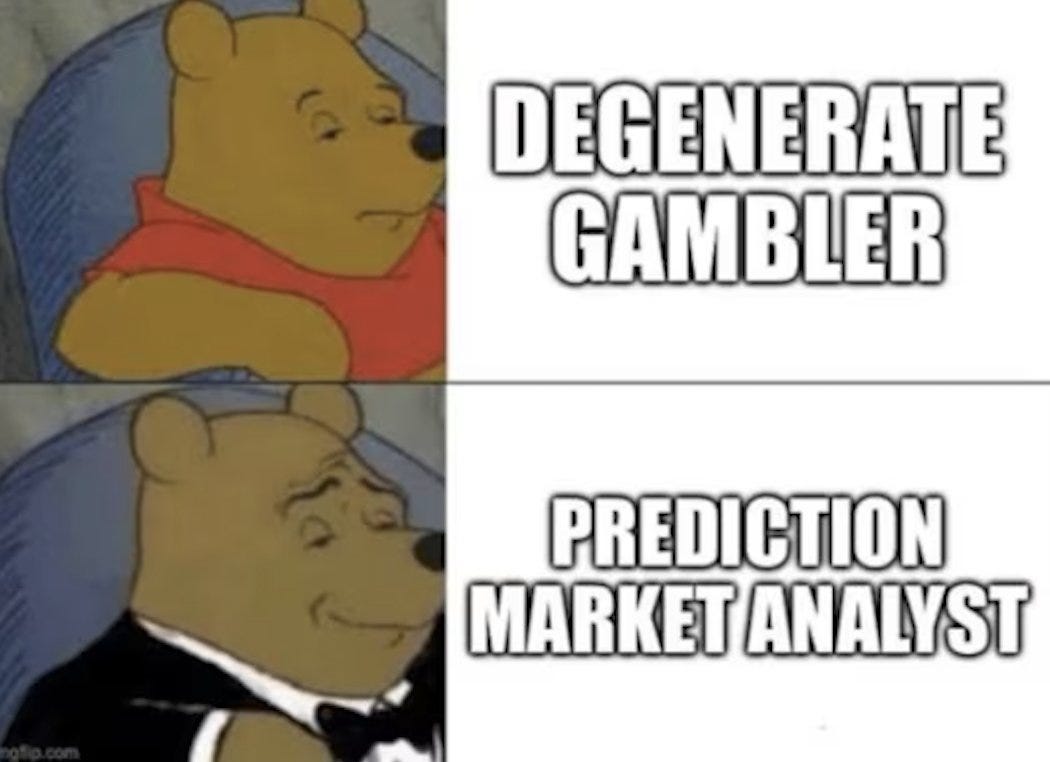
Trad bookies ♥ prediction markets (Financial Times, paywall): The lead image.
Billions are traded each week on Kalshi and Polymarket. There is a push to bring prediction markets to Australia (Australia Broadcasting Corporation): “Companies offering prediction markets are not presently allowed to trade in Australia but former Liberal MP Jason Falinski wants them to be made legal here. He says that current bans, which rely on geo-blocking technology to stop trade are ineffective but also says some topics should remain off limits.”
👀 I am also quoted in here.
Commentary from Straight to the Point: “Prediction markets cannot stay out of the news, and as is often the case, they’re not making headlines for their societal benefits, rather it’s for their slipups.”


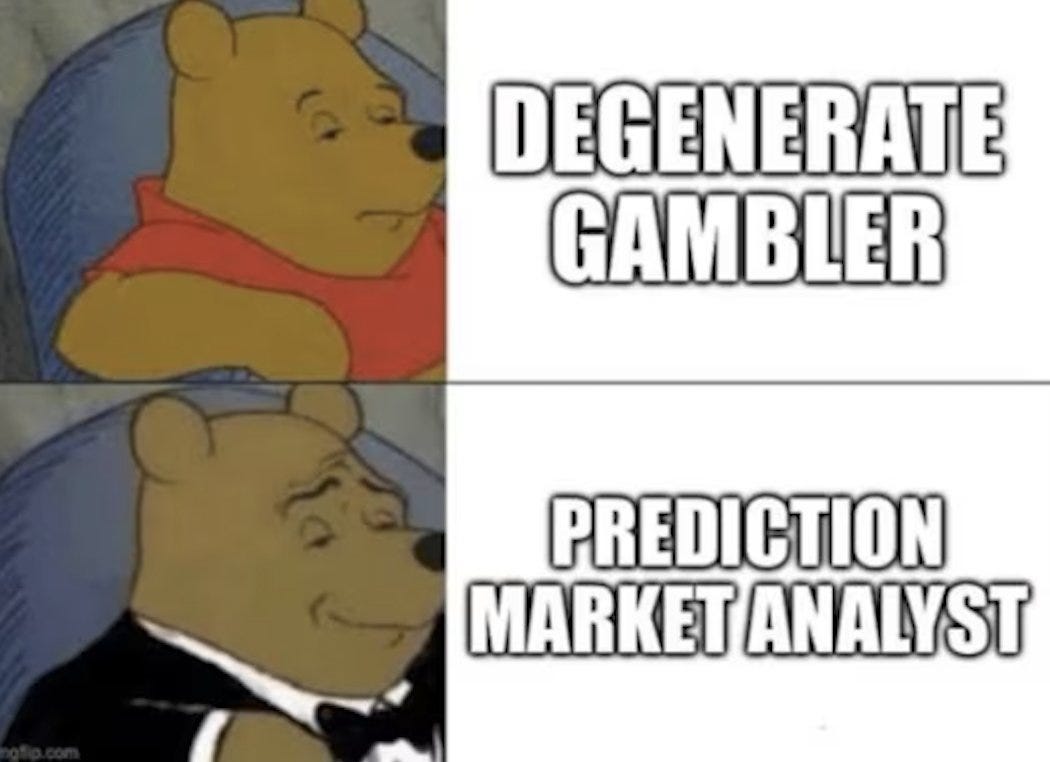

very interesting! from our seat watching the regulatory coverage across crypto newsletters this quarter, kalshi got CFTC approval for perps, polymarket is fighting on multiple fronts, and the legal scaffolding is being totally reimagined. we feel like everyone should be actually asking what does insider trading even mean in a market where outcomes are not determined by company performance?