

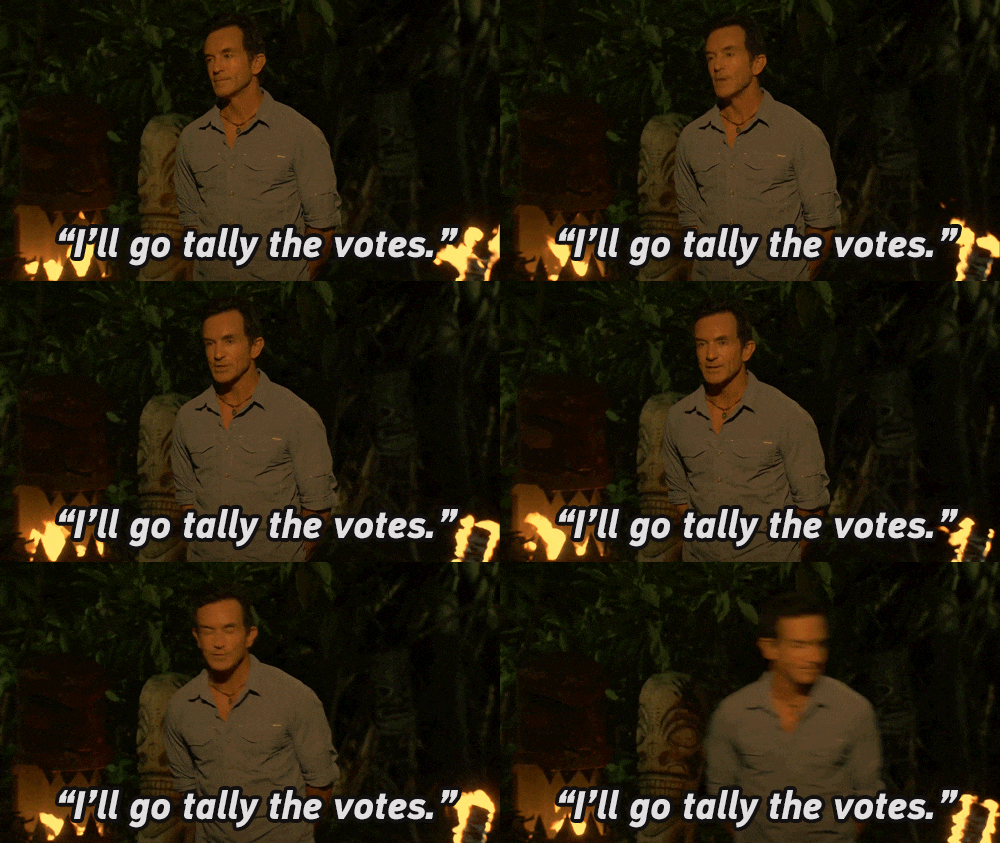
When you’ve lost Jeff Probst, it’s probably time to do some soul-searching.
The host of the long-running reality TV show Survivor had a few choice words for prediction markets like Kalshi and Polymarket, speaking with Variety:

“They have figured out a way to capitalize on [the show],” he tells Variety. “It doesn’t sit well with me as a human. I get it — they built a great business. They don’t care.” …
“Clearly, if 90% of the people are voting for somebody, there’s a leak. But to look at us, the producers, as though we have a problem, is the mirror pointing in the wrong direction,” he says. “[Prediction market platforms] are the ones with the problem, not us. We went and made our show in a vacuum, and we keep it very tightly contained, but if you are foolish and naive enough to not think that somebody might leak it, that’s your problem.”
That seems not great for prediction markets. (Click through to the story, there’s also a Kalshi comment in there.)
If you’re sitting here saying “How the hell did we end up here?” you’re not alone. I have so many thoughts on all of this, I felt compelled to write something on a Friday night. (As a parent of a six-year-old, my social life isn’t all that exciting.)
So where should I start? I am probably going to use a lot of exclamation points.
Stop letting people bet on things that already happened!
In case you think I am just being reactive based on recent events, I was on about this before it became a problem here. As was Axios’ Nathan Bomey, who wrote this story months ago:
“Survivor 50” hasn’t aired yet, but Kalshi, Polymarket have picked a winner
“Prediction markets where the result is already known or decided are some of the silliest things that exist in the space,” Dustin Gouker, a consultant who writes a newsletter on prediction markets, tells Axios in an email.
“You aren’t predicting anything! It already happened! Events where the information is already known by some cohort probably shouldn’t be a thing, in general.”
All of this is solved by one simple decision: no more trading/betting on things that already happened. The industry is literally called “prediction markets.” If you stick with letting people try to predict things that haven’t already happened: Problem solved! It’s not rocket science.
Yes, there is technically uncertainty for the public. But there is not uncertainty for the people who made the show, appeared on it, edited it, promoted it or received leaked information. That changes the nature of the market entirely.
Also get rid of mention markets on prerecorded shows, which is somehow an even dumber category.
Insider trading is the biggest issue in prediction markets right now
The negative headlines about prediction markets are largely about insider trading. And those headlines, to be fair, are mostly about Polymarket.
Into that environment, why are you giving people a reason to talk EVEN MORE about potential insider trading?
Kalshi’s head of enforcement, Robert Denault, tweeted this earlier in the week:
“Update: we continue to investigate insider trading in Survivor markets, but the below still holds true: so far, no traders with large positions seem to have a relationship to the show or to the network. Thousands of traders took early positions consistent with the outcome, likely because of public rumors. And public rumors don't equal insider information.”
Were people who know the answer trading on this market? Kalshi says it has not found evidence of that among traders with large positions. That may matter for enforcement purposes, but it doesn’t solve the underlying issue.
In reality, it’s almost immaterial whether there was insider trading. The optics of the situation are that people will believe that insider trading is happening no matter what, given the circumstances. You’re just helping reinforce a narrative by having the market at all.
Having to explain to millions of Survivor fans — and the general public — that you don’t tolerate/allow insider trading just isn’t a message that’s going to resonate.
The mere existence of prediction markets is sometimes creating problems
Over and over, we come back to this: Prediction markets might solve some problems, but they are also creating them.
Look, there have always been Survivor leaks, pretty much as long as the show has been on the air. It’s nothing new. But those leaks were always pretty easy to avoid. And leaking that information didn’t really help anyone, other than people who like spoilers on Reddit, I guess.
Now if you have information about who won Survivor, there’s a way to make money from it. That wasn’t a problem in the olden days before prediction markets, other than a pretty minimal amount of betting going on offshore. The inside information and leaking didn’t really matter that much… until there’s millions of dollars being traded on the outcome.
This is a refrain we have seen more than once, in things both important and unimportant. Some examples:
Kalshi caught an editor for Mr. Beast for insider trading. Great, you stopped it! But the information only had value because prediction markets were facilitating betting/trading on Mr. Beast videos!
The soldier who was arrested for allegedly betting on a Nicolás Maduro market at Polymarket is another example. Again, the information he had in his possession was made more valuable specifically because prediction markets exist, or at least they create a cleaner way to profit from said information. Yes, you could sell information to other countries, but then we’re moving away from just a serious crime to treason.
It’s all a bit of the chicken and the egg. Sometimes this kind of insider trading arguably doesn’t happen without a prediction market creating a venue where the information becomes more valuable. We’re seeing governments and companies have to devise policies to deal with prediction markets specifically, for problems that never existed before.
Again, we don’t know if there was any specific insider trading going on involving Survivor that was untoward. But it’s also hard to believe that leaks didn’t lead to the odds we saw at prediction markets.
Survivor markets exist mostly for gambling
There is just no real reason for Survivor markets to exist at prediction markets other than to let people gamble on them.
Yes, yes, yes, every event has some economic consequence in the world, blah, blah, blah.
The main reasons prediction markets exist are to provide a way to hedge economic risk and price discovery/information aggregation. Neither of these really holds up as a legitimate reason for Survivor markets to exist:
Risk hedging: There’s a lot of money at stake for Survivor, no doubt. But contestants and people involved with the show can’t trade. Kalshi, as we already heard above, is investigating if there was any insider trading. And here’s Kalshi’s prohibitions for the market:
The following are prohibited from trading this contract:
Persons who are employed by any of the Source Agencies are not permitted to trade on the Contract.
Persons who hold any material, non-public information on the Underlying are not permitted to trade on the Contract.
Price discovery: Almost no one wants to know who wins before the show airs! That’s the point of watching the show! There is some demand for spoilers, obviously. But “some people want spoilers” is not the same thing as socially useful price discovery.
I am sure someone can come up with some cockamamie way someone can legitimately hedge risk. Those aren’t serious people.
Anyway, if we just admitted Survivor markets existed for gambling purposes, then I’d have far less problem with them.
Survivor betting is not worth the squeeze and is also now terrible PR
Kalshi and Polymarket want to be the place where you trade on everything. Kalshi, especially, desperately wants to prove it’s more than a sports betting exchange with some crypto and election betting sprinkled in.
So, prediction markets look at things like reality shows, and I guess you can squint and think that’s one of the ways to help get you there. There are huge and engaged audiences for TV shows. It sounds like a great idea in theory: People watch sports and bet on them, and that works out OK.
But people watch Survivor for the thrill/journey/surprise of finding out who will win. If you go on Kalshi and Polymarket and see the odds are basically saying the show is over before it even starts, that’s just a terrible experience for a viewer. If you could just bet on it without seeing the odds, I guess that’s a potential workaround; but at that point, what’s the point?
There was $32 million traded on who the winner would be at Kalshi, which is basically the equivalent of how much trading there is on some single NFL games. For scale, there’s about $4 billion in trading volume every week on Kalshi right now. Math, math, math… I don’t think Survivor is moving the needle. There was less than $2 million traded at Polymarket.
In exchange for that, it appears you have pissed off, in no particular order: Jeff Probst, the producers of Survivor, CBS, and fans of the show. Those Probst quotes are some of the most negative things said about prediction markets.
If the show itself wants you to knock it off, are you really gonna go through this again for the next season of the show? Godspeed if you do. Maybe just take the L and move on. It’s OK to say you’re wrong once in a while, I promise. Or if you subscribe to the idea that all PR is good PR, I guess you can carry on, as well.
One more aside to explain why this started blowing up: Prediction markets and third-party affiliates also created a crush of content — both on social media and the web — that made it more difficult than ever to avoid the spoilers. Even if the market was only reflecting public rumors, the market made those rumors more visible, more monetizable and much harder for casual viewers to avoid.
Does the CFTC want to be a real regulator or nah?
One more point, and it circles back to the first section. We don’t need to have trading on stuff that already happened.
The Commodity Futures Trading Commission has shown little appetite so far to draw many hard lines around event contracts, beyond the most obviously problematic categories like war and assassination markets.
I don’t think it would be a stretch for the CFTC to say “You know what, this was all supposed to be about events that haven’t happened yet. So maybe we should stop having markets that are not about future events.”
That doesn’t feel like a huge stretch, does it? The CFTC has basically become a cheerleader for the prediction markets industry, and at times has looked more like its defender than its regulator. Here, it has a chance to act like an actual regulator.
I’d make a healthy bet that they won’t do anything on this front. But it would be one good way to start proving prediction markets aren’t actually the Wild West.
Congress already tipped its hand on this. Earlier this year, insider trading legislation was introduced for prediction markets https://thesynthesisai.substack.com/p/the-record. You don't write conflict-of-interest laws for poker tables. But once platforms accept that regulatory frame, they lose the right to run markets where the outcome is sitting on a hard drive in a CBS editing suite. They want the legitimacy of finance and the content surface area of gambling, and Survivor is where that contradiction became visible to everyone.