

Polymarket's US Return: An FAQ


Big news in prediction markets land: Polymarket is coming back to the US.
The international prediction markets platform announced it was buying an exchange that is licensed by the Commodity Futures Trading Commission for $112 million. More on the news:
The transaction brings up a lot of questions; I’ll do my best to answer some of them here.
What did Polymarket buy?
Polymarket bought QCEX, which is technically two things:
A derivatives exchange (QCX, LLC). This is the designated contract market, or DCM.
The DCM just got approval from the CFTC on July 9.
A clearinghouse (QC Clearing LLC).
Per the CFTC, here’s what a derivatives clearing organization (DCO) is: “An entity that enables each party to an agreement, contract, or transaction to substitute, through novation or otherwise, the credit of the DCO for the credit of the parties; arranges or provides, on a multilateral basis, for the settlement or netting of obligations; or otherwise provides clearing services or arrangements that mutualize or transfer credit risk among participants.
The DCO registered with the CFTC in December.
Kalshi Klear is Kalshi’s DCO, for example.
Sergei Dobrovolskii is the founder of QCEX; here’s what he said in the Polymarket press release:
"When we began the process to obtain our DCM & DCO licenses over 4 years ago, the prediction market was in its infancy. But we have long believed in its potential to change the way people access and understand information and express their views on that information. Shayne has built a cultural phenomenon in Polymarket. I am excited to bring our companies together and leverage our licenses, technology, and expertise in the retail trading sector to help Polymarket reach its full potential."
What did Polymarket’s CEO have to say about the acquisition?
Here’s CEO Shayne Coplan in the press release:
"Polymarket is the largest prediction market globally and has become synonymous with understanding the probability of current events. Demand is greater than ever — not just in user growth and trading volume, but in how mainstream audiences are turning to Polymarket to separate signal from noise, bias, and speculation. Now, with the acquisition of QCEX, we are laying the foundation to bring Polymarket home — re-entering the US as a fully regulated and compliant platform that will allow Americans to trade their opinions."
“Polymarket has acquired QCEX, a CFTC-regulated exchange and clearinghouse, for $112 million. This paves the way for us to welcome American traders again. I've waited a long time to say this: Polymarket is coming home…
Owning a DCM and DCO will let us serve all American traders and brokerages. This acquisition isn't just about a license; it’s Polymarket's homecoming, returning stronger and ready to serve American users once again.”
When is Polymarket coming back to the US?
That’s the big question, and we don’t know the timeline as we sit here. Polymarket intimated the return would be in the “near future.” That’s a nebulous phrase that could mean weeks, months or next year.
For the US sports betting opportunity, Polymarket would probably like to be live by September, when football season starts. Kalshi already has single-game markets for college football and NFL games, the equivalent of moneyline betting.
Is a fall launch feasible? I guess we’ll see. But Polymarket was under investigation by the federal government just over a week ago, and now it owns a federally licensed prediction market. That’s a turnaround that could give anyone whiplash.
The waitlist makes it clear Polymarket believes it will be in the US, eventually. We’ll have to wait for more signals or news from Polymarket.
Why wasn’t Polymarket in the US in the first place?
Prior to 2022, Polymarket offered prediction markets without running them through the CFTC. It then exited the country, officially, after a settlement with the CFTC:
From a CFTC press release:
The Commodity Futures Trading Commission today entered an order filing and simultaneously settling charges against Delaware-registered Blockratize, Inc. d/b/a Polymarket, based in New York City, for offering off-exchange event-based binary options contracts and failure to obtain designation as a designated contract market (DCM) or registration as a swap execution facility (SEF).
The order requires that Polymarket pay a $1.4 million civil monetary penalty, facilitate the resolution (i.e. wind down) of all markets displayed on Polymarket.com that do not comply with the Commodity Exchange Act (CEA) and applicable CFTC regulations, and cease and desist from violating the CEA and CFTC regulations, as charged.
“All derivatives markets must operate within the bounds of the law regardless of the technology used, and particularly including those in the so-called decentralized finance or ‘DeFi’ space,” said Acting Director of Enforcement Vincent McGonagle. “Market participants should proactively engage with the CFTC to ensure that our markets remain robust, transparent, and afford customers the protection provided under the CEA and our regulations.”
Of course, it’s pretty clear that Polymarket is serving some users who are Americans accessing the site via VPNs and using cryptocurrency. How large that cohort is is unknown, but it’s larger than zero.
How long has Polymarket been trying to get back into the US legally?
Probably soon after it left.
The US opportunity gained traction after Kalshi won a federal court appeal to offer betting on elections. It got even more interesting when Crypto.com took the lid off of sports betting via the CFTC/prediction markets at the end of 2024. Kalshi followed less than a month later and has seen $2 billion in trading volume in the six months since launch.
Coplan signaled his intent to bring Polymarket back to the US after President Donald Trump won the November election. And it looks like he delivered.
Does Polymarket offer sports betting?
Yes. It offers a lot of the same markets that Kalshi does, mainly 1. moneylines (who wins or loses a game) and 2. futures bets (both team and individual accomplishments).
Polymarket offers lots of other markets, as well, but sports is a major part of what you can bet/trade there.
How much bigger is Polymarket than Kalshi?
Comparing the two platforms isn’t apples to apples. After all, Kalshi only serves the US and Polymarket serves an international market (and some group of US users despite its legal status).
But Polymarket does seem to be sizably bigger than Kalshi. Here’s a look at current trading volume at the two sites:
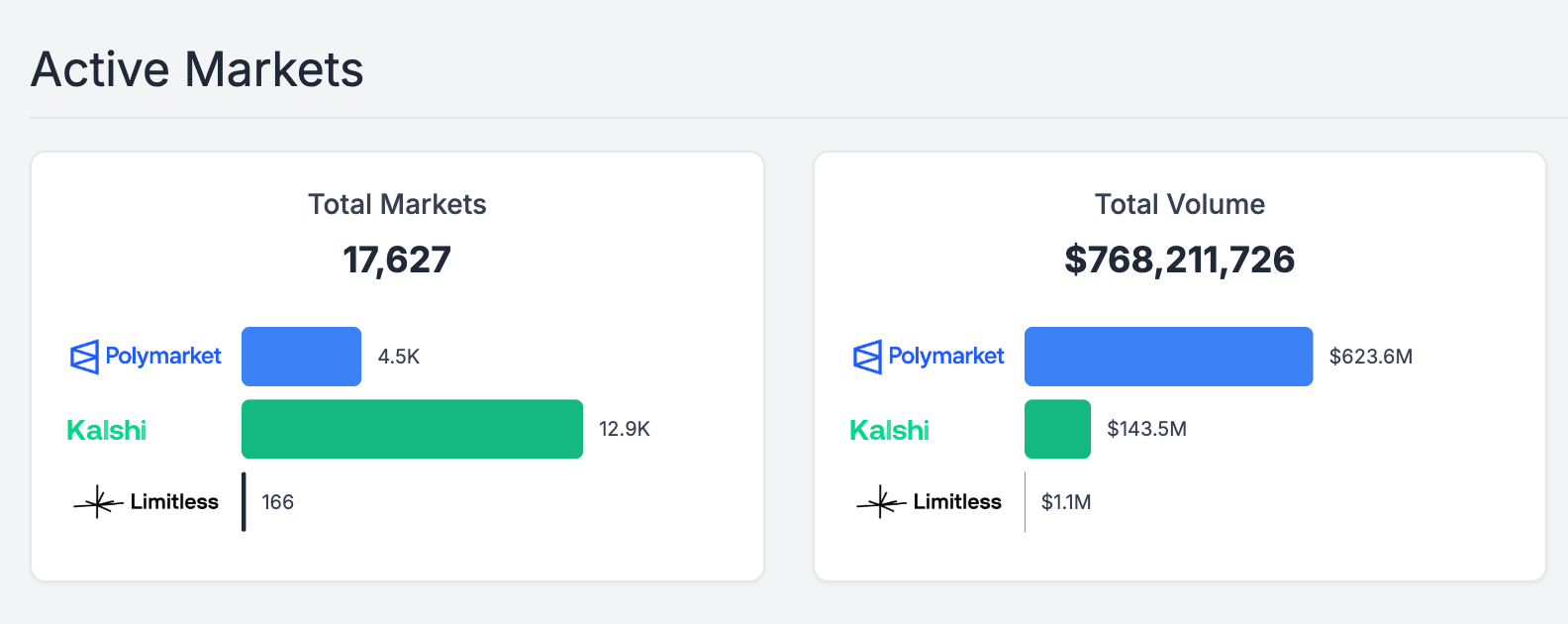
While Kalshi has about 3x the number of markets, Polymarket has 4x the volume.
Kalshi was recently valued at $2 billion after a funding round; Polymarket was reportedly raising money at more than a $1 billion valuation.
How will Polymarket handle transactions in cryptocurrency in the US?
Again, we don’t know a lot. But Front Office Sports reports that the US-facing platform could conduct business in dollars.
Will other companies buy CFTC-licensed markets/exchanges?
The smart money says “yes.”
DraftKings is already kicking tires on a similar M&A opportunity, Railbird, which recently won CFTC approval as well.
If you want to be in prediction markets, buying a DCM is one of the ways to do it that takes some of the time and pain out of the process.
PredictIt’s parent company has also been pursuing CFTC approval for a new DCM for years, it’s worth noting.
What does this mean for Kalshi?
It means the prediction market has real competition in the US.
There’s an argument that a rising tide lifts all boats, and Polymarket helps the prediction markets industry writ large. And that might provide Kalshi with some tailwinds.
However, the days of Kalshi having the sandbox to itself are over. Kalshi is now competing to acquire the same customers that Polymarket either has or will be trying to acquire. Some Kalshi users will likely move some of their action to Polymarket.
From Coplan on Twitter, I think the idea that Polymarket will “serve all American traders and brokerages” is interesting. Kalshi has a deal with Robinhood, and has said it in process of adding 20 brokerages. Polymarket will likely provide competition here, too.
It’s also worth noting that Kalshi is footing the bill for the legal battle in the fight to offer sports betting in the US. Polymarket will presumably be able to ride coattails for now and let Kalshi stay in the trenches. Of course, there are scenarios where sports betting via the courts could go away. And the opportunity becomes much smaller.
More real competition in the US prediction markets industry was inevitable, and now it’s here. And perhaps quicker than anyone thought.
More questions?
If you have more questions, reply to the newsletter, and I’ll do my best to answer them.