

Polymarket Takes Down 'Nuclear Weapon Detonation' Market
Roundup: Michigan AG sues Kalshi; prediction markets have mixed results in close primaries on Tuesday; CFTC Chair Michael Selig says prediction market rules are coming soon.

So much for me thinking we were putting Iran and war betting to bed yesterday!
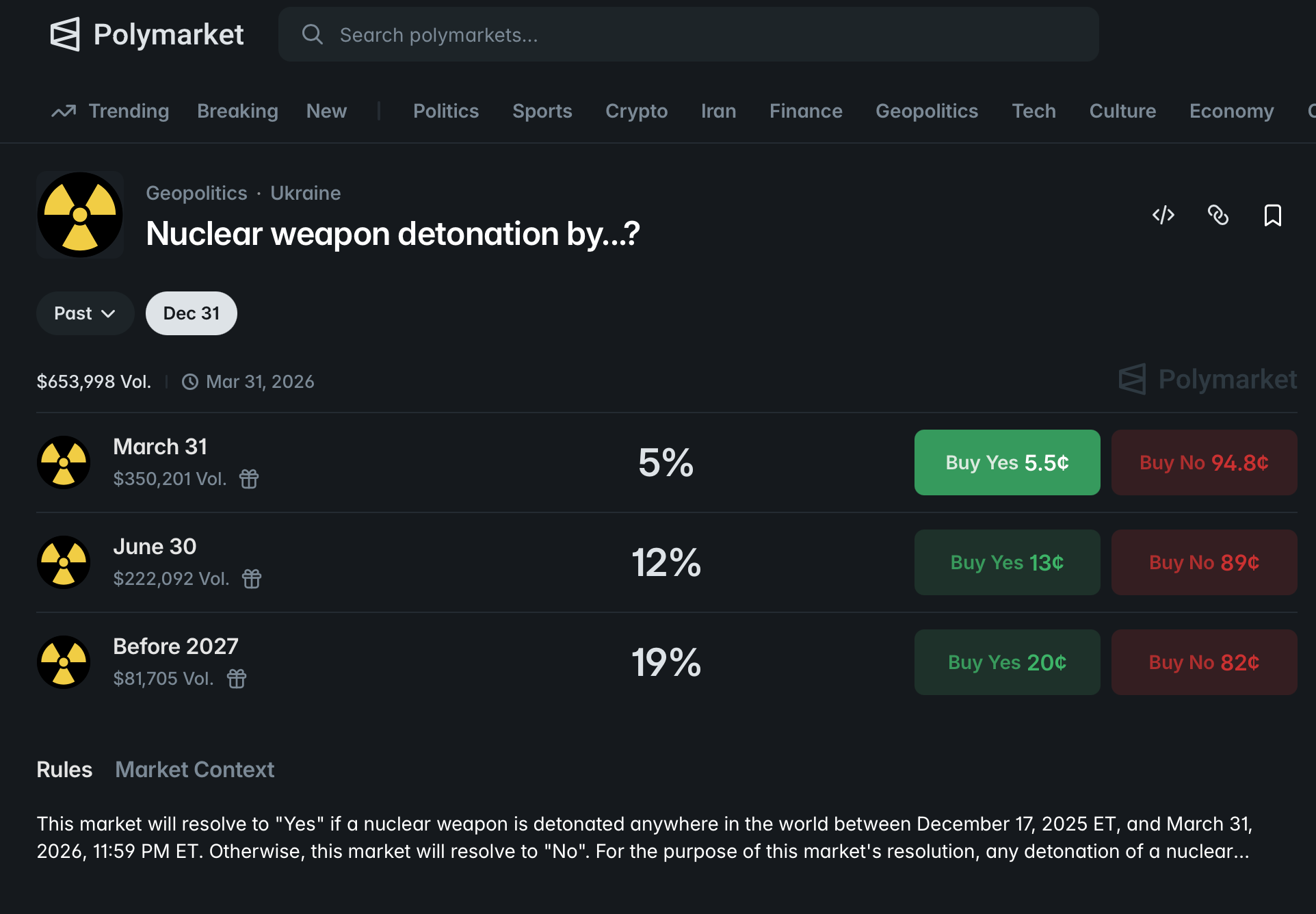
People on Twitter started discovering that Polymarket had a market for “Nuclear weapon detonation by...?” listed on its international site on Tuesday.
The market wasn’t new (here’s an example from 2023) but people finding it and tweeting about it was. This was the tweet that got the most traction, with more than 3 million views:

Visitors to the URL are now greeted with a message that the “event has been archived”:

However, you can still see the market on the Wayback Machine. Here’s what it looked liked on Tuesday morning when a snapshot was taken:
I gave some thoughts to Decrypt’s coverage.
And more from CoinDesk: “Bettors have long been able to speculate on the chance of a nuclear weapon detonating on Polymarket, but the current conflict with Iran – and scrutiny about insiders trading on war – has apparently caused the platform to remove the contracts.”
All eyes are on betting on war with Iran right now, and this market was picking up lots of negative reactions on Twitter. Taking it down was a no-brainer. And hopefully we don’t see this again, outside of perhaps markets about nuclear tests, which I can squint and see the utility of.
There will again likely be calls from politicians to do something about this, but it remains unclear what, if anything, the Commodity Futures Trading Commission could do. While Polymarket US operates under the CFTC umbrella, the international site does not. The CFTC has shown little appetite for reining in US-regulated prediction markets, much less ones that technically don’t serve America.
Meanwhile, the story around Iran and prediction markets is still capturing the attention of mainstream media. A sampling:
Israeli police investigate Polymarket user who correctly predicted Iran strikes (Middle East Eye): “Israeli police have opened an investigation into a bet made by a user on the gambling website Polymarket, which predicted that the US would strike Iran on 28 February, Israel’s Channel 12 news reported. A user named Magamyman made a gross profit of some $430,000 by successfully predicting the start of the war.”
Polymarket and Kalshi’s Iran War Wagers Are Ghoulish — and Troubling (Bloomberg, Opinion): “As bad behavior in finance goes, the idea of insiders betting on the US and Israel attacking Iran is about as appalling as it gets. Cashing in on death and destruction across the Middle East — or anywhere else — would be despicable. But beyond the moral dimension, there’s also the issue of national security: Given that handing such information to an enemy would be an act of treason, should risking intelligence leaks through price signals be seen as any less traitorous?”
Death to prediction markets profiting on war | Will Bunch Newsletter (Philly Inquirer): “I know … it’s shocking that something in America’s death spiral of late-stage capitalism is actually a rigged game, right? Still, it’s hard to decide which is worse about this new low of predictive betting on a war that’s already killed scores of innocent schoolgirls and hospital patients, and at least six U.S. service members: the rank immorality of wagering on death and destruction, or the insider trading that corrupts this already unholy process even further?”
A Darkly Modern Guide to Betting on War (Bloomberg): “The Polymarket and Kalshi flaps are a useful split screen. Polymarket’s international platform is the Wild West, where traders can push the limits of taste and morality without needing to worry about regulations. The downside, of course, is a risk that your counterparty is an insider. Kalshi, meanwhile, distinguishes itself as a stickler for the rules—but so much so that its users can have trouble following them. Which approach will win? That’s impossible to predict.”
Prediction market ‘gambling’ needs state regulation, not feds, Mick Mulvaney says after Iran war bets (CNBC, video on link): “Buying contracts on prediction markets is just another word for “gambling,” says former Trump White House Chief of Staff Mick Mulvaney, who is leading a coalition that wants state authorities, not a federal commodities agency, to regulate that growing industry.”
“The simple answer is that it’s gambling. It just is,” Mulvaney told CNBC’s Contessa Brewer, saying the burgeoning industry needs extra scrutiny following betting activity ahead of the Iran war.
More from Brewer:
After huge bets on the Iran strikes, do Polymarket and Kalshi face a trust crisis? (Fast Company): “The head of steam against prediction markets feels like a turning point—but it will have to come soon. The more attention that’s drawn to them, the more people are likely to pick up their wallet and connect it to the platforms.”
“It’s one of these markets that is driven by interest, because we’re inundated with information about it,” says John Holden, associate professor in business law and ethics at Indiana University’s Kelley School of Business.
Blockchain analysts say traders may have used insider information to profit on Iran conflict bets (Fox Business): “As millions of dollars flooded into controversial prediction markets tied to U.S. strikes on Iran and the death of Ayatollah Ali Khamenei, blockchain investigators say a handful of suspected insiders may have used non-public information to turn the fog of war into a personal windfall.”
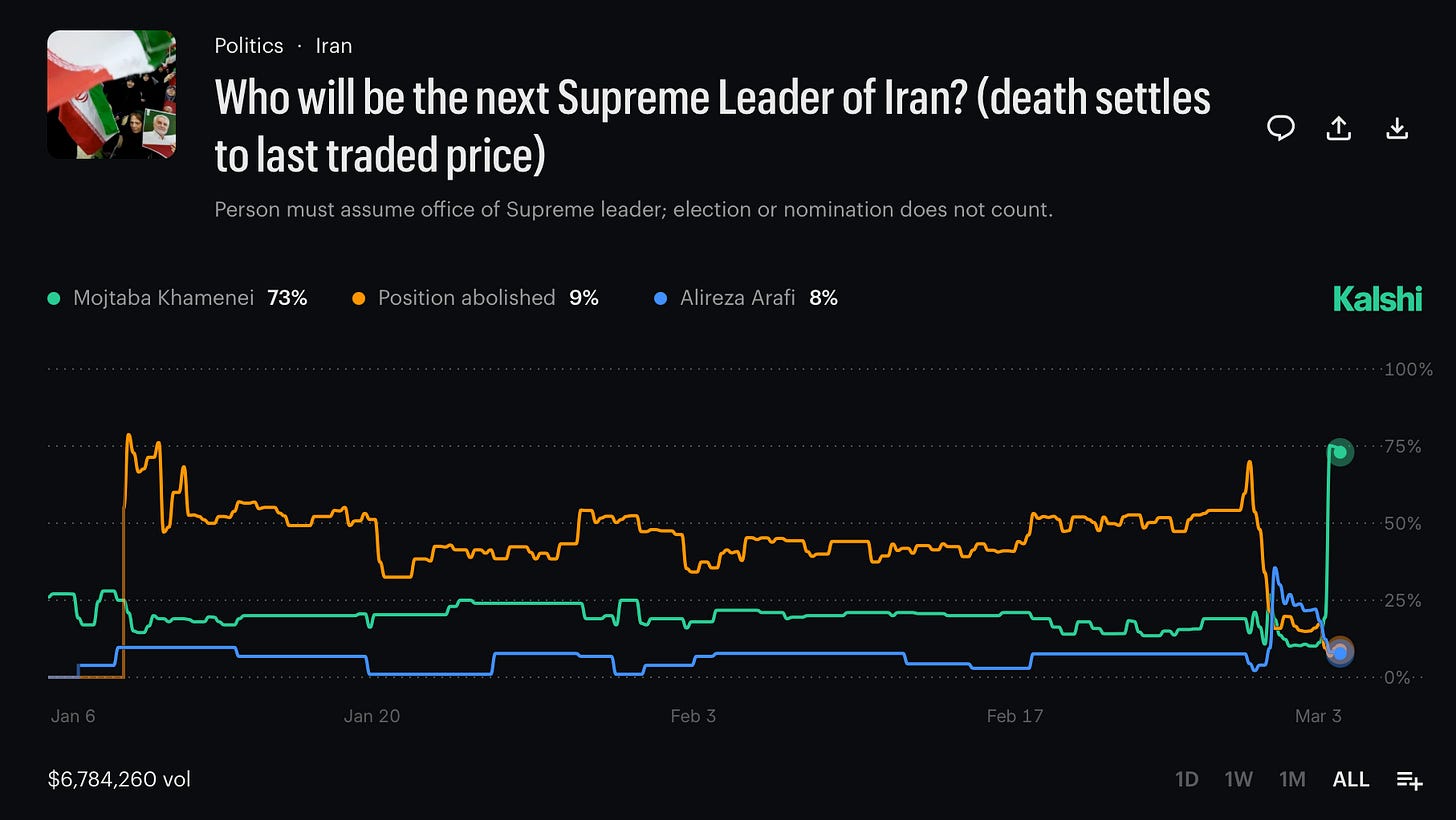
One last note before we get to non-Iran news: Kalshi has changed how it titles regime change markets after Saturday’s issues on Khamenei’s ouster:
Learn more about prediction markets!

I am helping Next.io with its new Emerging Verticals event on March 9 in New York City, ahead of the main conference. Much of the content is about prediction markets. You can get tickets and learn more here. Use code F0EVTCL0L10 for a 10% discount. Reach out if you have any questions about the event or getting tickets.
Prediction markets roundup
Michigan AG sues Kalshi (The Closing Line): Michigan Attorney General Dana Nessel has sued Kalshi in state court to try to stop the prediction market from offering sports event contracts in the state. From the complaint:
Kalshi offers an online sports betting operation to residents in the State of Michigan without the licensing approval of the Michigan Gaming Control Board. Specifically, Kalshi operates a so-called prediction market through which residents of the State of Michigan can engage in unlicensed gambling under the guise of trading event contracts. This market is an online trading platform through which users may wager on the likelihood of a sports-related occurrence. Kalshi conducts business across the United States, including within Michigan, where Kalshi makes its services available to residents, markets its platform to potential users, and accepts payments through widely used financial systems accessible by Michigan consumers.
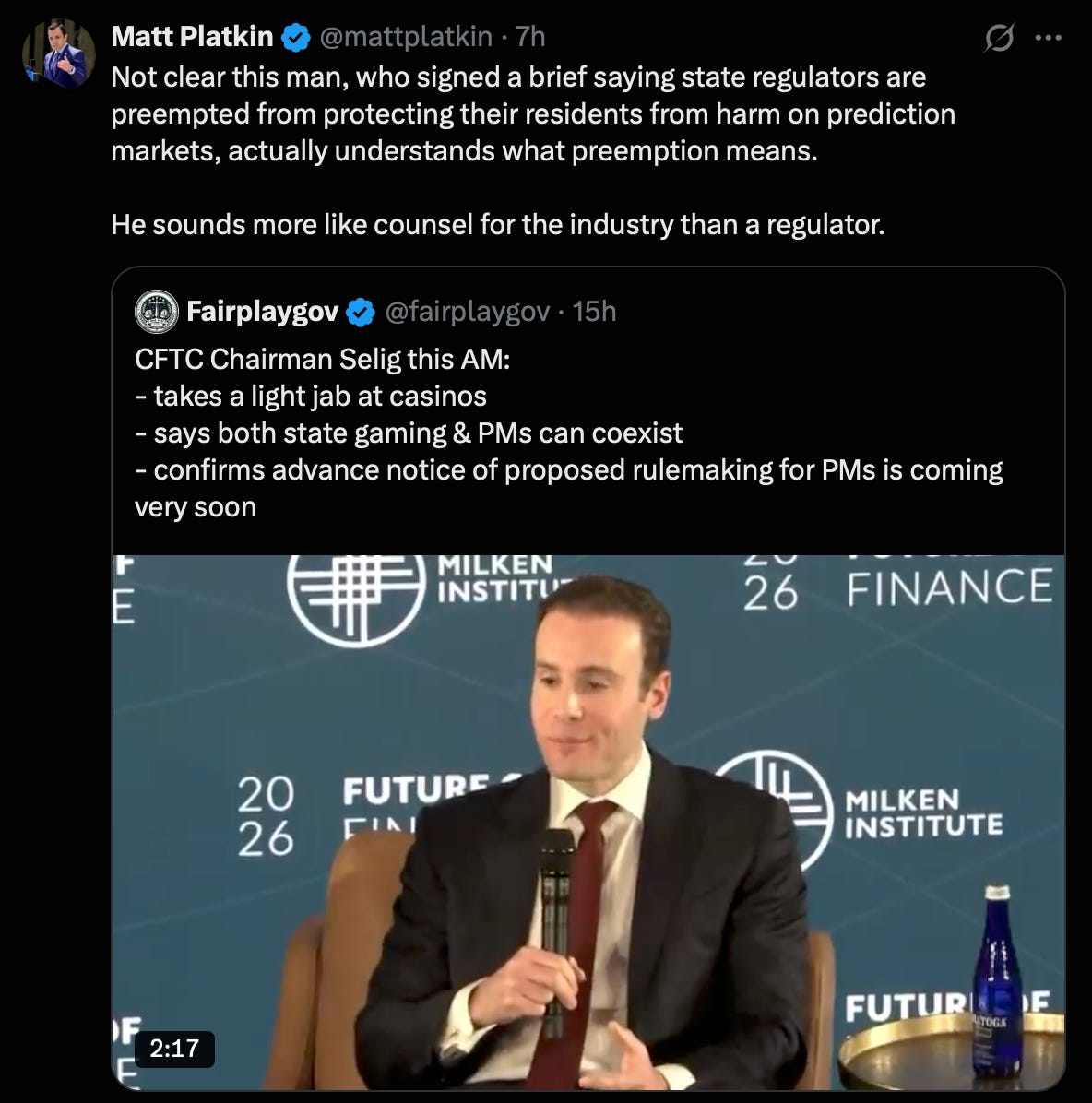
CFTC Chair Selig Announces Rulemaking Push: What it Means for Prediction Markets (DefiRate): “CFTC Chairman Michael Selig used a Washington stage Tuesday to deliver the clearest roadmap yet for where federal prediction market regulation is headed. And he put a timetable on it. Speaking at the Milken Institute Future of Finance event, Selig confirmed the agency will set formal self-certification standards for event contracts and move forward with an Advanced Notice of Proposed Rulemaking, or ANPRM, as the foundation for comprehensive prediction markets rules.”
“We’re going to be setting very clear standards as to the types of prediction markets that can be self-certified in our markets,” Selig said. “We’re also planning to move forward with an advanced notice of proposed rulemaking in the near future that will set the stage for more fulsome prediction markets rulemaking.”
You can watch Selig’s appearance here.
The former attorney general of New Jersey had some thoughts:
How did prediction markets do on Tuesday’s primaries?: There were some high-profile primaries on Tuesday, especially the Senate races for both Democrats and Republicans in Texas. How did prediction markets do?
First, we should realize prediction markets for elections only to be probabilities/odds of candidates winning. But prediction markets like to take victory laps when they “called” races correctly, including the 2024 presidential election. So they should be held to that standard until they change their tune, in my opinion.
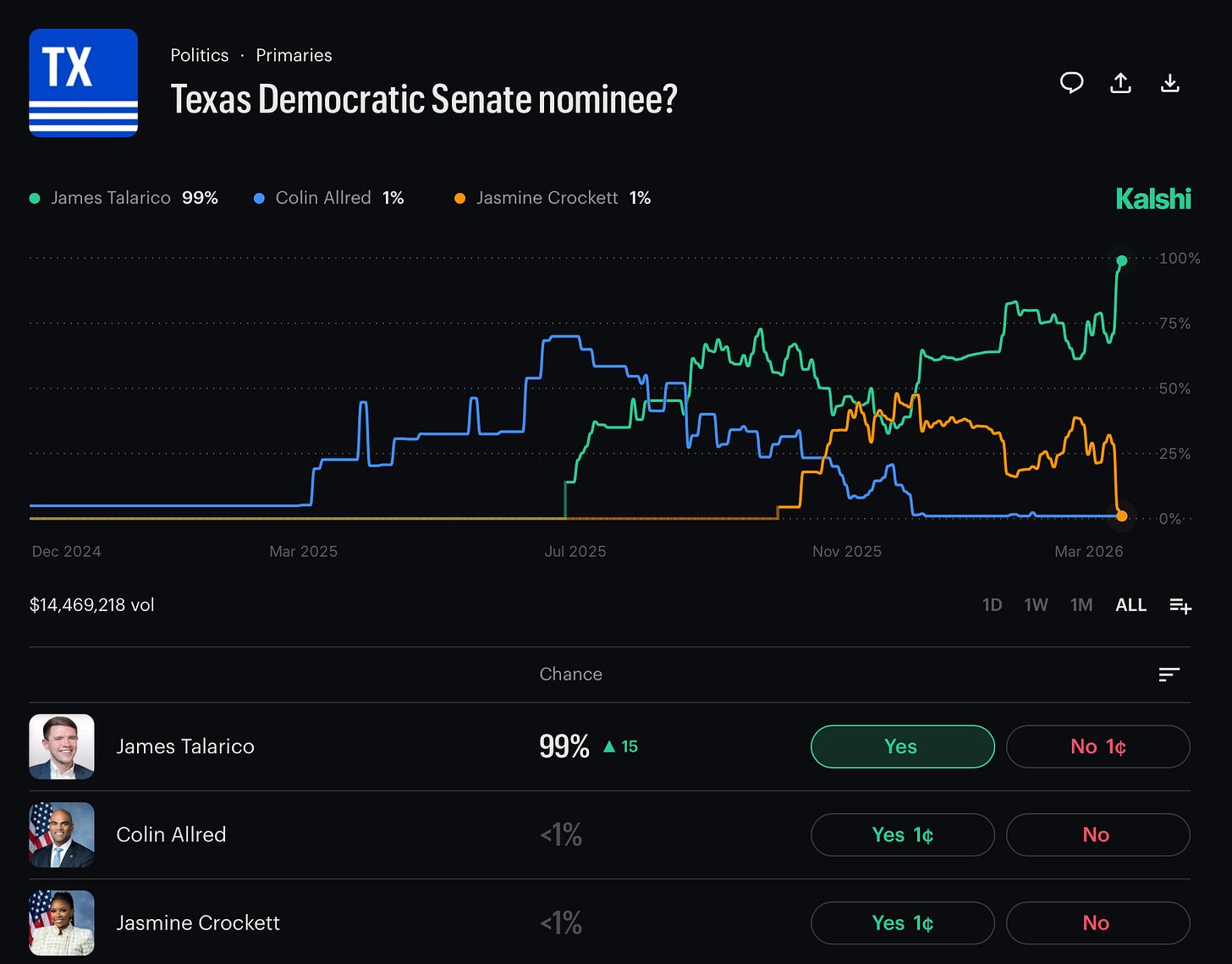
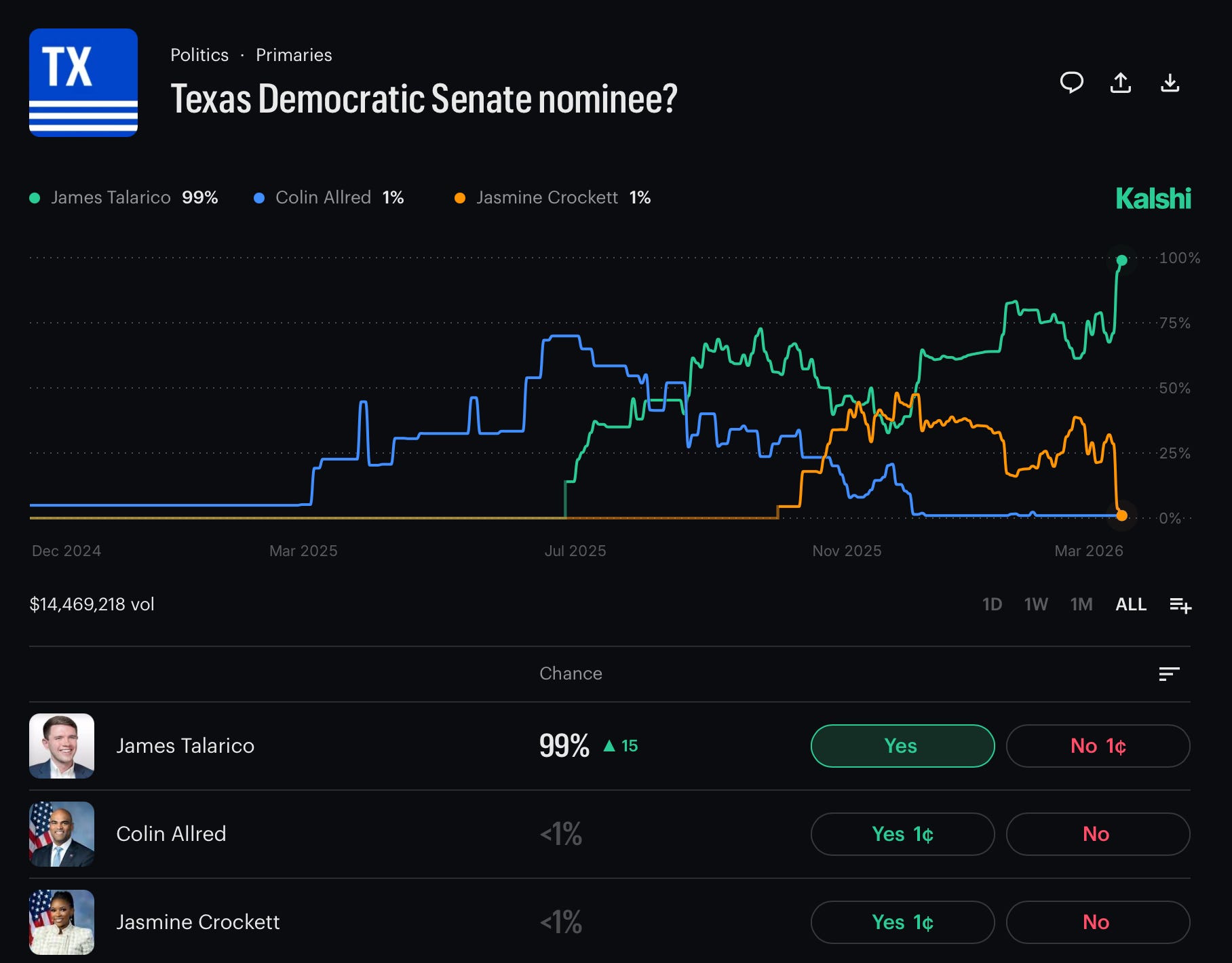
Texas Senate, Democrats: Both Kalshi and Polymarket had James Talarico as about an 80% favorite heading into Tuesday over Jasmine Crockett, and he was headed to victory.
Texas Senate, Republicans: On Monday, state attorney general Ken Paxton was about an 80% favorite to win at both Kalshi and Polymarket over incumbent John Cornyn. Those odds had shortened considerably by the end of the night, as the primary is heading to a runoff in May. Cornyn outperformed his polling numbers. Since we have Polymarket embeds, we might as well use them, right?
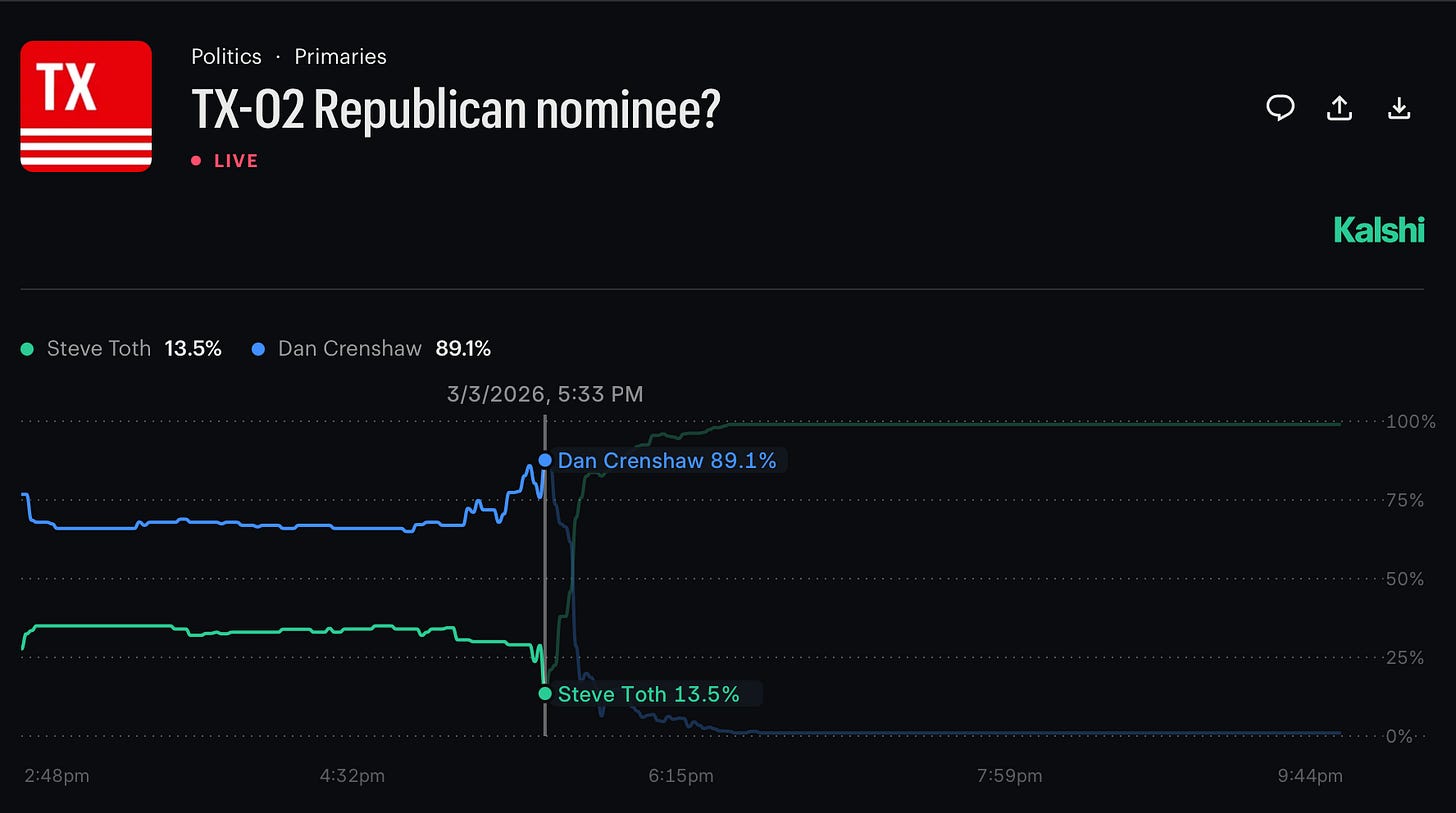
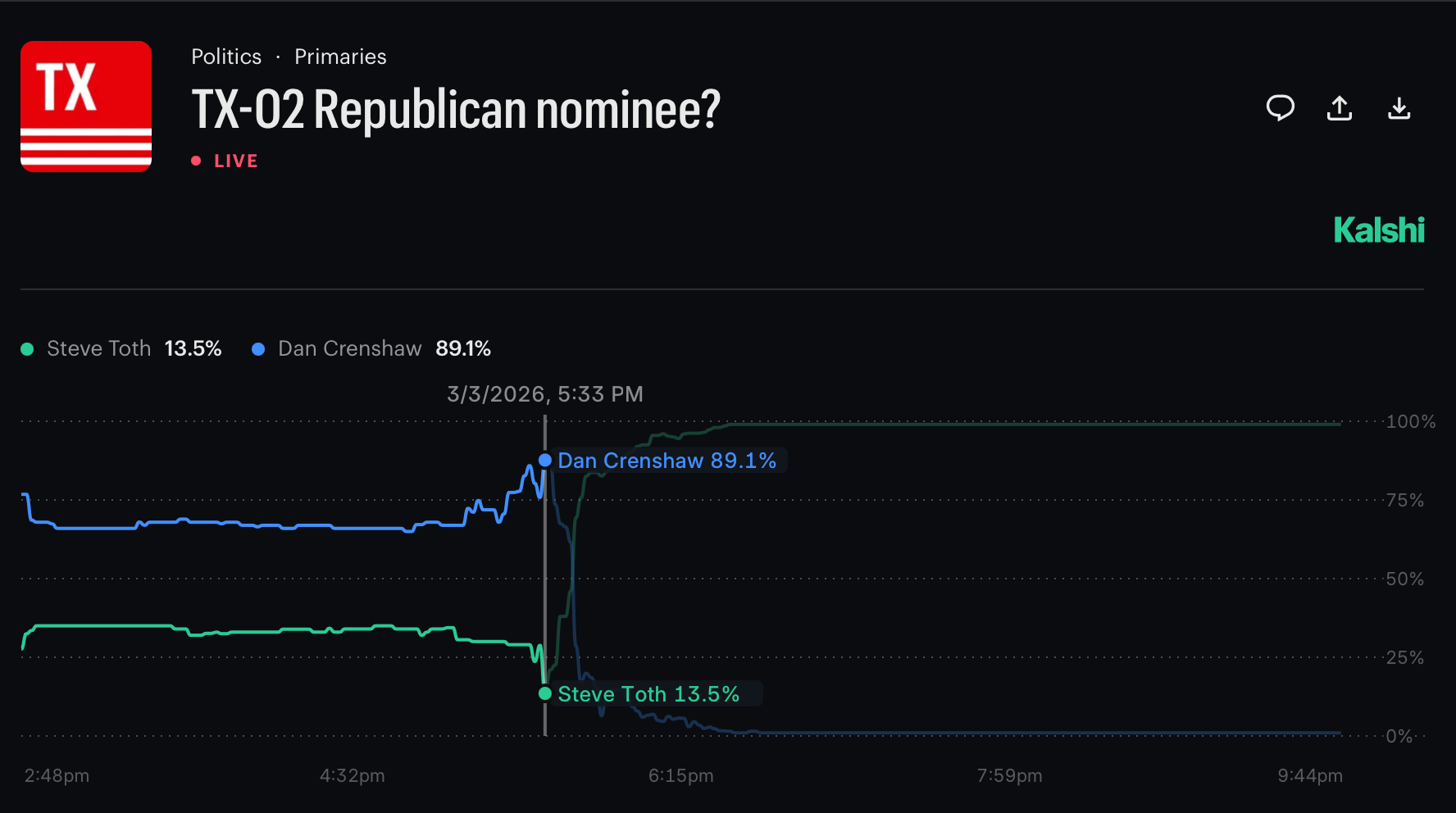
TX-02, Republicans: This was easily the biggest miss for prediction markets — in a high-profile race — as incumbent Dan Crenshaw was as much as a 90% favorite at Kalshi on Tuesday evening before polls closed. Steve Toth was winning handily early Wednesday morning.
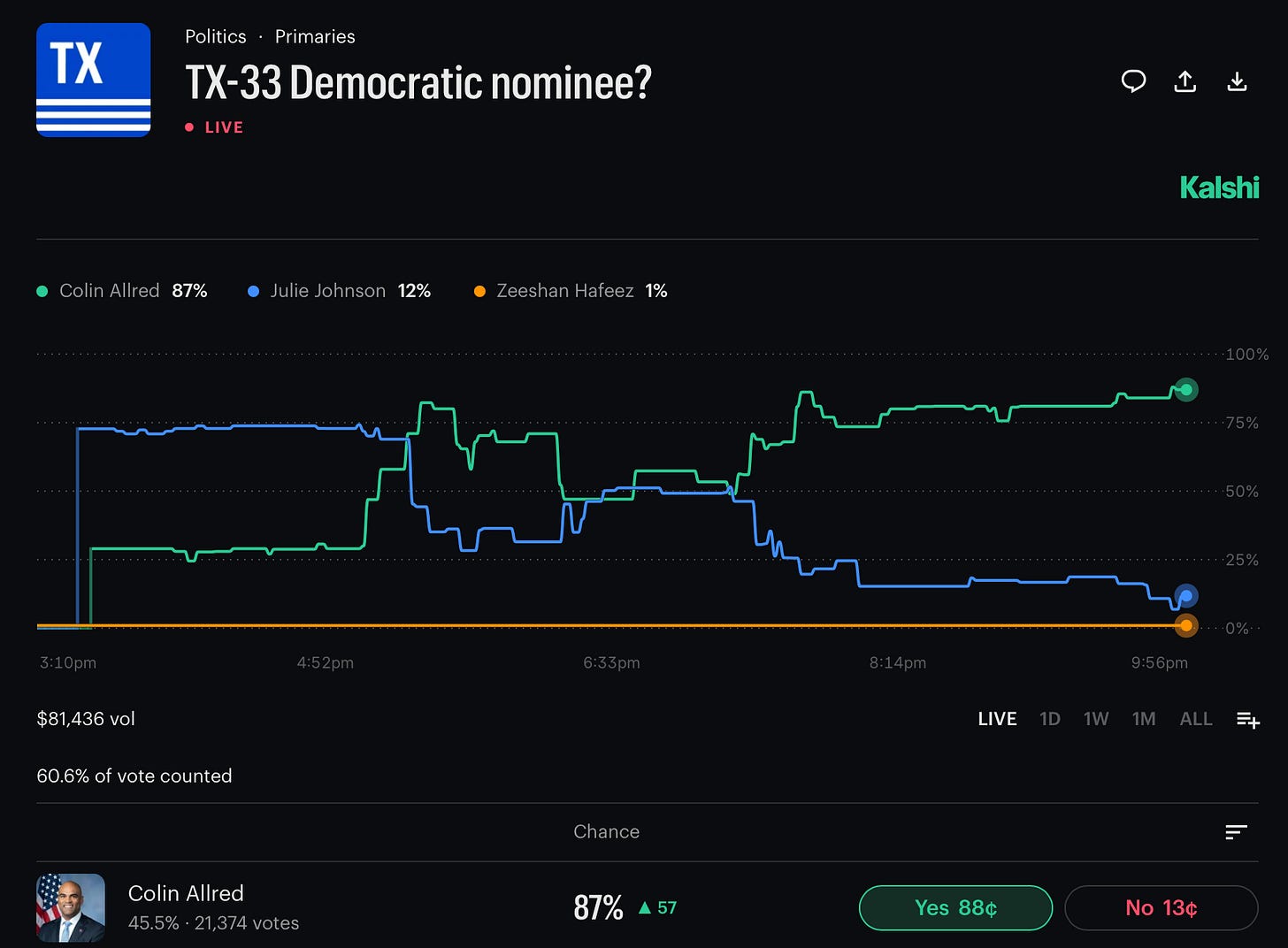
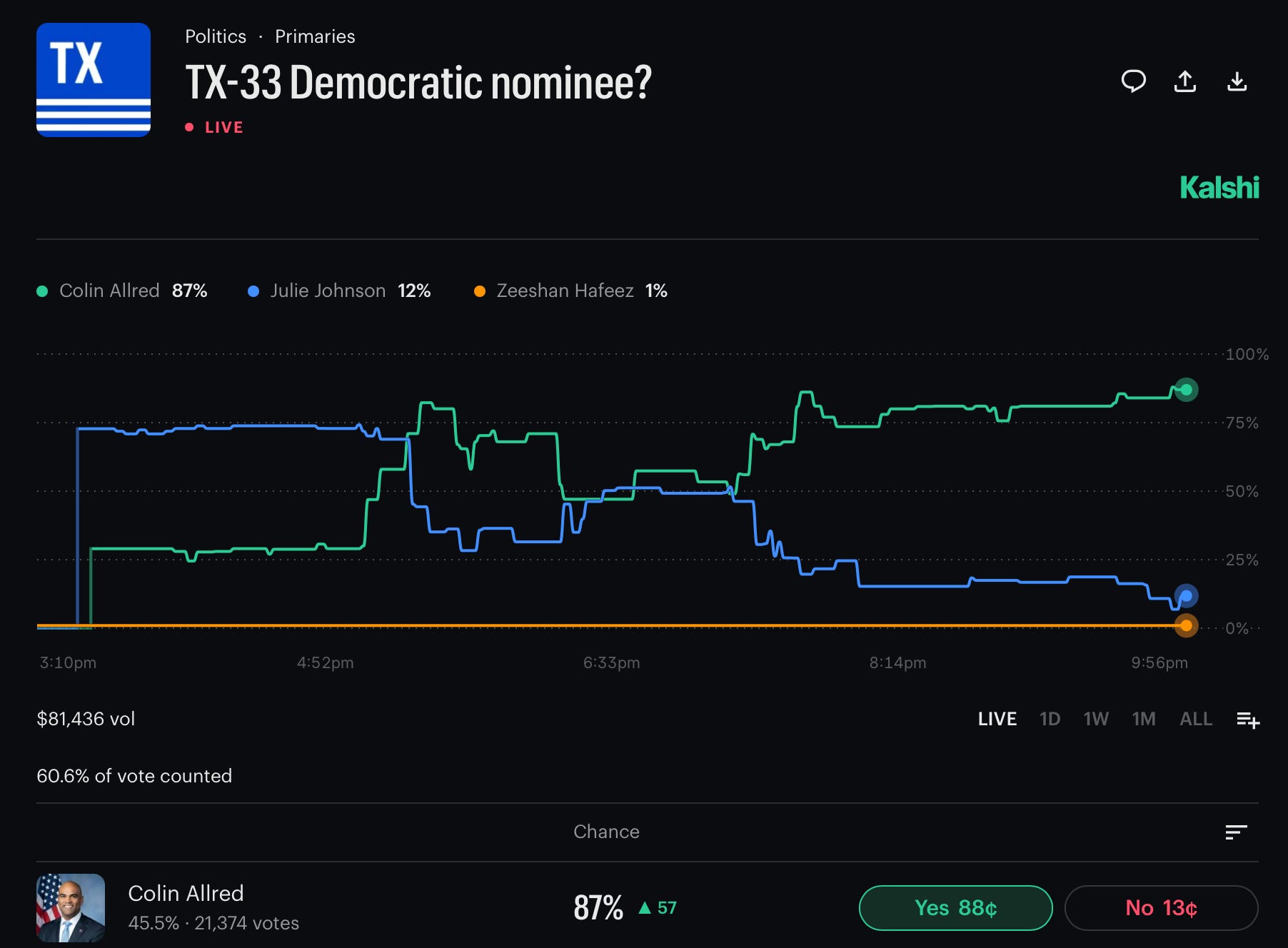
TX-33, Democrats: Colin Allred was an underdog heading into the day at both prediction markets but became the favorite later Tuesday:
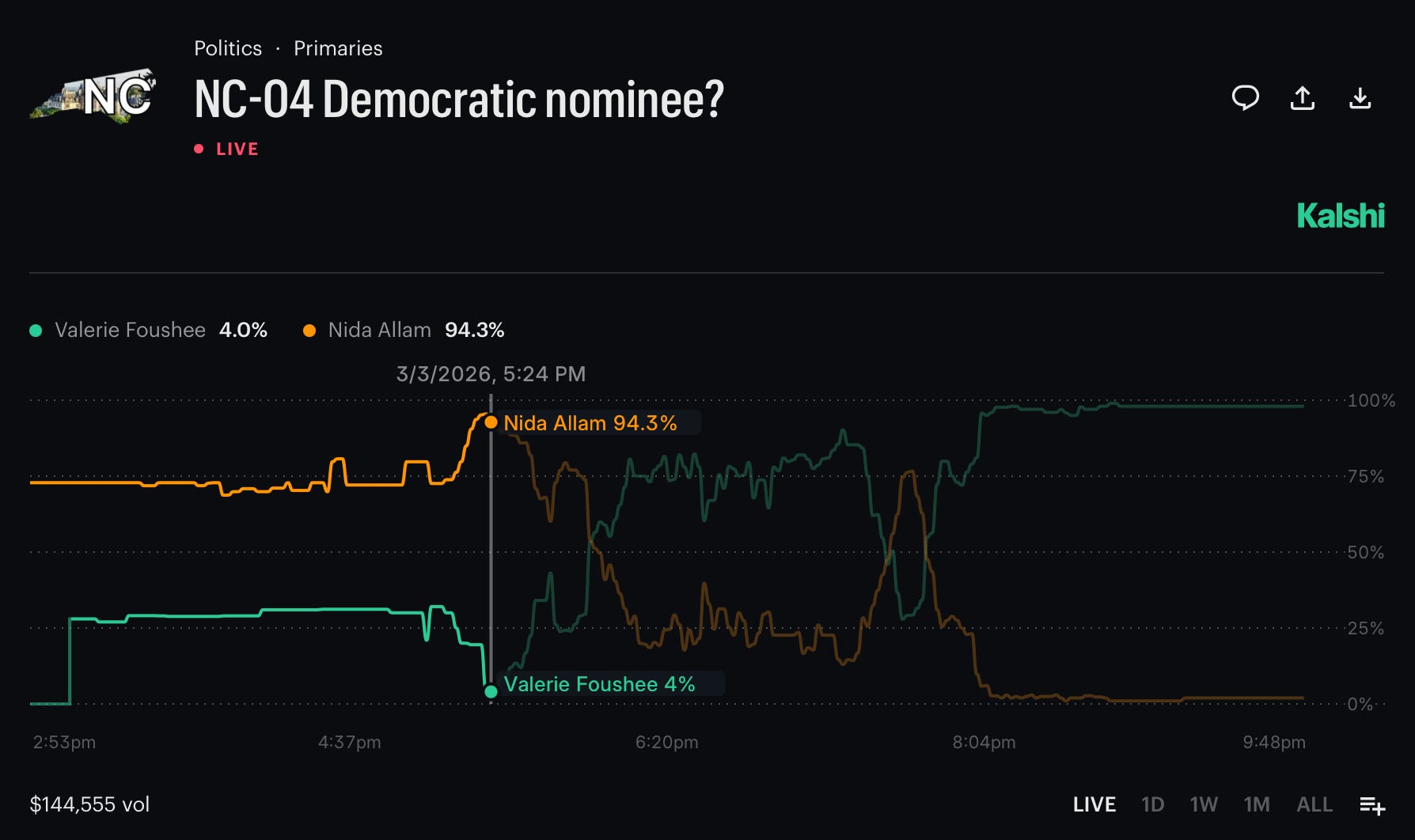
NC-04, Democrats: It appears Valerie Foushee should win this race; Kalshi had her as a big underdog on Tuesday.
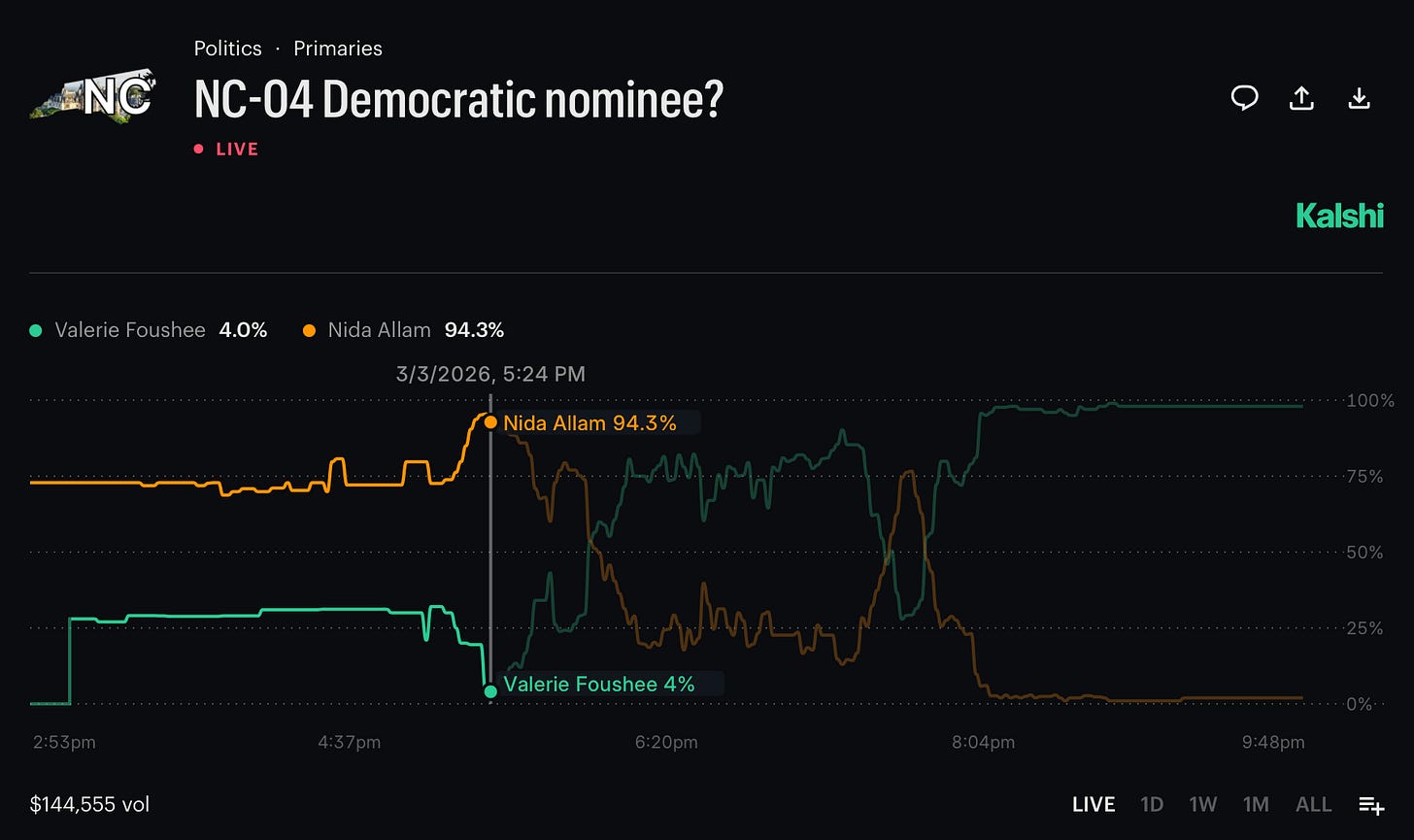
There were other races, of course — many of them not expected to be close — and favorites at Kalshi and Polymarket performed well. There was also little liquidity in many of those markets.
Who is out here betting on the Texas primary elections? (Chron): “The U.S. economy appears to be propped up by three things right now: weight-loss drugs, AI and gambling. That last one feels especially pervasive. Gambling ads are already all over sports broadcasts, and there seems to be no putting that genie back in the bottle. But now, you can gamble on everything, including the Texas Senate primary election.”


You can’t pause current events when your payments can’t keep up. With every failed deposit or lengthy withdrawal process, customers lose trust in your brand. And when money doesn’t move fast enough, your liquidity suffers. PayNearMe’s PayXMTMplatform is purpose-built for Payment Experience Management, giving you the fast, familiar payment options your customers want while streamlining back-end operations for your team. Get real-time payments for real-time events—from one simple integration.
Sportradar CEO believes company can lead the field in prediction markets data (SBC Americas): “This is a rapidly developing opportunity in the U.S. and one where we are uniquely positioned to capitalize as the B2B leader in our industry with our premium sports rights portfolio and unmatched product suite,” said Sportradar Chief Executive Officer Carsten Koerl during the company’s Q4 earnings call.
“Our focus is to monetize this opportunity while delivering the accuracy, integrity, and scale that exchanges and market makers need to grow responsibly. We can monetize best with the real-time data. The market maker segment is specifically interesting because they need real-time data to price this, and they need the models to lay the liquidity there. We are sitting on this huge knowledge, we are sitting on the liquidity, and we are sitting on the deep data in real time.”
New Prediction Market With Crypto Roots Is Making Waves in Asia (Bloomberg): “A little-known prediction market platform with Asia roots burst onto the scene late last year, but already its fast start appears to be running out of steam. Opinion Labs debuted in October and within weeks began recording notional trading volumes rivaling those of market-leaders Polymarket and Kalshi, according to user data compiled by Artemis Analytics. … But now the flywheel is faltering: Opinion’s $604 million of trades in the week ending Feb. 22 were less than half the volumes seen by Polymarket and Kalshi.”
Rolex Enthusiasts Get Kalshi Contracts to Bet on Watch Prices (Bloomberg): “Luxury watch devotees can now bet on where the price of their beloved Rolex is headed or which model Patek Philippe will discontinue. Kalshi Inc. is working with watch marketplace Bezel to create so-called event contracts tied to high-end watches as part of a push to expand betting on collectibles, according to executives at the companies. It’s the latest in a string of prediction products rolled out for goods such as sneakers and items like Labubus and Pokémon cards. The contracts allow users to trade on outcomes such as whether an item will surpass a price threshold or predict whether a brand will launch a new model.”
Watches have “been viewed as a financial market for a really long period of time, but it’s also passion-driven, and a lot of folks are just collecting because they love having something on their wrist,” Quaid Walker, chief executive officer and co-founder of Bezel, said in an interview.
Prediction Markets Have the Racing Industry’s Attention (Bloodhorse): “Churchill Downs Inc. officials in the final week of February delivered a ‘Don't tread on me,’ message to prediction markets. A similar message is expected this first week of March at a National Horsemen's Benevolent and Protective Association conference.”