


I will be at NEXTPredict in New York City this week, and I will be moderating a couple of panels. Reply to the newsletter, email dustin@closinglineconsulting.com, text, DM or send a passenger pigeon if you want to meet.
Things are contentious for prediction markets in a lot of states. But it’s gotten particularly contentious in Ohio of late, including a new letter obtained by The Event Horizon that the state’s gambling regulator sent on Tuesday.
We’ll start with more reporting around Polymarket’s lawsuit against state officials, a preemptive strike as legal and regulatory pressure mounts against prediction markets in Ohio. Here’s the latest:
Polymarket calls Ohio sports betting rules discriminatory, unconstitutional in suit (SBC Americas): “Polymarket petitioned a federal court for an injunction against Ohio in recent days, arguing that the state’s attempt to protect its online sports betting market by taking enforcement action against prediction markets is discriminatory and unconstitutional.”
“Ohio’s threatened enforcement through its protectionist licensing regime violates the U.S. Constitution’s Commerce Clause and is preempted by the Commodity Exchange Act (CEA),” reads the complaint filed Oct. 16. “On the view that lawful derivatives are sports gambling, Defendants demand that Polymarket US’s nationwide exchange contort itself to fit a state regulatory scheme designed for in-State casinos.”
From Ohio Capital Journal: “The Ohio Casino Control Commission issued cease-and-desist letters to 10 companies operating in the state that allow consumers to ‘trade’ on sporting events. Each had a deadline of Friday to respond and confirm it had shut down those markets.”
“As of the end of business on Friday, most platforms were still up and unchanged. Some of the bigger companies are airing ads during games, which Ohio Gov. Mike DeWine has seen.”
It’s a new and noticeably offensive tack from Polymarket this time, challenging Ohio’s sports betting licensing regime under the Commerce Clause. Shoot for the stars, right?
Then Tuesday: The Event Horizon obtained a sternly worded letter the OCCC sent to its sports gaming and fantasy contest licensees and applicants, warning them about providing services to prediction market operators offering sports event contracts in Ohio.
Here’s how the letter opens:
Dear Sports Gaming and Fantasy Contest Licensees and Applicants:
The Ohio Casino Control Commission (“Commission”) is deeply concerned by reports that certain Commission licensees continue to facilitate, support, or otherwise provide services to entities offering sports event contracts to persons located in Ohio without a sports gaming license. These services reportedly include, among other things, liquidity provision and market making, integrity monitoring, and equipment, data security, and other technology-related services.
The commission goes on to discuss the potential consequences of continued affiliation with “illegal” operators and demands that licensees take steps to ensure they’re in compliance:
The continued facilitation or support of illegal gambling activity, or the affiliation with illegal operators, by a Commission licensee raises significant suitability concerns. As you are aware, maintaining suitability is a continuing obligation of licensure. A licensee’s decision to provide services to, partner with or otherwise support an entity engaged in unlicensed sports gaming in Ohio reflects on the licensee’s character, integrity, honesty, and reputation. Such conduct also undermines public confidence in Ohio’s regulated sports gaming and fantasy contest markets.
The commission threatens to reopen suitability investigations and potentially suspend or revoke licenses of companies that fail to comply.
A footnote in the letter makes it clear the reach is wide:
For purposes of this guidance, the term “licensee” encompasses all fantasy contest operators; sports gaming proprietors, management services providers, mobile management services providers, suppliers, and their key employees; certified independent integrity monitors; certified independent testing laboratories; and any applicant for any of these licenses or certifications.
The regulator demands that licensees immediately cease any covered activities and gives them until Oct. 30 to notify the commission of their compliance. (emphasis added).
Accordingly, the Commission expects any licensee currently facilitating, supporting, or providing services of any kind to an entity offering sports event contracts to persons located in Ohio without a sports gaming license to immediately cease such activities.
Finally, there’s this caveat for compliance, also in the footnotes:
Licensees that are Futures Commission Merchants or Introductory Brokers that do not allow its customers located in Ohio to directly or indirectly access sports event contracts listed on Designated Contract Markets will be in compliance with this advisement.
Meanwhile, new bills regarding prediction markets could appear in the state legislature this session or next.
From Legal Sports Report: “Ohio lawmakers and regulators are both trying to rein in prediction markets, and the platforms are brushing off both.”
“[Sen. Bill] DeMora has introduced two bills, but there is little time to get them passed by the end of session on Dec. 17, and bills do not roll over to 2027. SB 430 would classify sports event contracts as sports betting, subjecting them to the same state regulations as sportsbooks. SB 479 would ban election contracts.”
Ohio is fast becoming one of the busiest battlegrounds in this fight between states and prediction markets, with both sides continuing to take potshots at each other in the media while trading more meaningful blows in federal court.

You can’t pause current events when your payments can’t keep up. With every failed deposit or lengthy withdrawal process, customers lose trust in your brand. And when money doesn’t move fast enough, your liquidity suffers. PayNearMe’s PayXMTM platform is purpose-built for Payment Experience Management, giving you the fast, familiar payment options your customers want while streamlining back-end operations for your team. Get real-time payments for real-time events—from one simple integration.
The Event Horizon briefing
A quick look at what matters most in prediction markets.
📍 The Big Story
Utah sues Kalshi, saying it’s ‘the manager of a back-alley gambling den’ (Salt Lake City Tribune): “Utah is suing Kalshi for what the state calls a ‘brazen pattern of unlawful conduct’ and is asking a judge to order the company to stop offering wagers in the state.”
“The lawsuit follows a legal dispute with Kalshi, which tried to settle the question earlier this year when it preemptively sued Utah, alleging the federal government’s Commodity Futures Trading Commission has authority over the markets Kalshi runs.”
“In August, a federal judge ruled for the state in its case against Kalshi, further advancing Utah’s ability to regulate prediction markets in the state. In response, Kalshi appealed the decision to the U.S. Circuit Court of Appeals.”
🔍 The state is taking something of a novel approach by including the liquidity providers at Susquehanna as defendants.
 Daniel Wallach@WALLACHLEGALMAJOR UPDATE: Two Susquehanna trading firms have also been named as defendants in Utah’s civil enforcement action against Kalshi. This marks the first state AG civil enforcement action targeting prediction-market market makers.
 Daniel Wallach @WALLACHLEGALBREAKING: Utah sues Kalshi for a “brazen pattern of unlawful conduct,” seeks injunctive relief to block in-state wagers and an order to recover “the millions it’s made through fees from wagers Utahns placed and that residents have lost through wagers.” https://t.co/rQ482xEY6D4:07 PM · Oct 20, 2026 · 14.7K Views4 Replies · 11 Reposts · 85 Likes
Complaint here (via Utah News Dispatch).
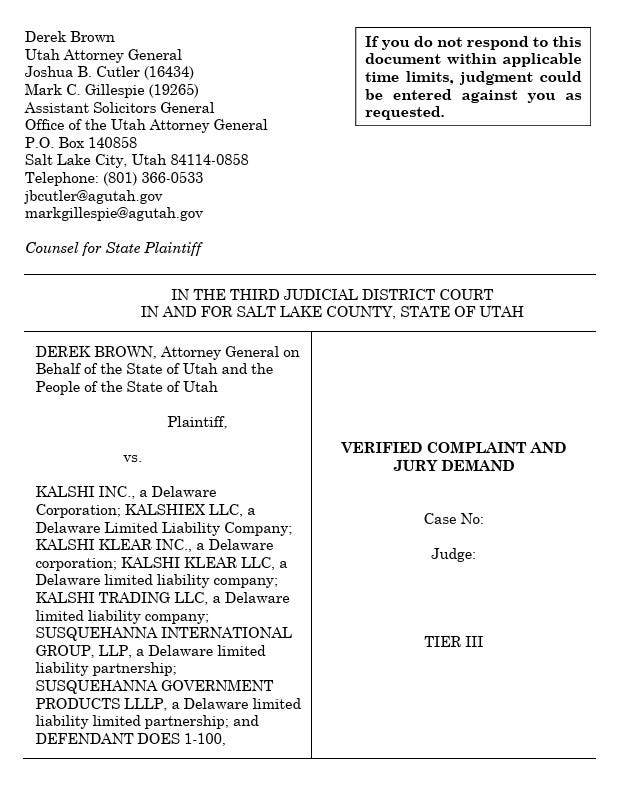
Video | Utah Attorney General Derek Brown announces legal action involving online gambling:


🔭 What To Watch For
Public comments.
CFTC Makes Regulations on Swap Definitions Available for Public Comment (DeFi Rate): “The Commodity Futures Trading Commission has posted its latest regulations concerning the definition of ‘swaps’ under the Commodity Exchange Act. The rules are available for public comment until Nov. 18, 2026.”
“In their current form, these regulations exclude ‘casino-style gambling products’ from swaps classification … . As decisions are pending at the Supreme Court of the United States, these regulations could factor into those proceedings.”
🔍 The interim final rule is already in effect.
🔥 Hot Market
Super Bowl Halftime Show Headliner(s) (KXSUPERBOWLHEADLINE):
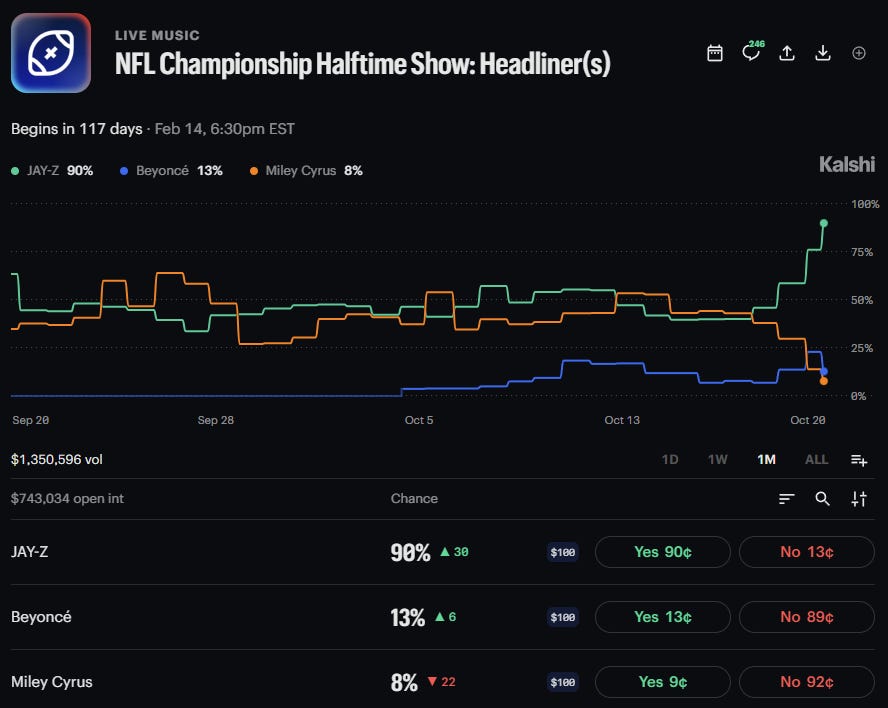
Recent movement coincides with a report from The Puck early Tuesday morning:
Jay-Z Picks Jay-Z for Super Bowl LXI: “After weeks of handwringing, Jay-Z, the chief decision-maker on who plays the Super Bowl halftime show, has finally picked the artist who will take the stage in L.A. in February: himself. That’s according to multiple sources, who say the pick has long felt inevitable and more compelling than Miley Cyrus and Justin Bieber, both of whom were considered for SBLXI. Besides, a Jay-Z performance is the natural next step in the $5 million-a-year deal his Roc Nation signed with the NFL in 2019—and re-upped in 2024— to curate and produce the halftime show.”
One of the knock-on effects of the normalization of prediction markets (and the many allegations of insider trading) is that news like this always will make some people wonder if anyone profited from the information before it was known to the public.
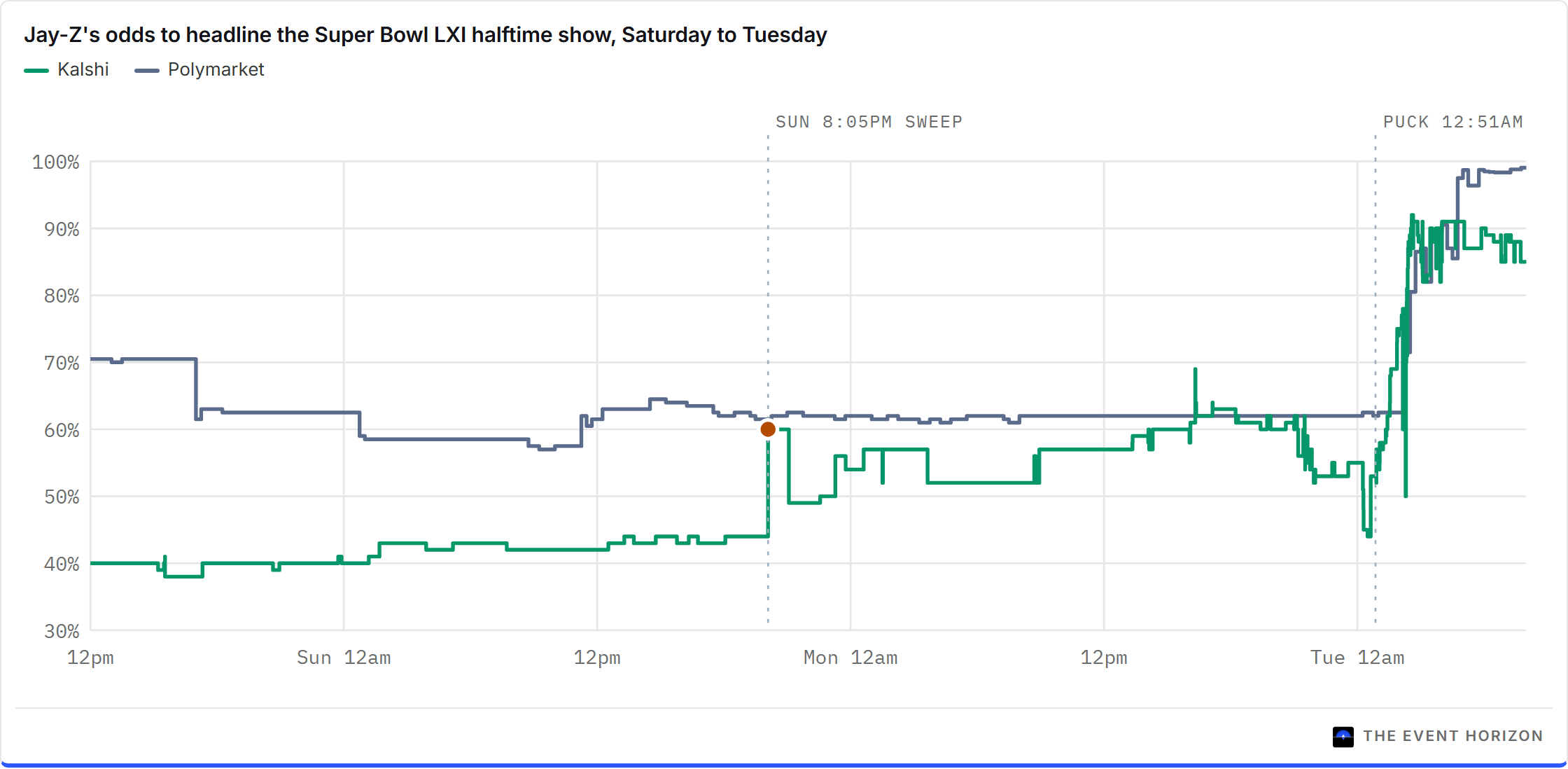
It’s by no means cut and dried here, but trading records do show a sweep that cleared all resting Jay-Z orders between 44¢ and 60¢ almost 30 hours before The Puck published its story — a total of 2,058 contracts across 14 simultaneous buys.
The transaction was bracketed by two large sells for Miley Cyrus totaling 3,275 contracts, pushing her price down from 44¢ to 33¢ in the process.
Kalshi’s tape doesn’t identify the individual accounts that execute these trades, so it’s impossible to separate a coincidence from a correlation. But it sure is interesting to look at!
Polymarket’s similar “To Perform” market meanwhile showed no visible reaction to the story until more than an hour after its publication.
💬 Quote/Tweet Of The Day
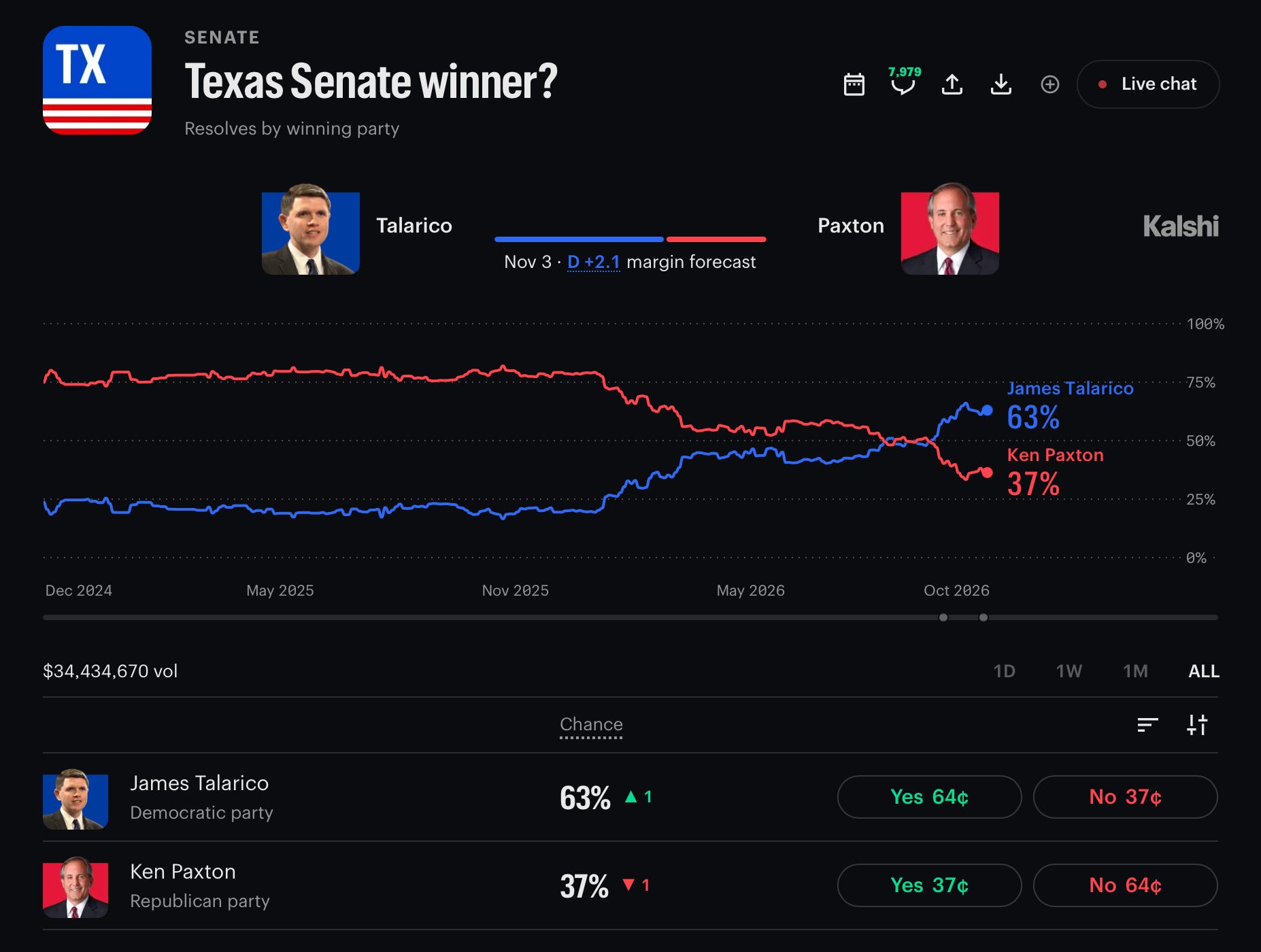
“It's interesting how little the early voting data seems to move the prediction markets. I've seen people on here say that the Texas voting has either been terrible or excellent for Talarico, yet the people with money on the line don't seem to ascribe any signal to it.”
— Joe Weisenthal (via Twitter/X)
The odds have moved a little of late. Kalshi:
Polymarket:
📝 New Markets
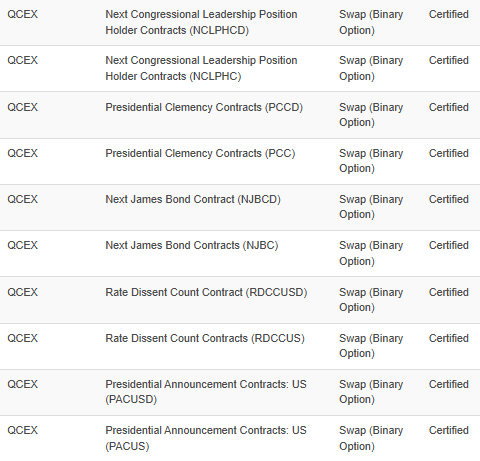
Filings for new markets listed with the Commodity Futures Trading Commission:
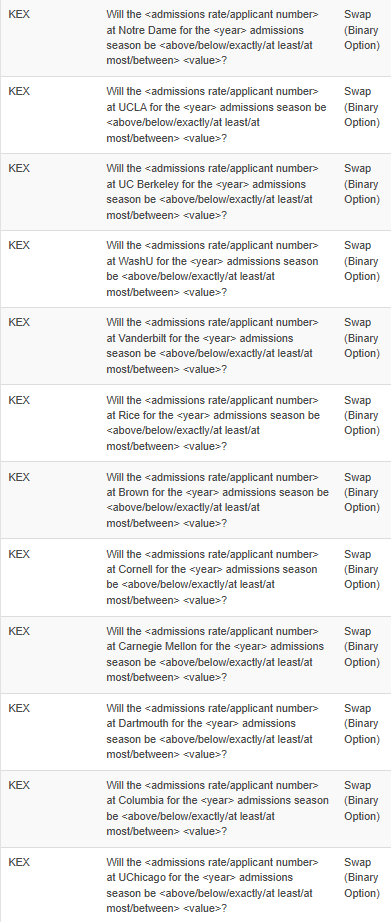
Kalshi: College admission levels and a crude oil perp:

Polymarket US: Political, financial, and James Bond markets
Gemini: College basketball

📊 Volume Tracking For Monday, Oct. 19
Kalshi volume: $2.50 billion
Parlays: 65.2% of volume
Sports: 16.6% of volume
Crypto: 14.9% of volume
Trend line:
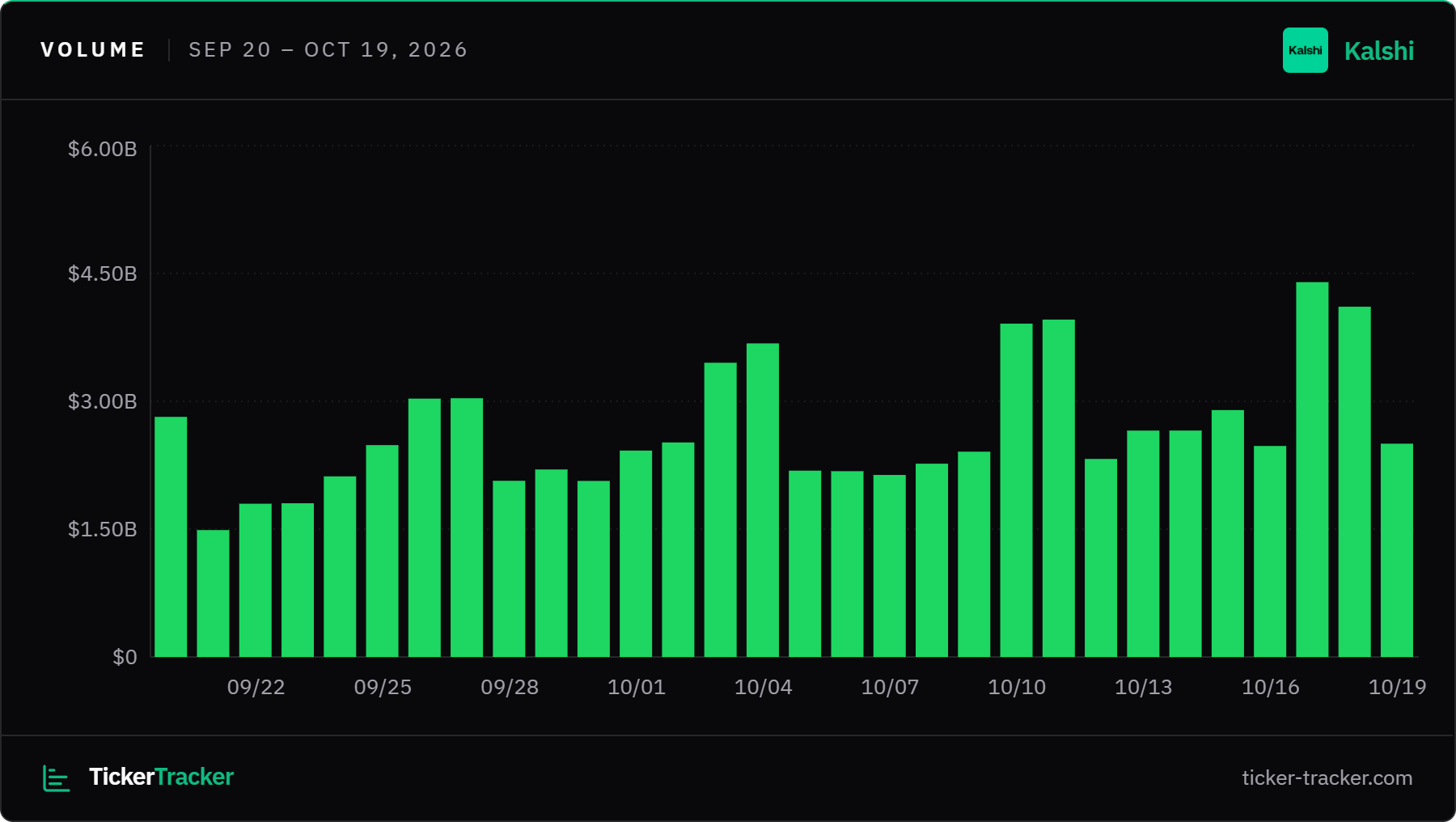
Trailing seven-day volume (Oct. 19) on exchanges:
Kalshi: $21.7 billion
Polymarket US: $3.24 billion
DraftKings’ DKeX: $1.05 billion
Novig: $728 million
CDNA: $557 million
Underdog Exchange: $397 million
Rothera: $263 million
ProphetX: $75.5 million
Data is provided by TickerTracker.

News roundup
Everything else important that happened in or was written about prediction markets:
🚨 Important stuff
Cruz Bill Would Allow State Jurisdiction Over Prediction Markets (Bloomberg | $): “Sen. Ted Cruz (R-Texas) plans to introduce legislation after the midterms aimed at prohibiting federally regulated prediction markets from skirting state gambling laws.”
“Cruz’s legislation would prevent prediction markets from providing event contracts tied to gambling activities — including sports betting — unless it is authorized by a state or a tribal government, according to details of the bill obtained by Bloomberg Law.”
Source: Prediction market ads not expected on NBC’s NBA openers (SBJ): “The Kalshi, Polymarket and Novig TV ads that have aired across high-profile MLB postseason games in recent weeks will not find their way onto NBC’s season-opening NBA telecasts on Tuesday, a source told SBJ, indicating that the league will enter the season with the door still closed to deals with prediction market operators.”
Private Jets, Investor Pressure Push Polymarket CEO to Grow Up (Bloomberg | $): “Interviews with people familiar with Polymarket’s operations reveal a broader effort, extending beyond Coplan’s spending habits, to bring greater discipline to a business built around the founder’s youthful entrepreneurial instincts. Some of the changes investors have sought are already in place. But the effort to turn a founder-driven startup into a mature financial exchange has suffered a number of setbacks and continues to frustrate even some prominent backers.”
Polymarket Pressured into Removing Predatory “Cornell 7” Prediction Event (press release): UltraViolet, a national women-led gender-justice organization responsible for numerous impactful campaigns that create a cost for tech-enabled sexism and sexual violence, released the statement below following reports that prediction market platform Polymarket had removed a market allowing users to bet on the outcome of the horrific “Cornell 7” sexual abuse case in which a former university student, known as Jane Doe, accused seven fraternity members of drugging and brutally gang-raping her.
Ultraviolet’s petition launched last week drew immense public scrutiny to Polymarket’s disgusting practices and called on Polymarket’s high-profile celebrity ambassadors to cut ties with the platform.
“This is a victory for survivors. By allowing its users to gamble on the ‘Cornell 7’ case, Polymarket was essentially gamifying gang rape and profiting from the pain of courageous survivors like Jane Doe,” said Jenna Sherman, Campaign Director at UltraViolet. “The fact that over $450,000 went into betting on the outcome of an alleged gang-rape is a stain not just on Polymarket, but also its many celebrity ambassadors—like Lebron James, Sue Bird, and Emily Ratajkowski—who are legitimizing and profiting off of the platform’s morally indefensible practices.”
Hyperliquid Policy Center Urges the SEC to Adopt Regulation Crypto Assets with Five Refinements (Twitter/X): Our comment asks the SEC to take five steps:
Codify the airdrop analysis in the final rule text, and anchor it to whether a recipient gave tangible and definable consideration.
Address secondary trading and intermediary status directly, so that tokens distributed under the exemptions can trade freely from the outset. The SEC should provide clarity for persons and onchain protocols that facilitate secondary market trading.
Make the safe harbor usable without a tacit admission of prior investment-contract or issuer status, and extend its protection to projects whose essential managerial efforts are still underway. Filers should be able to certify instead that their token was never tied to an investment contract in the first place.
Incorporate the SEC staff’s buyback guidance into the final rule or adopting release, harmonize the “central party” concept, and distinguish programmatic buybacks from discretionary ones. Dispersed validators, network participants, and users should not count as a controlling “group” merely because their incentives align.
Make federal preemption durable, so that it survives a project’s satisfaction of the safe harbor. As proposed, preemption would end at that point, exposing tokens to registration regimes in more than 50 jurisdictions and giving projects a reason to delay finishing their work.
Developers who launched abroad or turned American users away did so because they could not tell how U.S. law applied to them. A final rule with these refinements would give them a reason to build here. We are focused on ensuring that Americans can access onchain markets under U.S. rules, and we will continue engaging with the SEC and its staff as the Commission finalizes the rule.

⚖️ Legal and regulatory
From CFTC Chairman Mike Selig:
 Mike Selig@ChairmanSeligFinancial market protections shouldn’t vary from state to state. The @CFTC’s federal regulatory system mandates consistent market-based standards across the country, so Americans have the same safeguards and rights regardless of where they place a trade. @Bankless
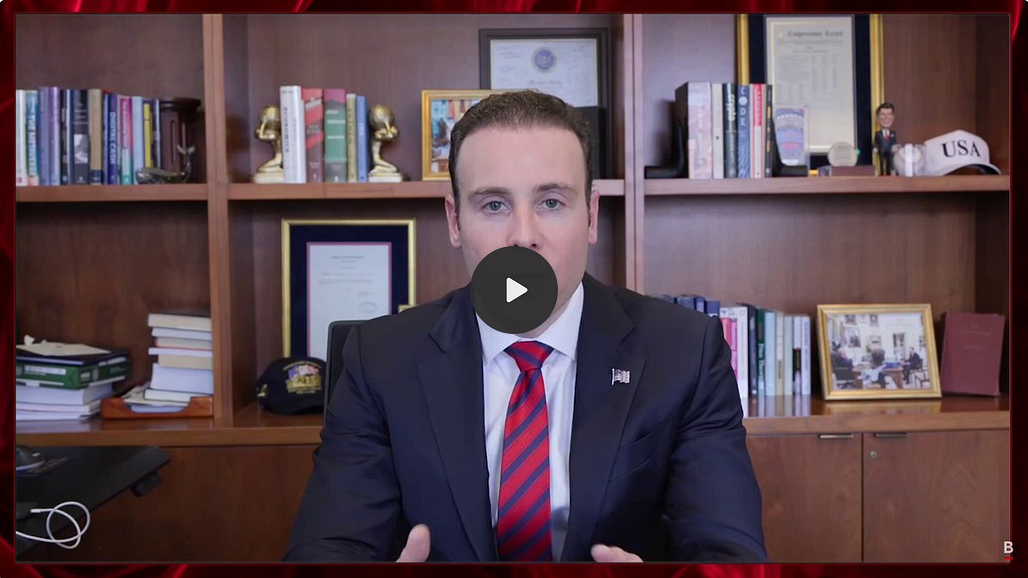 1:59 PM · Oct 20, 2026 · 10.1K Views22 Replies · 70 Reposts · 390 Likes
Notable:
 Dustin Gouker@DustinGoukerInteresting to note that the MAGA hat is gone from the CFTC chairman’s background. Today and from March.
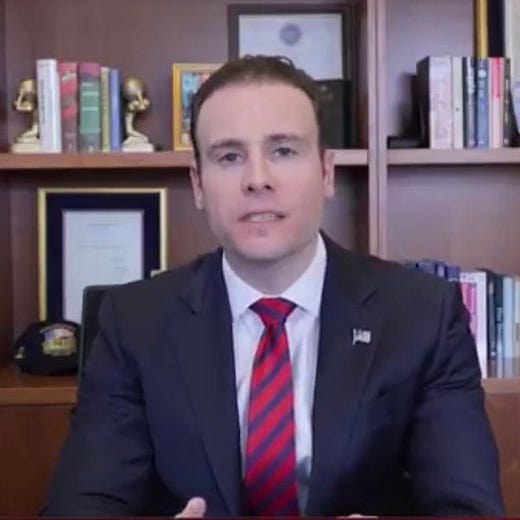
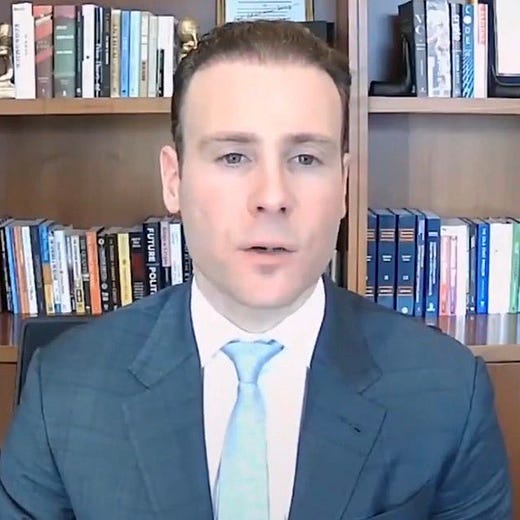 10:02 PM · Oct 20, 2026 · 7.64K Views2 Replies · 1 Repost · 32 Likes
Also sort of related:
 Joe Weisenthal@TheStalwartI asked @CMEGroup CEO Terry Duffy if, in his view, there are literally any laws anymore when it comes to financial regulation.
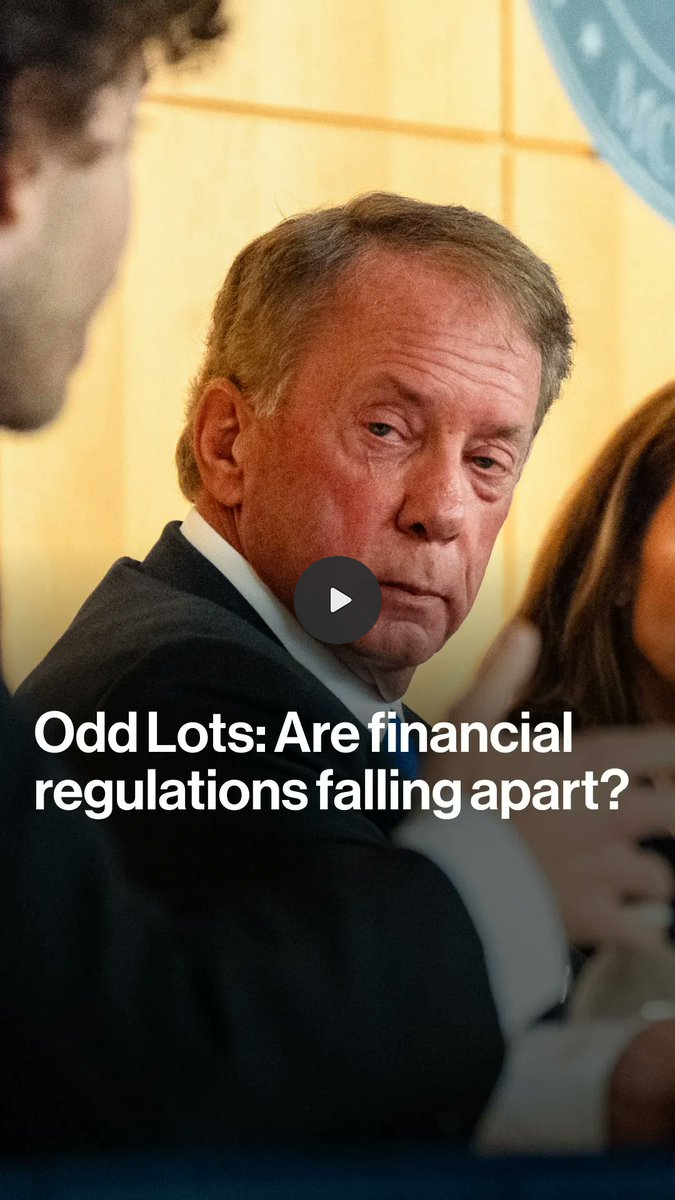 3:45 PM · Oct 20, 2026 · 65.3K Views17 Replies · 41 Reposts · 271 Likes
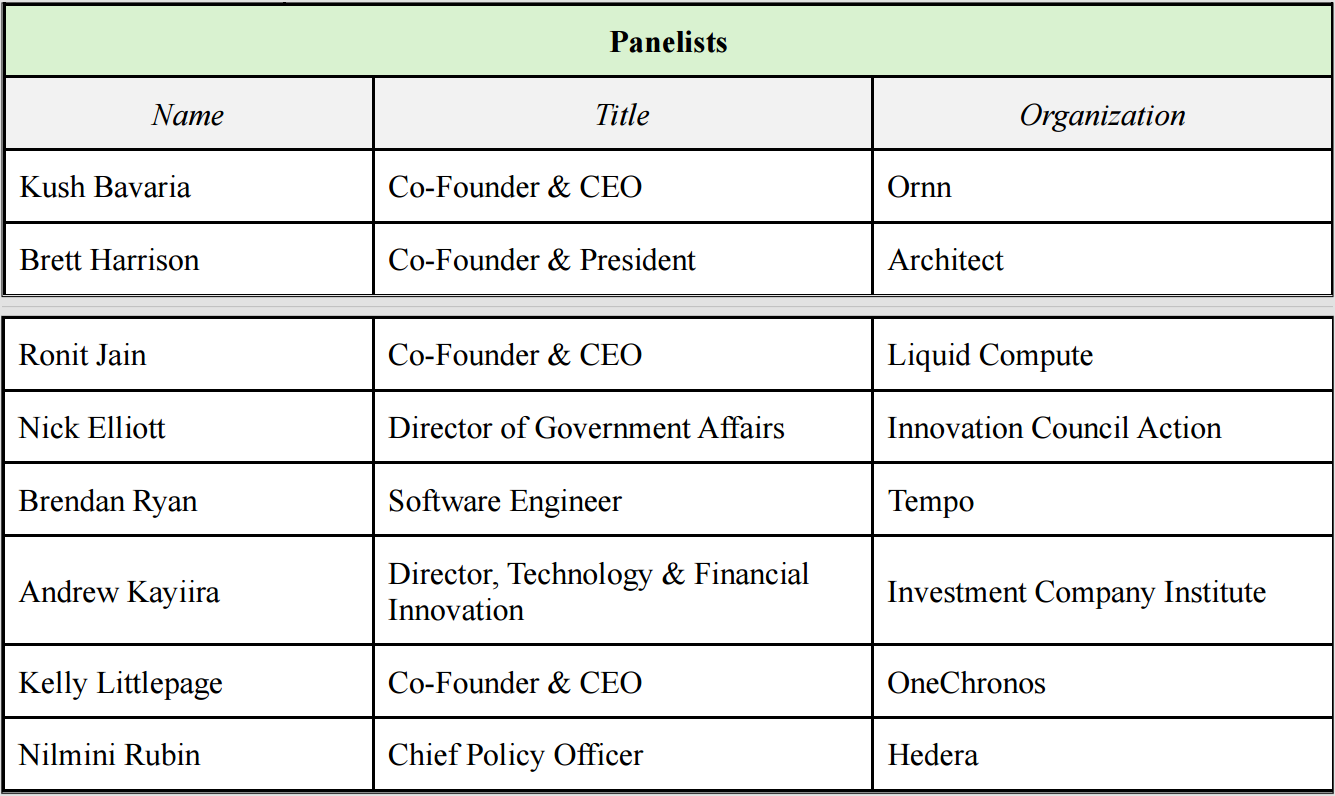
CFTC’s Innovation Task Force Announces Agenda & Panelists for Inaugural Frontier Forum on Super Intelligence (press release): The CFTC’s Innovation Task Force today released the agenda for the inaugural Frontier Forum on Super Intelligence.
Attendees will discuss how SI is being implemented on the frontier, the impact that SI and its proliferation will have on U.S. markets, and the Commission’s role in fostering responsible SI adoption and innovation while protecting market participants from novel and emergent risks.
“Super intelligence is poised to transform our financial markets,” said Chairman Michael S. Selig. “Through this inaugural Frontier Forum, we are bringing together leaders at the intersection of technology and finance to explore the opportunities and risks of super intelligence and help shape the next frontier of American financial innovation.”


📣 Industry news
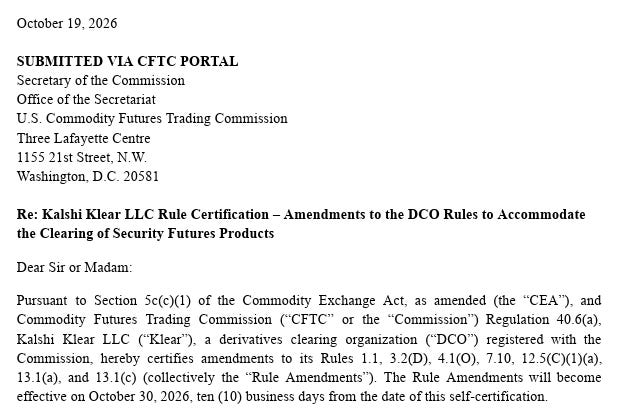
Kalshi advances stock perps amid CME, Nasdaq, Cboe objections (NEXTPredict): “In an Oct. 19 filing with the Commodity Futures Trading Commission (CFTC), Kalshi Klear outlined changes to accommodate what it described as the “upcoming clearing of security futures products.” The amendments address clearing-member eligibility, customer-fund protections and collateral treatment, with an intended effective date of Oct. 30.”
“The move comes amid opposition from more established exchanges. CME Group, Nasdaq and Cboe filed objections with the Securities and Exchange Commission (SEC) on Oct. 14, arguing that perpetual stock contracts should be classified as security-based swaps rather than security futures.”
Prediction Markets Trail Sportsbooks In Key Growth Metric, Stifel Finds (Legal Sports Report): “Prediction markets generated more than $82 billion in trading volume in September, but growth trailed traditional sportsbooks when measured on a more comparable basis, according to research from Stifel.”
“Of that total, $76.7 billion came from federally regulated prediction markets, up 64% from August. But using a measure more closely resembling sportsbook handle, Stifel estimated trading grew 27%, compared with a 43% month-over-month increase in regulated sports betting handle in states that have reported results so far.”
“Stifel said the slower growth could signal earlier-than-expected market saturation and customer turnover, despite companies like Kalshi and Polymarket spending heavy on user acquisition and product improvements.”
Risk Of Manipulation, Logistics Drive Availability Of College Football Player Props On Prediction Markets (InGame): “Kalshi’s trading volume continues to set new records on a near-weekly basis, but one potential accelerant is still missing from its menu, and from most of its competitors’ menus: player proposition markets on college football.”
“On that point, a Kalshi spokesperson told InGame: “We don’t offer [college football player props] because they’re subject to manipulation.”
More fees for parlays at DKeX (DraftKings):
 PredictionMarketPulse@PredMP'@DraftKings exchange (DKeX) filed two CFTC submissions today that change what it charges, both effective Nov 2: 1. Maker fee rate on Combination Contracts (multi-leg) doubles at every price. Coefficient 0.035→0.07, max $0.0175 per contract at $0.50. Taker fees unchanged.…7:04 PM · Oct 19, 2026 · 1.56K Views4 Likes

📖 Everything else
New ‘King Blocker’ promo renews Dillon Brooks-LeBron James rivalry (AZ Central | $): “Kalshi has Brooks in a 30-second commercial promoting ‘King Blocker 9000,’ a device that'll block any mention of James' name and his nicknames.”
“The commercial is set to run eight days on TV, streaming platforms and social media beginning Tuesday, Oct. 20 on opening day of the 2026-27 season.”
 Tarek Mansour@mansourtarek_you can also use this to block Kalshi ads cc @allanmaman
 Dillon Brooks @dillonbrooks24Thanks for inventing this, @Kalshi6:20 PM · Oct 20, 2026 · 48.9K Views21 Replies · 33 Reposts · 650 Likes
Novig nears $4bn lifetime volume as NFL doubles, combos top 50% (NEXTPredict): “Novig’s weekly NFL trading volume reached $123.0m in Week 6, slightly more than double its opening-week level, although growth slowed to 0.9% from the previous week. The increase extended a football-led expansion that had already pushed baseball into second place among the exchange’s individual sports categories during September.”
“Through the first 19 days of October, sports trading averaged $49.7m a day, up 80.4% from September. Football alone averaged $32.7m daily, exceeding September’s daily average across all individual sports markets combined.”
From Substack:
Prediction markets are now ‘bespoke insurance’ for businesses, and a Los Angeles restaurant group’s $60,000 hedge on Kalshi is the latest example (Fortune | $): “One Los Angeles restaurant group traded $60,000 on Kalshi to hedge against the Dodgers’ abbreviated playoff run, and it’s just one example of how prediction markets are transforming how companies, particularly small businesses, are calculating and responding to risks.”
“Kalshi told Fortune that the hospitality group, which was unnamed but operates 25 bars, including several near Dodger Stadium, made the trade on the platform if the city’s MLB team did not advance to the World Series. The Dodgers lost in the NLCS to the Milwaukee Brewers last week, and the position returned almost twice the original bet. The stake helped the business make up for the revenue it would have gotten had the Dodgers played more playoff games.”


