

This newsletter was sent to 3,189 subscribers who want to keep up with developments in the prediction market industry.
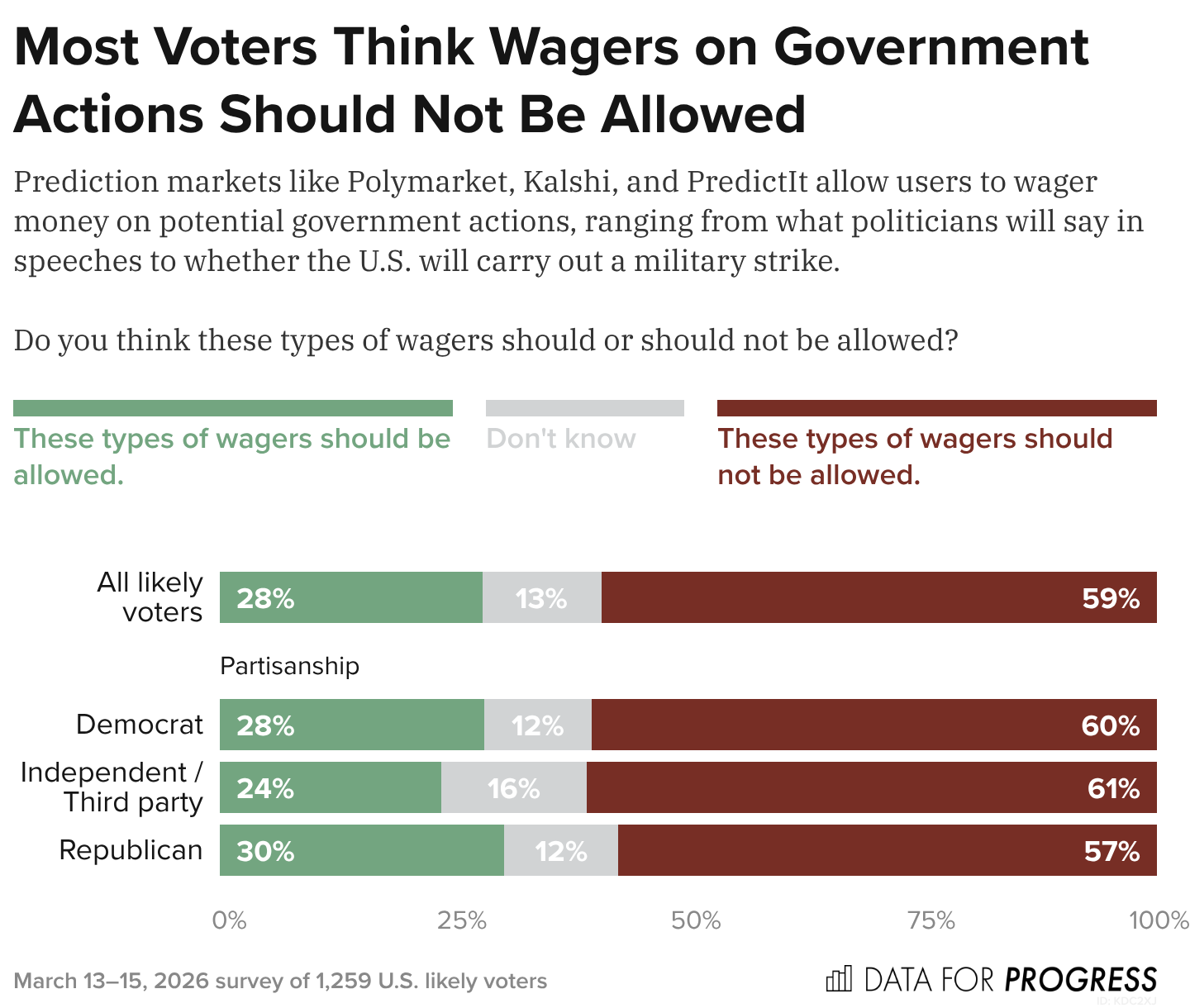
We’re learning more about what Americans think of prediction markets with each passing day. And a new poll says that a majority of likely voters oppose betting “on potential government actions, ranging from what politicians will say in speeches to whether the U.S. will carry out a military strike.”
There’s also a lot of support for banning politicians from trading on prediction markets, according to polling conducted by the progressive think tank Data for Progress. Here are some excerpts:
A majority of voters (59%) agree that wagers on potential government actions…should not be permitted. This skepticism is consistent across party lines — 60% of Democrats, 61% of Independents, and 57% of Republicans say these wagers should not be allowed. …
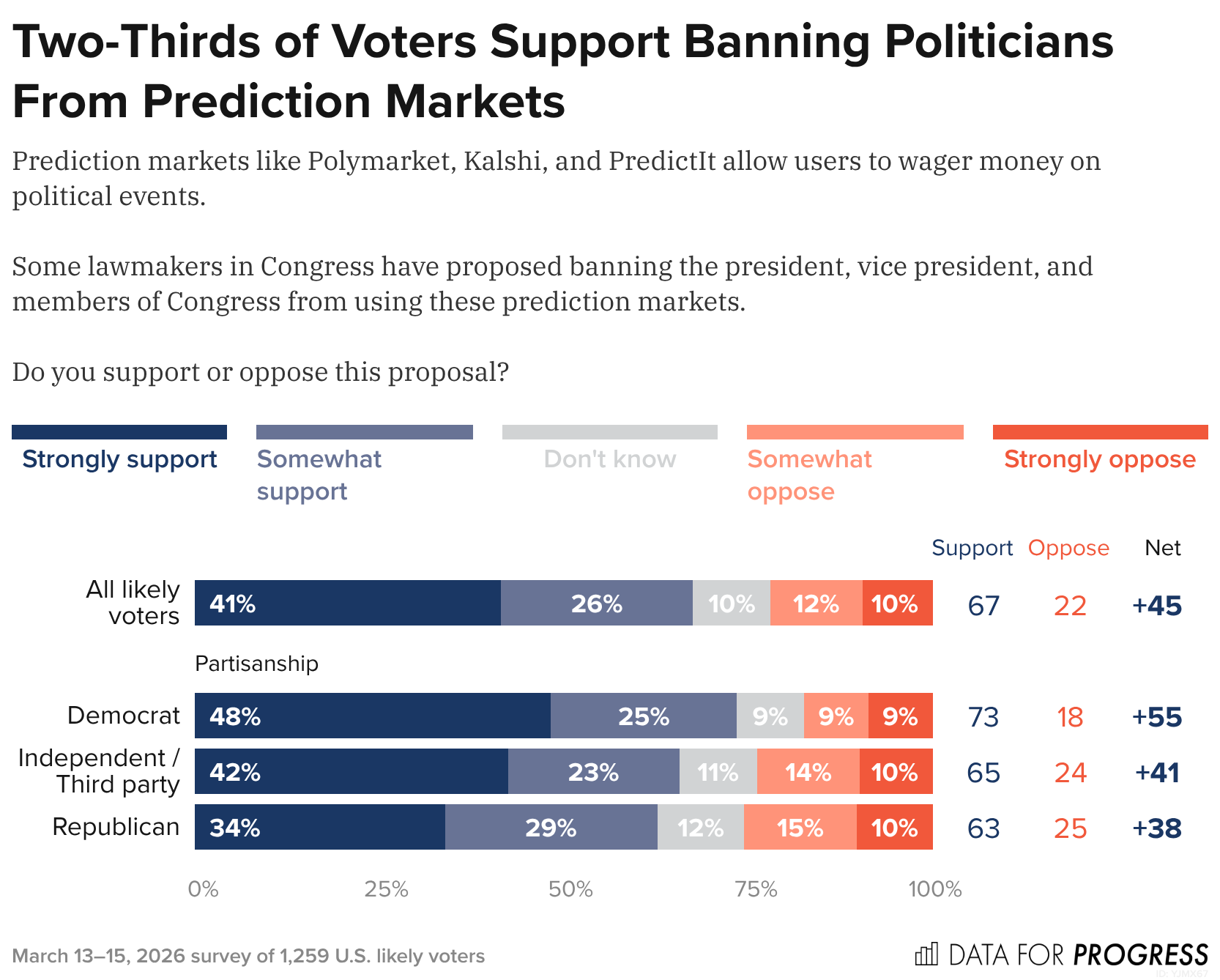
Voters also show strong support for barring the president, vice president, and members of Congress from using prediction markets. Two in three voters (67%) support such a ban, including 73% of Democrats, 65% of Independents, and 63% of Republicans. …
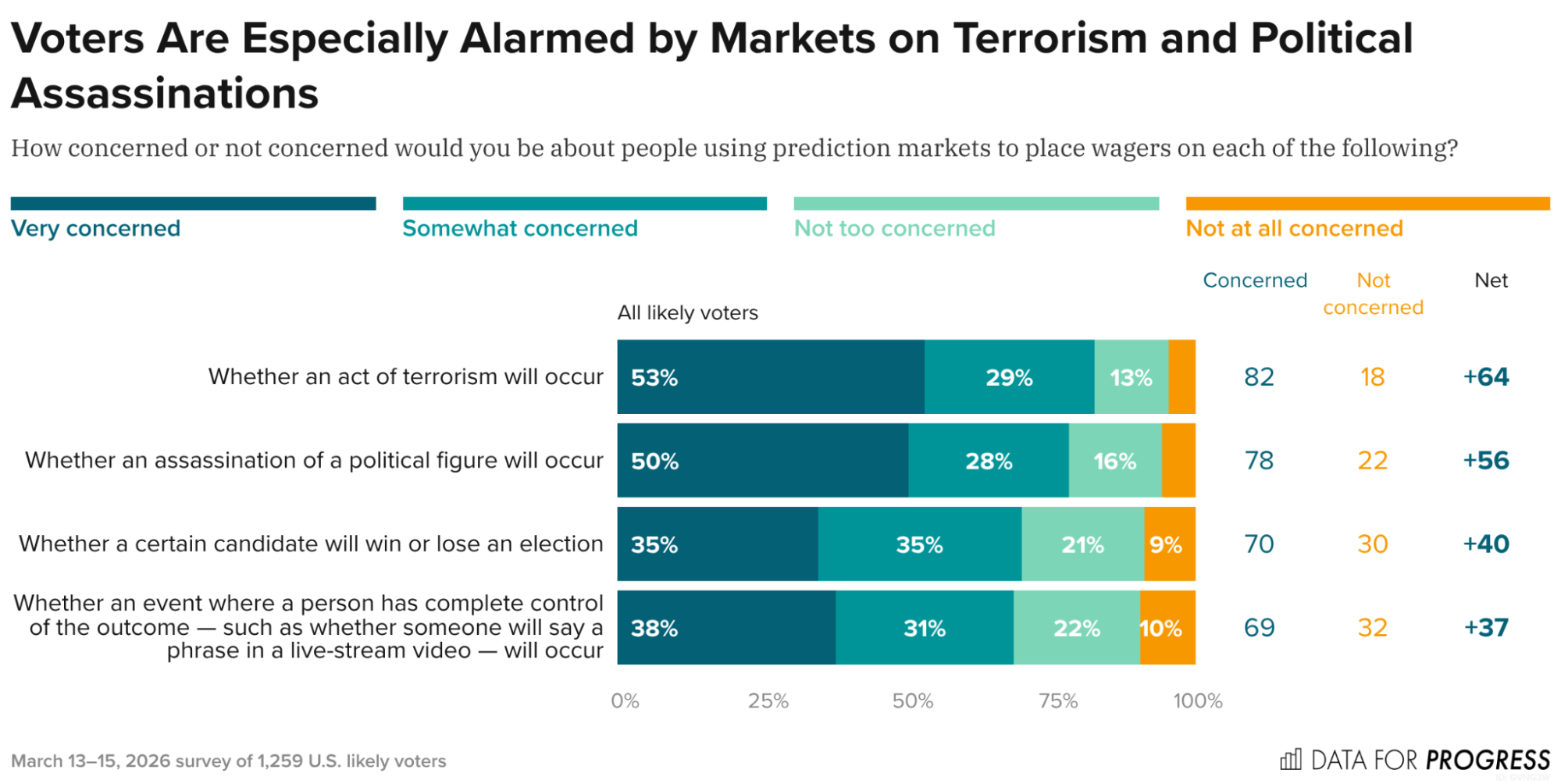
Interestingly, the poll also found that election betting is a cause of concern among voters:
Voters are also concerned about markets that let users bet on whether a candidate will win or lose an election (70% concerned) and markets covering events where a person has complete control of the outcome (69% concerned).
Here’s more data from another recent poll, conducted by Kalshi investor Paradigm:
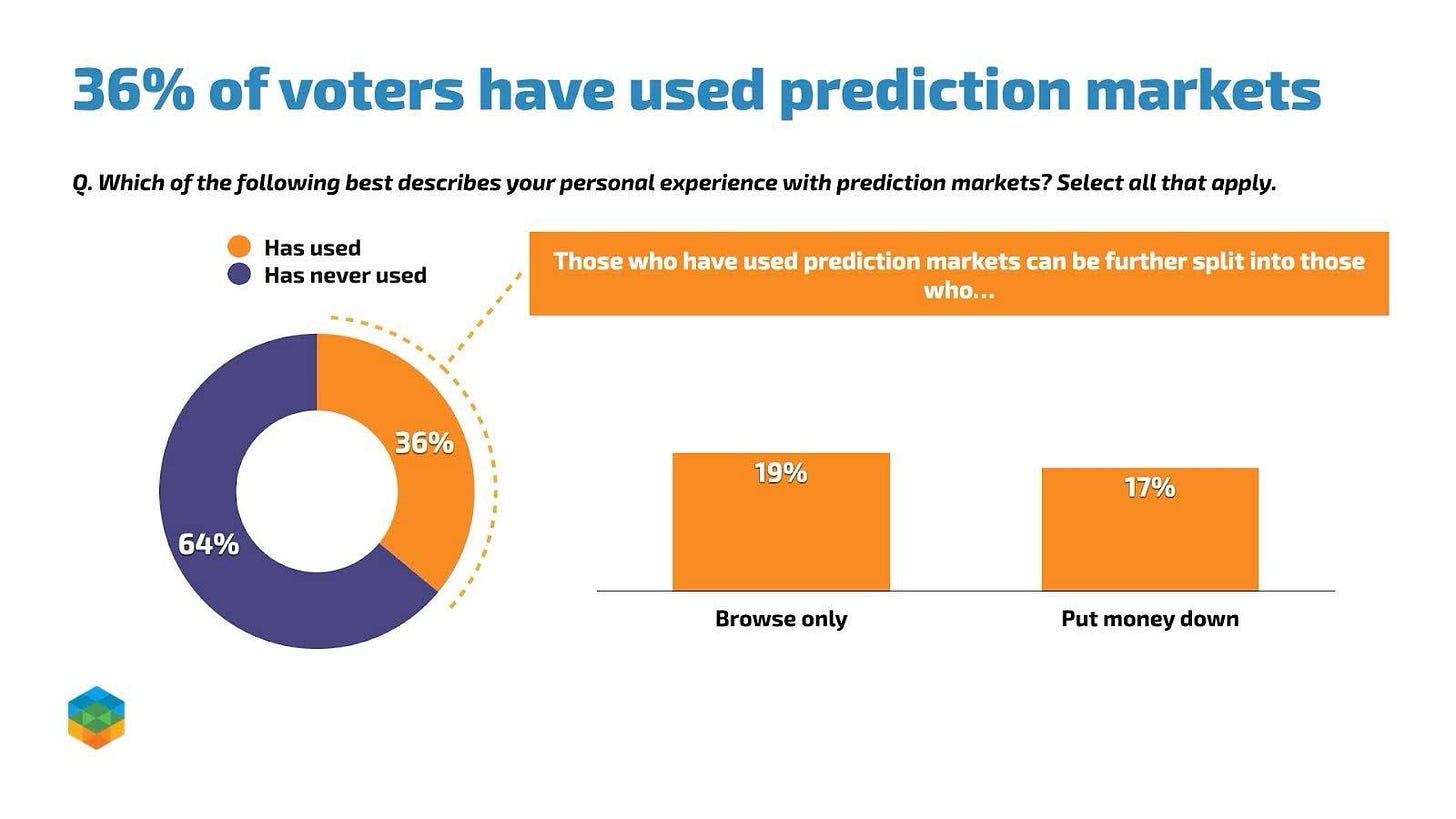
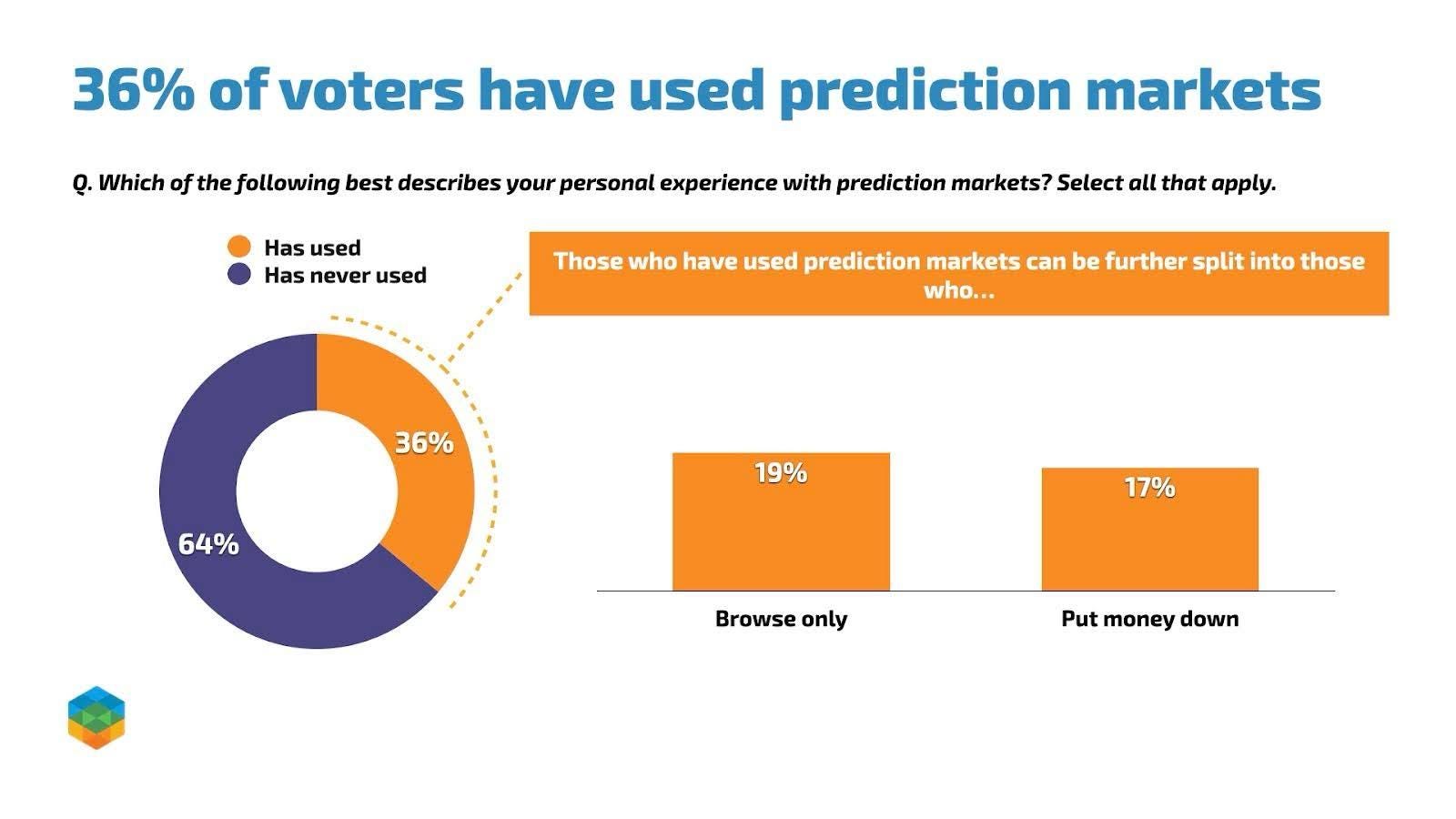
Paradigm February 2026 Poll on Prediction Markets (Paradigm): Over one-third of voters already use prediction markets, whether it’s to check the forecasts or trade. That’s the top finding of our new poll on prediction markets, and yes, this was a surprise even to us. … TLDR: Tens of millions of Americans use prediction markets, Americans want prediction markets regulated but not banned, and Americans’ views of them are still up for grabs.
For this poll, we worked with Echelon Insights to poll 1000 U.S. Likely voters between February 13th and 18th, with the poll entering the field a few days after the Super Bowl to give the electorate time to digest any ads and commentary on these markets around the game. A more detailed methodology summary can be found below.
36% of voters already use prediction markets, and that number should change the entire regulatory conversation. When asked what best described their personal experience with prediction markets, 11% of respondents said they put money on outcomes with them, and 19% said they browse the odds for information but don’t put money down, and 6% say they do both. This is far higher usage than we expected.
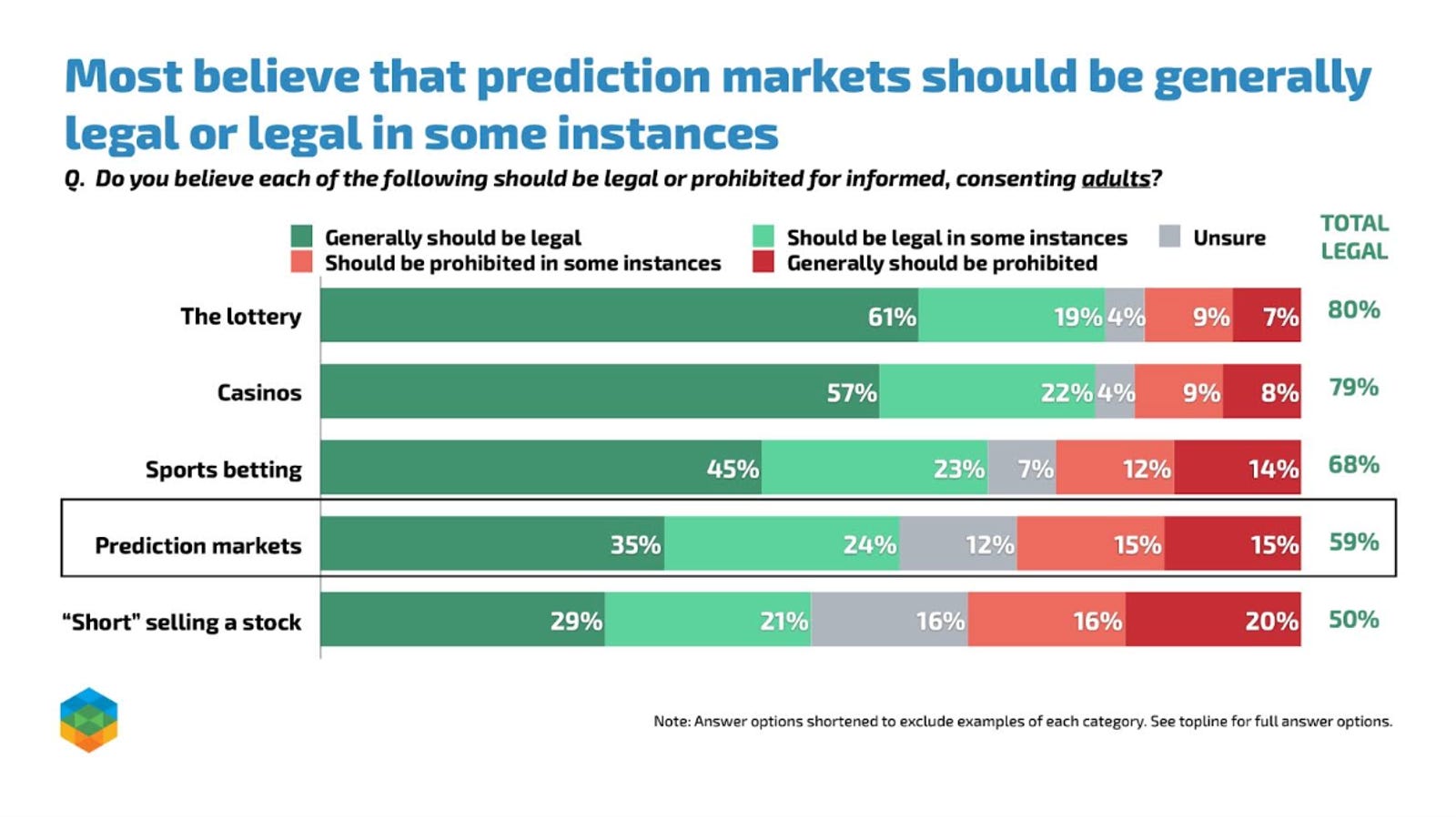
Most Americans want prediction markets to be legal but regulated. 35% of respondents felt prediction markets should be legal. A plurality of respondents had mixed views, with 24% saying they should be legal in some instances and 15% saying they should be prohibited in some instances, such as for war and terror contracts. But respondents are more supportive of prediction markets than short selling, which 20% of respondents say should be generally prohibited, but just 29% say should be generally legal.
More on the poll from me at The Closing Line:

Prediction markets roundup
 Emanuel (Mannie) Fabian@manniefabianGamblers trying to win a bet on Polymarket are vowing to kill me if I don’t rewrite an Iran missile story This is my account:timesofisrael.comGamblers trying to win a bet on Polymarket are vowing to kill me if I don’t rewrite an Iran missile story11:26 AM · Mar 16, 2026 · 1.17M Views149 Replies · 960 Reposts · 4.14K Likes
Polymarket responded pretty quickly after the report:
 Polymarket@PolymarketPolymarket condemns the harassment & threats directed at Emanuel Fabian — or anyone else for that matter. This behavior violates our Terms of Service & has no place on our platform. We've banned the accounts for all involved & will pass their info to the relevant authorities.8:03 PM · Mar 16, 2026 · 204K Views152 Replies · 146 Reposts · 1.5K Likes
💡My take: It feels like we are just starting to realize some of the second-order effects of the existence of prediction markets. The athlete harassment issue in sports betting has now crossed over to other things you can bet on. I’m hoping I can pull together more thoughts on this later this week.
JPMorgan Is Considering New Prediction Market Guidance for Employees (Barron’s): “JPMorgan Chase is reviewing company policies to determine whether it should add new guidance around employees’ participation in platforms such as Kalshi and Polymarket, people familiar with the matter said. Separately, the bank, which has a vast trading business, has no current plans to hire traders of its own to bet on prediction markets, according to the people.”
‘Grooming our kids’: CA lawmakers target sports betting apps, prediction markets (Sacramento Bee): “A new law put forward by Bonta, Assemblymember Pilar Schiavo, D-Chatsworth, and Common Sense Media would prohibit fantasy sports wagering apps and prediction market apps from advertising specifically to minors or allowing them to use their services. Lawmakers say these companies are normalizing gambling and sports betting, which is illegal in California. …
“You can call it whatever you want, but when people are risking real money on outcomes of events, that’s gambling,” said Schiavo. “These multi-billion dollar corporations are, in fact, grooming our kids to be gamblers for life.”
💡My take: It’s still not clear that passing new state-level bans will accomplish anything in the short term, as the existing court cases are about federal preemption of state law. But policymakers seem like they are going to keep trying in lots of states anyway.
Illinois regulators say prediction markets are illegal gambling, but bettors — and the Trump family — love them (Capitol News Illinois): “DePaul University assistant law Professor Karl Lockhart, who has studied prediction markets, said the conservative majority Supreme Court could decide either way on the matter. While the Trump administration has championed the industry, federal oversight of prediction markets would encroach on states’ rights, a traditionally conservative issue. In any case, Lockhart said there needs to be a stronger regulatory framework.”
“You have to have some sort of system of morality in place in a society otherwise, or your laws are just going to keep pushing things to the lowest common denominator and the lowest possible place,” he said.
Perfection is nearly impossible: Kalshi is giving away $1 billion for a perfect bracket (Kalshi): We’re announcing a contest to give away one billion dollars to anyone who makes a perfect bracket, to demonstrate a lesson in probability. If no one hits perfect (which is almost impossible to do - more on that below), we’ll give one million dollars to the next best bracket and one million dollars to two nonprofits we love. …
Because of the huge number of games and the chaos of the tournament - where underdogs regularly beat top seeds - a perfect bracket has never been publicly verified, making it one of the most difficult prediction challenges in sports.
That’s exactly why Kalshi is running this contest: to show how probability works differently in different scenarios. You probably won’t win this contest. But prediction markets aren’t the same: they let you trade on ongoing probabilistic assessments in real time, and develop strategies to better monetize your math and conclusions in an active marketplace.
💡My take: I will give Kalshi some credit…it’s at least saying here how impossible it is to win. You’re far more likely to win Powerball, for instance, than you are to get a perfect bracket.
But c’mon, the promotion is not mostly about showing “how probability works differently in different scenarios.” It’s about getting people who think they have a chance at winning at a billion (or a million) dollars to sign up for Kalshi and start betting on sports. A bunch of affiliates working with Kalshi are pumping the contest and the chance to win a billion dollars. And there’s nothing wrong with that! Let’s just be honest about why the promotion is happening.
NBA player Devin Booker is promoting this as well:
 Book@DevinBook$1 billion @Kalshi
 9:42 PM · Mar 16, 2026 · 331K Views111 Replies · 58 Reposts · 916 Likes
Oscar recap: Kalshi markets correctly call nearly 80% of last night’s winners (Kalshi): “Last night was a massive night for Hollywood as the 98th Academy Awards celebrated the greatest achievements in cinema over the past year. It was also a massive night for traders on Kalshi, where Oscar markets closed with well over $100 million in trading volume. That’s a huge jump from $29.6 million in 2025 and just $2.3 million in 2024, showing how quickly prediction markets around the Academy Awards have grown.”
“Kalshi’s market forecasts were accurate for nearly 80% of the Oscar markets listed, correctly predicting the winners in 19 of the 24 categories (it was almost 20 out of 24, but more on that later). These forecasts also correctly predicted the ‘Big Five’ awards (Best Picture, Best Director, Best Actor, Best Actress, and Best Original/Adapted Screenplay).”
💡My take: A few things here. First, no one really needs or wants to know who wins the Oscars before they happen. Isn’t that… kind of the point of watching an award show? To be somewhat surprised by who wins?
Second, favorites at prediction markets may have gotten most of the winners right, and that’s cool, but there was very little drama in most of the categories. And many people who do this every year got 20 or more of them right. So, sorry if I am not throwing prediction markets a parade on “accuracy.”
Anyway, the more interesting part is that a lot of people did bet on The Oscars! But it’s still not that much in the grand scheme of things:
 Sam McQuillan@sam_mcquillKalshi took $99.25M in trading volume on Oscar-night outcome markets since trading opened in September. For context: that’s about 21% of the NFL trading Kalshi handled during Wild Card weekend alone.2:49 PM · Mar 16, 2026 · 1.91K Views1 Repost · 8 Likes
And here is a Substack that is nominally about the Oscars but goes much deeper than that: “To place a bet on DraftKings you have to download a gambling app, create an account, and deposit money: a series of steps that requires you to decide you want to gamble. Millions of Americans haven’t made that decision, and never would. But they already have Robinhood. They already have Schwab. The money is there, the account is open, and the bets are increasingly one tap away from their savings.”
The Polymarket Gamblers Betting on the Value of Your Apartment (Curbed): “The prediction-market platform Polymarket recently asked users to guess where New York City’s median home value would fall on March 1. The rules were as follows: “This market will resolve according to the median home value for all property types in New York City, New York on March 1, 2026. If the reported value falls exactly between two brackets, then this market will resolve to the higher range bracket.” Users with names like Outgoing-Canoe and BR43 silently placed their bets. (When it comes to chatty gamblers, most of the daily action seems to be happening around the city’s weather. “Check the underground weather website, it just updated,” a user called Ujusylviia advised on a bet for March 9. “The highest temperature on 7th was 47 so good luck.”) The introduction of a monthly market around the median value of depressing one-bedrooms in the Financial District and fantasy brownstones in Brooklyn Heights was part of a new set announced in mid-January allowing the various “sharps” of the site to try and predict home prices in “high-liquidity cities” like ours. So, of course, they did.”
(I am quoted in here too.)
Minnesota Bill Would Ban Prediction Markets And Bar Operators From Gaming Licenses (InGame): “A Minnesota bill would make prediction markets illegal by removing them from a futures-exchange exception in the state’s gambling laws and bar companies offering the product from gaming licenses for 10 years. But like all state prediction market bills, it is unclear whether the bill would actually be enforceable. The bill, SF4511, was introduced Monday by Sens. John Marty, Jordan Rasmusson, Mary Kunesh-Podein, Erin Maye Quade, and Matt Klein. It has been referred to the Senate’s Judiciary and Public Safety Committee.”
Kalshi Versus Polymarket Versus Everyone: Inside The Prediction Market Industry’s Cooperation Problem (InGame): “It’s been a little over 11 years — or roughly 7,325 years in gambling time — since FanDuel, DraftKings, and the rest of the daily fantasy sports industry were in the crosshairs of state regulators, attorneys general, and lawmakers at both the state and federal level. The industry, which grew out of what amounted to a loophole in the Unlawful Internet Gambling Enforcement Act (UIGEA), was on the ropes. While the companies in the space were busy fighting one another for market share, they all faced the same extinction-level crisis.”
“Jason Robins and I were not exactly best friends, but we had a common interest,” Nigel Eccles, one of FanDuel’s co-founders, told InGame. “We relentlessly competed with each other. But on legislative stuff, we had a 100 percent overlap in our interests and we knew that. If we didn’t come together, the real risk was that we both were going to lose. We were up against vested interests, casinos, lawmakers … a lot of people that didn’t want us to be successful. So it would have been crazy for us not to come together and fight this jointly.”
Traders Flip Senate Control Bet as Democrats Overtake Republicans on Kalshi, Polymarket (Decrypt): “The narrow lead represents a dramatic reversal from a year ago, when markets priced Democrats at just 18% probability. The shift reflects a steady repricing by traders over recent months that accelerated in the past few weeks amid escalating geopolitical tensions between the U.S. and Iran.”
Prediction Markets Loom Over Sports Betting As Industry Weighs Risks (Legal Sports Report): “Prediction markets dominated discussion at an online gaming conference in New York this week as analysts, regulators and executives debated what the fast-growing sector will mean for the regulated sportsbook industry. Speakers across several panels at the NEXT.io Summit pointed to surging trading activity on platforms such as Kalshi, legal battles in more than a dozen states, and growing concerns from tribal and commercial sports betting operators.”
Prediction market Kalshi takes legal stand against Arizona’s gambling laws (Arizona Capitol Times): “That’s because the Arizona Department of Gaming already has sent a letter to Tarek Mansour, the company’s chief executive officer, arguing that Kalshi’s practices run afoul of laws that regulate gambling on professional and college sports. Douglas Jensen, the agency’s chief law enforcement officer, said state law says only companies with a state license can do that.
“But Jensen said this isn’t just about whether Arizonans can wager on their favorite teams. He said that the state criminal code makes it illegal to accept wagers, not just on games of skill or chance but on ‘any other unknown or contingent future event or occurrence whatsoever.’”


