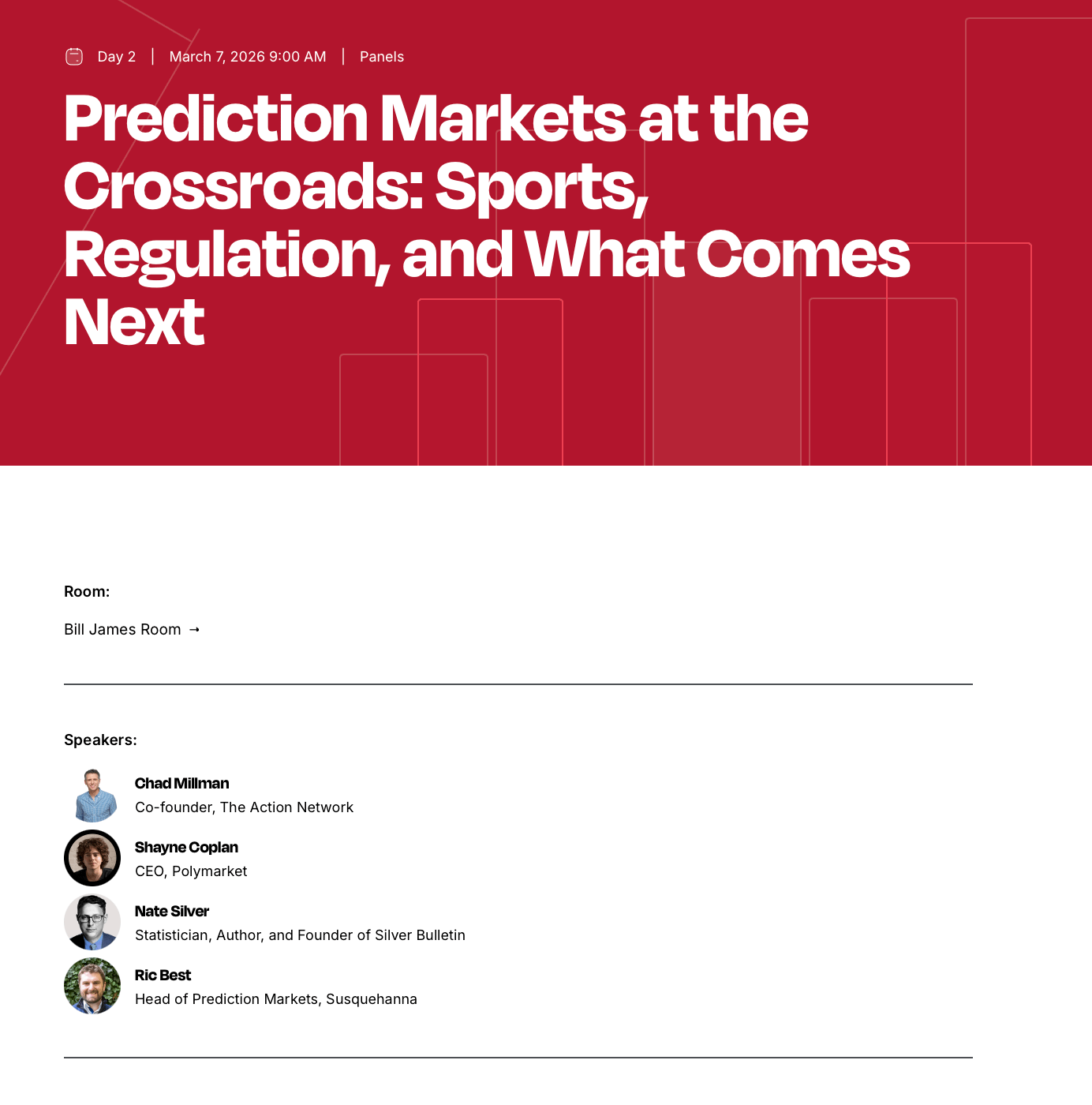
If you’re in New York, come see me to talk about prediction markets

I am helping Next.io with its new Emerging Verticals event on Monday in New York City, ahead of the main conference. Much of the content is about prediction markets. You can get tickets and learn more here.

Will Congress try to stop sports event contracts at prediction markets? That still seems like a long shot. Insider trading, however, is a different story.
Congress is really locked in on the subject in the wake of insiders potentially winning big on Polymarket by betting on US operations in Venezuela and Iran.
Two Democratic senators introduced a bill on Thursday aimed at government officials profiting from insider trading:
Today, Oregon’s U.S. Senator Jeff Merkley and Minnesota’s U.S. Senator Amy Klobuchar launched a new effort to prevent government officials at the highest levels from engaging in prediction markets, cracking down on the potential for any insider trading.
Following multiple public reports on the growing influence of prediction markets and their potential for corruption, Merkley and Klobuchar introduced the End Prediction Market Corruption Act—a new bill to ban the President, Vice President, Members of Congress, and other public officials from trading event contracts. The bill will ensure that federal elected officials maintain their oath of office to serve the people by preventing them from trading on information that they gained through their role.
“When public officials use non-public information to win a bet, you have the perfect recipe to undermine the public’s belief that government officials are working for the public good, not for their own personal profits,” said Merkley. “Perfectly timed bets on prediction markets have the unmistakable stench of corruption. To protect the public interest, Congress must step up and pass my End Prediction Market Corruption Act to crack down on this bad bet for democracy.”
“At the same time that prediction markets have seen huge growth, we have seen increasing reports of misconduct. This legislation strengthens the Commodity Futures Trading Commission’s ability to go after bad actors and provides rules of the road to prevent those with confidential government or policy information from exploiting their access for financial gain,” said Klobuchar.
Merkley and Klobuchar’s End Prediction Market Corruption Act is cosponsored by U.S. Senators Chris Van Hollen (D-MD), Adam Schiff (D-CA), and Kirsten Gillibrand (D-NY).
Their bill is supported by Public Citizen, Citizens for Responsibility and Ethics in Washington (CREW), and Project On Government Oversight (POGO).
“The American people deserve unwavering ethical standards from their government officials. Officials have a responsibility to avoid not only actual conflicts of interest but even the appearance of impropriety. POGO is pleased to endorse the End Prediction Market Corruption Act, which will further prohibit covered government officials from exploiting nonpublic information for personal gain in prediction markets,” said Janice Luong, Policy Associate for the Project On Government Oversight (POGO).
“It is now more important than ever that prediction markets be governed by ethical constraints, especially when it comes to bets placed by governmental officials. Sen. Merkley’s legislation would appropriately prohibit key government officials from buying or selling on the prediction markets contracts in which they could have insider information on changes in the market. Public Citizen heartily endorses this bill,” said Craig Holman, Ph.D., Public Citizen.
“The rapid rise of retail prediction markets creates the risk that officials across the government could use nonpublic information to trade on and profit off event contracts,” said Debra Perlin, Vice President of Policy of Citizens for Responsibility and Ethics in Washington (CREW). “The American people must be able to trust that their government officials are working on their behalf rather than for personal gain. Senator Merkley’s legislation represents a vital step forward to ensure that those in positions of power, including senior executive branch officials and members of Congress, cannot abuse their access to nonpublic information in order to profit.”
This legislation joins a similar but different bill from Rep. Ritchie Torres on the topic of insider trading.
It also comes as the new advocacy group Gambling Is Not Investing is trying to pick up steam. The new head of the anti-prediction markets coalition — former Trump chief of staff Mick Mulvaney — appeared on CNBC to plead his case.
The default is always to bet on Congress doing nothing. But it’s getting harder to ignore all the noise.
Prediction markets roundup
READ THIS WHOLE THING | The Wildest Frat Party on Campus? Prediction Markets (WSJ): “As they attempt to build market share, both Kalshi and Polymarket have aimed marketing at an eager group of users that isn’t known for financial discretion: college students. Both companies have begun splashing cash on campuses. Polymarket has offered to pay fraternities, in exchange for signing up users, money that can be spent on throwing ‘epic parties’—one frat raised $30,510 over a two-week period. Both platforms have been paying student influencers to promote them as ways to raise fun money, enlisting student athletes as brand representatives and supporting student clubs.”
Polymarket CEO Shayne Coplan will be at the Sloan Sports Analytics Conference this weekend: Looks like you might be able to watch it here.
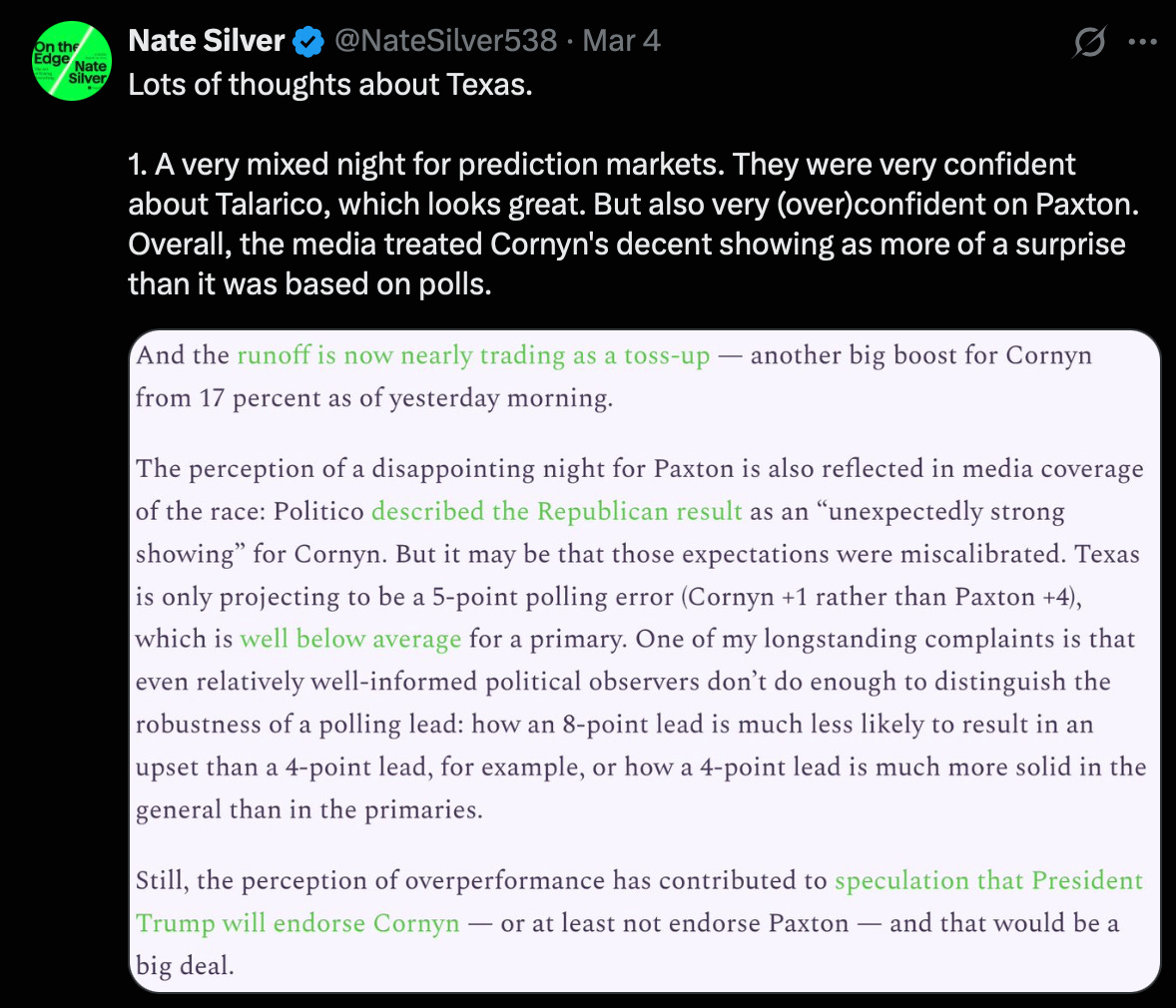
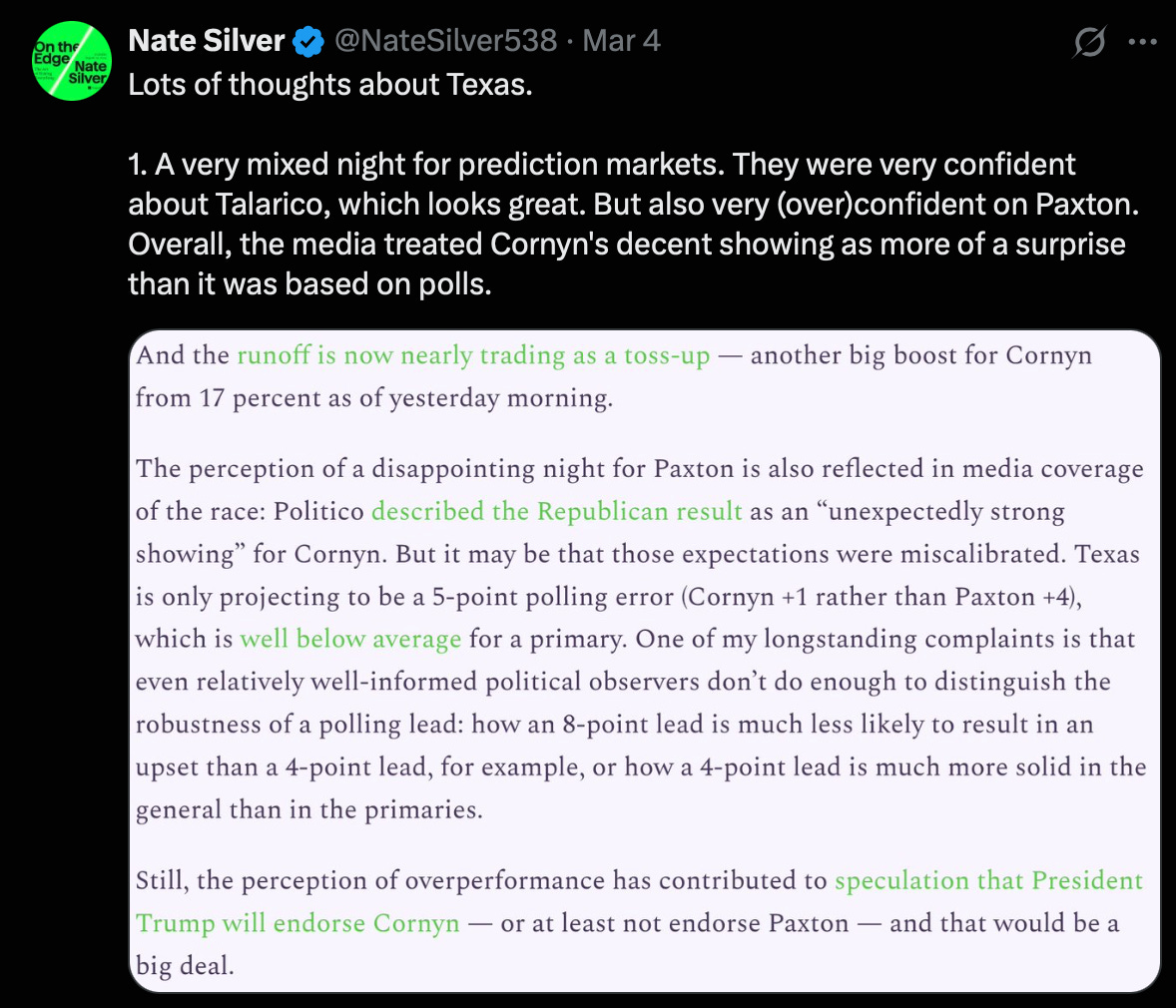
Silver also weighed in on how prediction markets fared on the primaries:
YOU SHOULD READ THIS TOO | ‘I Don’t Think The Public Has A Clue’: Inside The World Of Market Makers (InGame): “How much does the public really know about market makers? You know, the people and firms on the other side of your trades on Kalshi, Polymarket, and the growing list of prediction market exchanges? Here’s a brutally honest answer.”
“I don’t think the public has a clue what market makers do,” said the man who prefers to be known in gambling circles as “SigmaSquirrel” (@SquirrelSigma on X). He’s a partner in a market-making operation called SharpX Analytics that quotes parlay and combo prices on Kalshi and ProphetX. And he repeated his words for emphasis. “I don’t think they have a clue.”
Companies largely quiet over insider trading on prediction markets (Semafor): “With prediction-market bets soaring on everything from what MrBeast will say during his next YouTube video to what Apple will unveil at its next event, the risk that corporate employees use insider information to bet on Kalshi and Polymarket is growing. But it seems companies — like government regulation — haven’t kept up. Semafor reached out to more than 100 companies, law firms, banks, PR shops, and hedge funds, and found that few had explicit rules around prediction markets. Others, like Google — whose 2025 Year in Search headlines appear to have been front-run by someone who knew the numbers ahead of time — had no comment.”
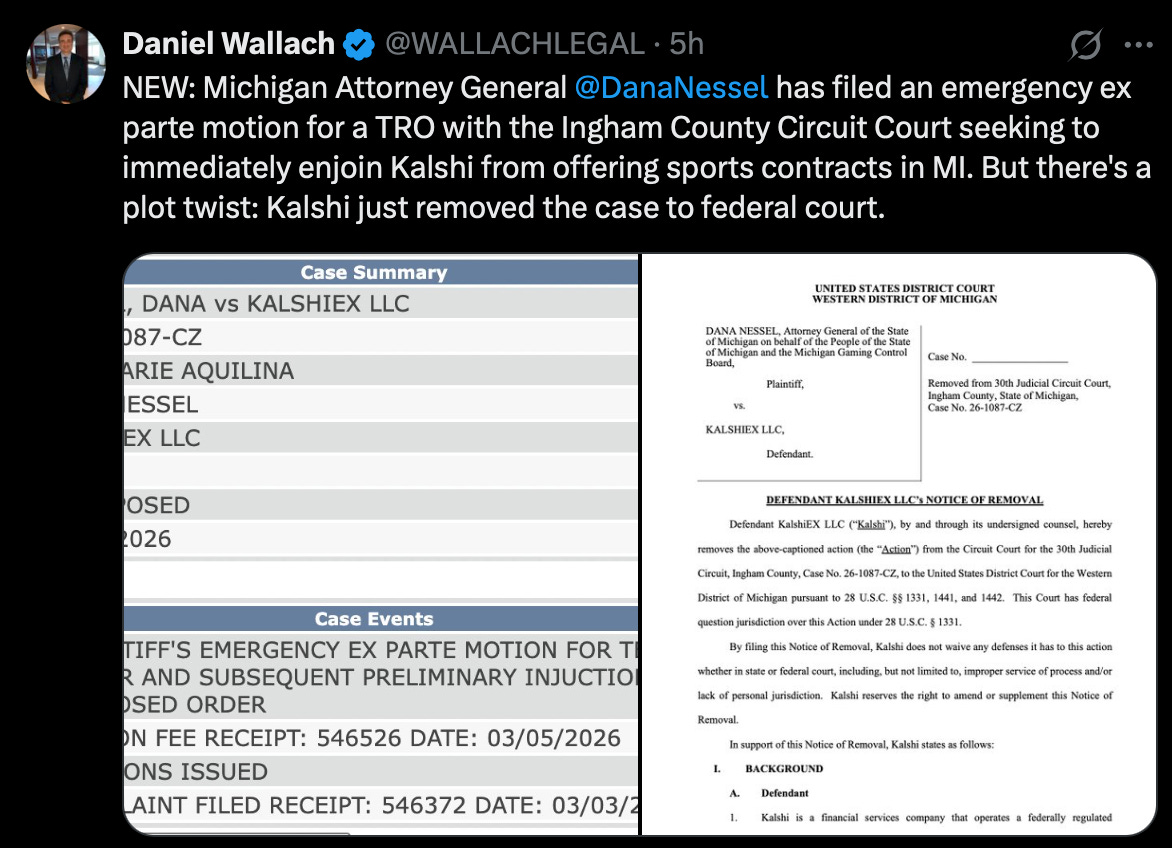
The latest on the new case between Michigan and Kalshi:
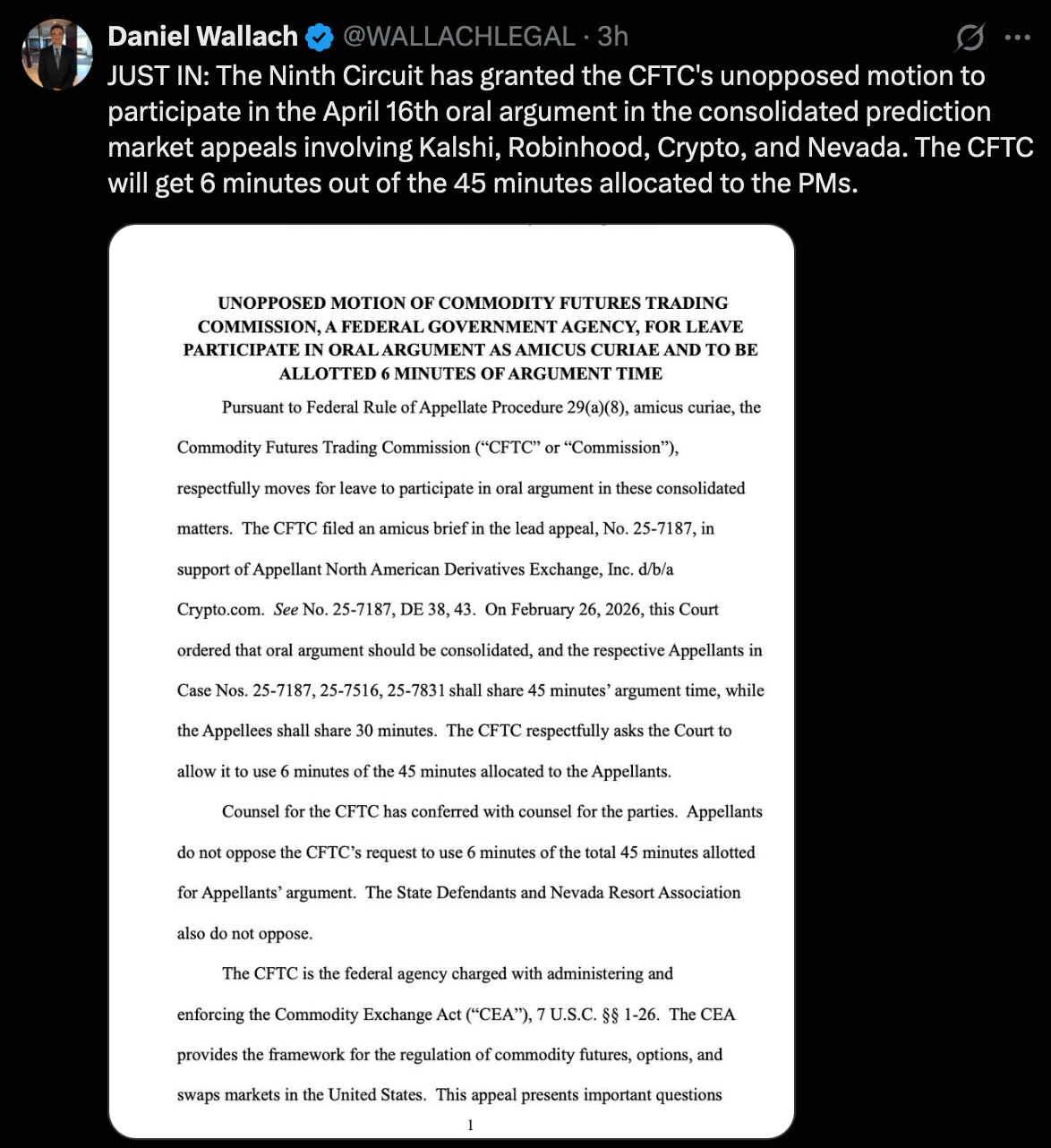
Also the Commodity Futures Trading Commission will participate in oral arguments in Nevada:
I was on a show called Press Play, on the NPR affiliate in Los Angeles: You can listen around the 17-minute mark.


You can’t pause current events when your payments can’t keep up. With every failed deposit or lengthy withdrawal process, customers lose trust in your brand. And when money doesn’t move fast enough, your liquidity suffers. PayNearMe’s PayXMTMplatform is purpose-built for Payment Experience Management, giving you the fast, familiar payment options your customers want while streamlining back-end operations for your team. Get real-time payments for real-time events—from one simple integration.
Stocktwits Announces 2026 Cashtag Awards Presented by Polymarket, Hosted at the New York Stock Exchange (press release): “Polymarket, the world’s largest prediction market platform, enables users to trade on real-world event outcomes and tap into crowd-sourced probabilities. The 2026 Awards will be hosted on May 4 at the New York Stock Exchange and will celebrate the individuals, products, and platforms shaping the future of digital finance and trading.”
“The Cashtag Awards are about the people building where finance and information intersect,” said Shayne Coplan, Founder and CEO of Polymarket. “We’re excited to partner with Stocktwits to recognize the creators, innovators, and entrepreneurs who are making markets faster, more transparent, and more reflective of what people actually believe.”
A Technology for a Low-Trust Society (The Atlantic): “A few hours before Donald Trump gave his State of the Union address, Republican sources told the PBS correspondent Lisa Desjardins that the speech would break records. The president would speak for more than two hours, she reported on X, and one reliable source claimed he might ramble on for 180 minutes.”
“The post went viral. At about the same time, the market started to move on Kalshi, an online platform where people can invest money in the outcome of a given news event. (Don’t call it gambling.) Forecasts on “How long will Trump speak for at the State of the Union?” shot up by 10 minutes after Desjardins posted: Armed with what they perceived as insider information, users thought they could make a buck by accurately “predicting” the outcome of his speech.”
Prediction markets in the news are a dangerous gamble (The Verge): “Today on Decoder, let’s talk about prediction markets, which continue to insert themselves into the news cycle and the news itself in increasingly weird, unsettling, and potentially illegal ways. My guest today is Liz Lopatto, senior reporter at The Verge, who owns what we cheerfully call the chaos beat. Liz has been writing a lot about prediction markets lately and especially why they all seem so intent on being perceived as sources of news — a position that directly incentivizes insider trading. That, in turn, creates a long list of very predictable problems.”
Does the CFTC’s opinion on prediction markets even matter? (SBC Americas): “As the federal and state court cases pile up around prediction markets and the Commodity Futures Trading Commission (CFTC) takes a lenient stance towards the vertical, where is this all heading? The answer is likely that it is heading to the Supreme Court, and a firm resolution may still be some way away. But the way in which the CFTC has changed its position on event contracts has left many observers scratching their heads. Count International Masters of Gaming Law (IMGL) President and Jones Walker Partner Marc Dunbar and his IMGL colleagues among that group.”
Prediction Markets Are a New Headache for Campaigns (Twitter article): “Prediction markets are becoming a new wrinkle in campaign politics, and most campaigns have not yet thought through what they mean operationally. Campaigns are used to managing polls. Polls shape the horse race narrative, influence donor confidence, and drive internal decision-making. Prediction markets introduce a similar dynamic, but with different mechanics and incentives.”