

This newsletter was sent to 3,339 subscribers who want to keep up with developments in the prediction market industry.
Someone messaged me on Tuesday, asking if I had seen that Kalshi started promoting pre-built parlays to its users.
I was not aware! So I checked it out, and sure enough, Kalshi has a “Popular Combos” section under the sports tab on the app.
State-regulated sportsbooks commonly do the same thing: surfacing pre-made parlays that people can bet on with a couple of clicks.
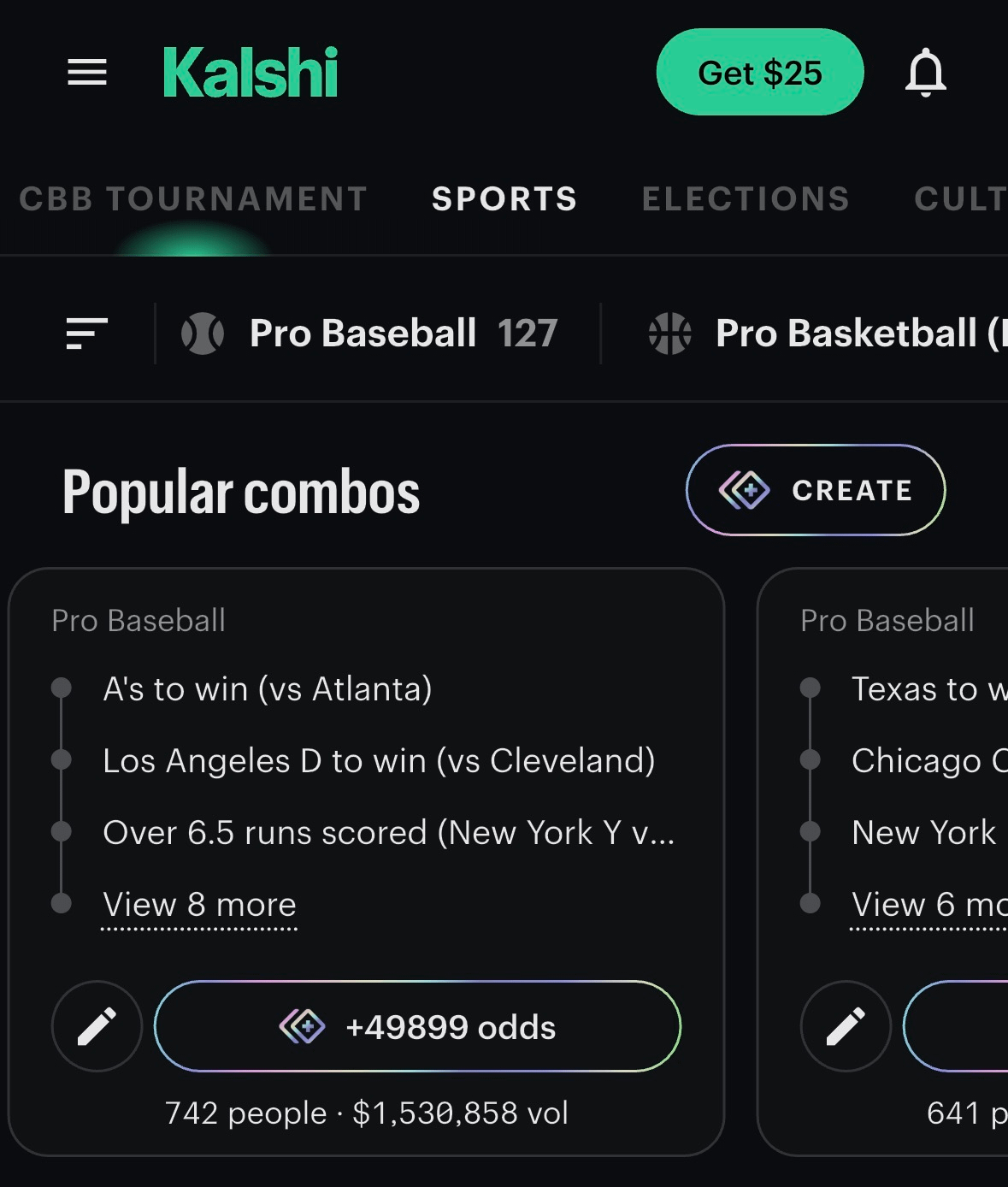
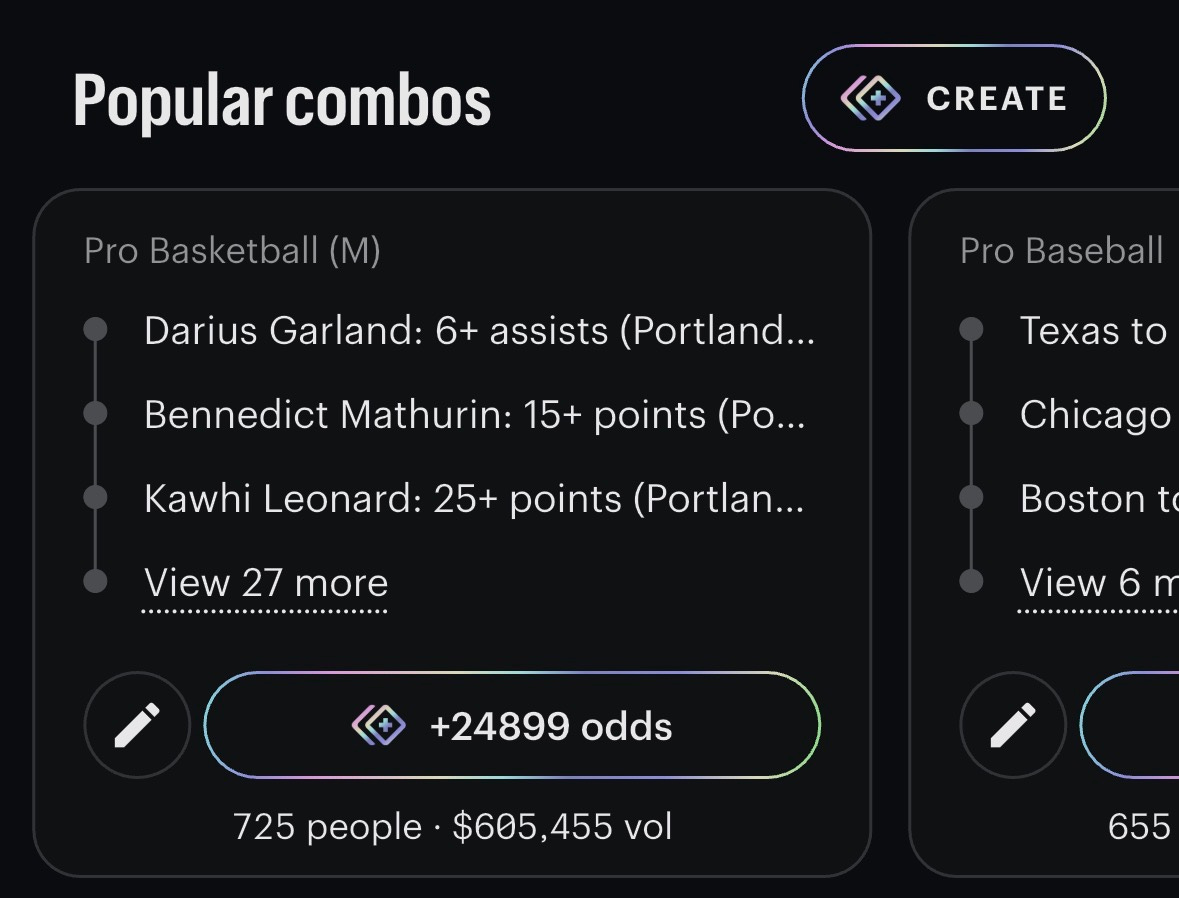
But it got even more interesting when I saw what Kalshi was promoting to users. Two of the parlays were as follows:
An 11-leg parlay at roughly +50000 odds
A 30-leg(!) parlay at about +25000 odds
I placed small bets trades on both of these parlays combos, and not shockingly, neither of them won. Only five of the legs hit in the 11-legger. If I am counting correctly, 12 of the legs missed in the 30-legger.
It’s not clear how Kalshi is surfacing these, but here’s one theory:

In any event, here’s my problem with all of this:
One of prediction markets’ talking points is that it’s better and less predatory than sportsbooks. That argument starts to fall apart if you are starting to pick and choose terrible parlays to serve to your users that have very little chance of hitting. Do sportsbooks do this same practice? Yes. Are they trying to get you to bet on 30-leg pre-built parlays? I am pretty sure they don’t.
Yes, yes, Kalshi isn’t the house and doesn’t profit when users lose, etc. But they are still taking fees, and market makers using the RFQ process to offer these parlays are clearly winning. I placed a whopping 40 cents across both parlays, and half of that went to Kalshi fees.
If we understood all of this to be “gambling,” I’d also have less of a problem with it. But if you’re trying to tell me that 30-leg parlays are 1. not gambling and 2. a meaningful financial instrument, you’re not a serious person.
The promoted parlays popular combos are back on Wednesday, and they are far more reasonable offerings than they were on Tuesday. That’s at least an improvement.
Prediction markets roundup
Six Months After Declaring Victory, Robinhood Is Falling Behind In Prediction Market Race (InGame): “Robinhood’s share of volume on Kalshi has fallen from almost 60% in September to less than 23% in the first 27 days of March, in a sign that the stock trading giant is losing its status as a kingmaker in the prediction market world. In an update to the stock market on Monday afternoon, Robinhood revealed that its users had traded 2.6 billion contracts. With each contract traded being worth one dollar, 2.6 billion contracts traded is $2.6 billion of volume.”
How prediction markets landed in Congress’ crosshairs (Politico): “Lawmakers are quickly coming to a realization: Odds are, Congress is going to have to do something about booming prediction markets. …”
“The platforms, once considered niche, are poised to get new scrutiny across Capitol Hill this year. Senate Commerce Committee members have discussed holding a hearing focused on the industry, according to four people granted anonymity to discuss the private conversations. The House Agriculture Committee, which oversees commodities trading, has been holding bipartisan briefings on the issue, with more expected.”
‘Astonishing and Appalling’: Senator Blasts MLB-Polymarket Deal (Front Office Sports): “Sen. Richard Blumenthal (D., Conn.) was stunned by Major League Baseball’s deal with Polymarket. Blumenthal isn’t buying that there’s any meaningful difference between traditional sports betting and sports event contracts on prediction-market platforms, and he thinks the MLB-Polymarket deal is lending the industry legitimacy it has not earned.”
“It is astonishing and appalling that Major League Baseball would, in effect, be complicit in this,” Blumenthal tells Front Office Sports.
Crypto Startup Uses Polymarket to Bet on Its Own Fundraise, Blindsiding Backers (Decrypt): “P2P.me was established to push boundaries with stablecoins, but the startup has determined that wagering on itself via Polymarket may have been a bridge too far. On Saturday, the firm backed by Coinbase Ventures and Multicoin Capital apologized for speculating on its latest fundraising round using the prediction market, describing the move in a post on X as an inappropriate attempt at conveying conviction to the public. In total, the company that bills itself as a non-custodial service for converting between stablecoins and cash signaled that it notched less than $15,000 in profits on the prediction market move. Still, it recognized how a small payday could carry outsized consequences.”
Jamie Dimon: JPMorgan could offer prediction market services to investors (CBS News): “JPMorgan Chase CEO Jamie Dimon revealed that his bank is considering offering prediction market services to its customers.”
“It’s possible one day we’ll do something like that,” Dimon said in an interview with “CBS Evening News” anchor Tony Dokoupil, speaking about services such as Kalshi and Polymarket, which allow people to make bets on everything from the outcomes of sporting events to elections.
Dimon added, “We’re not gonna be in sports. We’re not gonna be in politics. There’s a bunch of stuff we won’t do. And obviously, we have strict rules around insider information.”
Agencies Must Create Clear Prediction Market Rules to Avoid FTX-Style ‘Implosions’: CFTC Chair (Decrypt): “If regulators fail to set up clear policies and rules around prediction markets, there could be another FTX-like implosion, according to Commodity Futures Trading Commission Chairman Michael Selig.”
“The failure of agencies to actually regulate, to do their job and set policy, is such a disservice to the builders and innovators and everyday Americans who want to access these products,” Selig said in an interview with Dastan President and Co-Founder Farokh Sarmad.
CFTC Warns Against Insider Trading on Prediction Markets (Bloomberg): “A key Commodity Futures Trading Commission official said the agency will use its powers to root out insider trading in prediction markets, as concerns about suspicious activity on the exchanges grow.”
“Unfortunately there’s a myth in mainstream media and social media that insider trading law doesn’t apply in the prediction markets,” CFTC Enforcement Director David Miller said at a panel at New York University on Tuesday. “That is wrong.”
As Utah battles Kalshi in court, Moore and Curtis look to regulate prediction markets in Congress (Salt Lake Tribune): “Utah’s fight against prediction markets has made its way to Congress. … (U.S. Rep. Blake Moore) Moore said his federal bill was inspired by Cox’s concerns, as well as those raised by Utah Attorney General Derek Brown. He said as well that he aimed to ensure the legislation would not encroach on traditional futures markets, such as corn, which farmers can use to set prices on future purchases.”
“We do not want to have a traditionally legitimate financial tool … to create a loophole for basic online gambling in our states, and particularly states that don’t want to allow that type of activity,” Moore said.
To DraftKings, the prediction markets are both a threat and an opportunity (Boston Globe, paywall): “The hot topic at the DraftKings headquarters in early March wasn’t its core business of sports betting or online casino games.
Instead, for industry insiders attending DraftKings’s Investor Day, it was the Boston company’s entry into what many see as the next frontier of gambling: prediction markets. DraftKings is ramping up to take on Kalshi and Polymarket in a burgeoning industry that could be worth billions of dollars. It’s also an industry that’s experiencing similar legal pushback to what DraftKings encountered when it was still primarily a purveyor of fantasy sports games.”
CME, A Partner To Both FanDuel And DraftKings, Reverses Course On Political Event Contracts (InGame): “CME, prediction market partner to FanDuel and DraftKings, has self-certified contracts on U.S. elections, in an apparent U-turn after CEO Terry Duffy last year said political event contracts were not a ‘good thing.’
“Commodity Futures Trading Commission (CFTC) filings show that CME self-certified U.S. election contracts. The business also self-certified parlays on basketball and baseball, alongside new contracts on soccer and golf. The new parlays — following football parlays, which were self-certified just before the Super Bowl — will likely be a major part of FanDuel and DraftKings’ prediction market offerings in states in which they offer sports contracts.”
Legend Trade Series + Polymarket:
 legend.trade@legendtradeIntroducing the Legend Trade Series, presented by @Polymarket April 16, 2026 - trading goes live on the esports stage 8 traders. 3 rounds. 1 winner. Watch on Kick, X, and YouTube - or attend in NYC. The first of many global trading esports events.10:41 PM · Mar 30, 2026 · 182K Views75 Replies · 52 Reposts · 314 Likes
Paradigm, a major investor in Kalshi, is building its own prediction markets trading terminal, say sources (Fortune): “One of the most influential investors in crypto wants a bigger slice of the burgeoning prediction markets space. Venture capital firm Paradigm is developing a prediction markets trading terminal, according to sources familiar with the matter, who asked for anonymity to talk about private business dealings. Arjun Balaji, a partner at the venture firm, is leading the initiative, which will cater to professional traders and market makers, according to the sources, who say he’s been working on the project since late 2025.”
Iowa Senate passes bill to try to license and tax prediction markets (SBC Americas): “The Iowa Senate has become the first U.S. legislative chamber to pass a bill that would attempt to regulate and tax online prediction market platforms at state level.”
“Senators approved an amended version of Senate File 2470 on Tuesday by a vote of 45-1, but not before it was significantly amended to increase the proposed licensing fees and clarify certain parameters. In short, the bill would attempt to render prediction markets illegal unless the platform offering them obtains a license from the state Department of Revenue and pays tax on its event contract activity.”
Legal updates!:
Robinhood files suit as Washington moves against prediction markets (Next.io): “Robinhood has filed a lawsuit in Washington seeking relief against officials from agencies including the Washington State Gambling Commission and the state attorney general. … The lawsuit cites the example of Washington State’s recent action against Kalshi. Local authorities argued that Kalshi’s operations amount to illegal online gambling and have requested penalties, restitution, and an injunction. Robinhood states that the risk to its business is real because the same action could be taken against its own operations, as it routes customer trades through Kalshi and other exchanges.”
Arizona:
 Daniel Wallach@WALLACHLEGALNEW: 28 Native American Tribes and 10 tribal associations (including the Indian Gaming Association) have filed an amicus brief in support of Arizona's response to Kalshi's motion for preliminary injunction. Brief authored by leading tribal gaming attorneys, who are 5-0 as amici.
 3:14 AM · Apr 1, 2026 · 1.82K Views1 Reply · 1 Repost · 8 Likes
Mission Accomplished: IGA Mobilizes Indian Country Against Prediction Markets (InGame): “The first four panel sessions at the Indian Gaming Association’s annual conference Monday had the feel of a rally or protest. Conference Chair Victor Rocha’s (pictured above, left) plan was to use the back-to-back-to-back-to-back sessions to set the tone and give an overview of why the rise of sports events contracts may be the biggest threat in the history of tribal gaming. Given the amount of raised voices, waving hands, and outright cheering at some points, he succeeded in mobilizing and engaging Indian Country.”



Most regulated sportsbooks cap parlays at 12-16 legs — DraftKings maxes at 16, FanDuel at 15. So Kalshi isn't just copying sportsbook practices, they're exceeding the limits that sportsbooks themselves imposed after regulatory pressure. The compounding math is the real story: if each leg carries even a modest bid-ask spread through the RFQ process, the effective vig on a 30-leg parlay is far worse than any sportsbook's standard juice. Kalshi https://thesynthesis.ai/journal/the-record.html — the question is whether that growth is real price discovery or flow that even DraftKings decided wasn't worth the regulatory risk.
Someone who owns the Dow stocks, not the index, but each of the 30…. Are they not everyday making a bet that the stock ends higher? It would be a 30 game parlay on “over yesterdays close”
I am ready to bring a much more calibrated version of this to market in partnership with Kalshi, Poly, Robinhood, Draft Kings, Fanatics, Nasdaq, TXSE, NYSE, JPM, SoFi, and even Peloton…. If this reads like a promo, then you don’t know how hard it is to get their attention. Your substack is excellent and I added SHADEoGREEN.com to the directory you are building. Would be so happy to connect. Andy@SWE235.com