

If you want to catch me in person, a lot of opportunities coming up!
Sept. 28-30 in Vegas for G2E
Oct. 5-8 at PREDICT conference, NYC
Oct. 21-23, NEXTPredict, NYC
Leagues don’t seem to like markets about player movement and team transactions.
Nonetheless, Kalshi just certified more markets related to those things based on the NBA, and in particular superstar Steph Curry.

There are active Steph Curry markets already, fwiw:
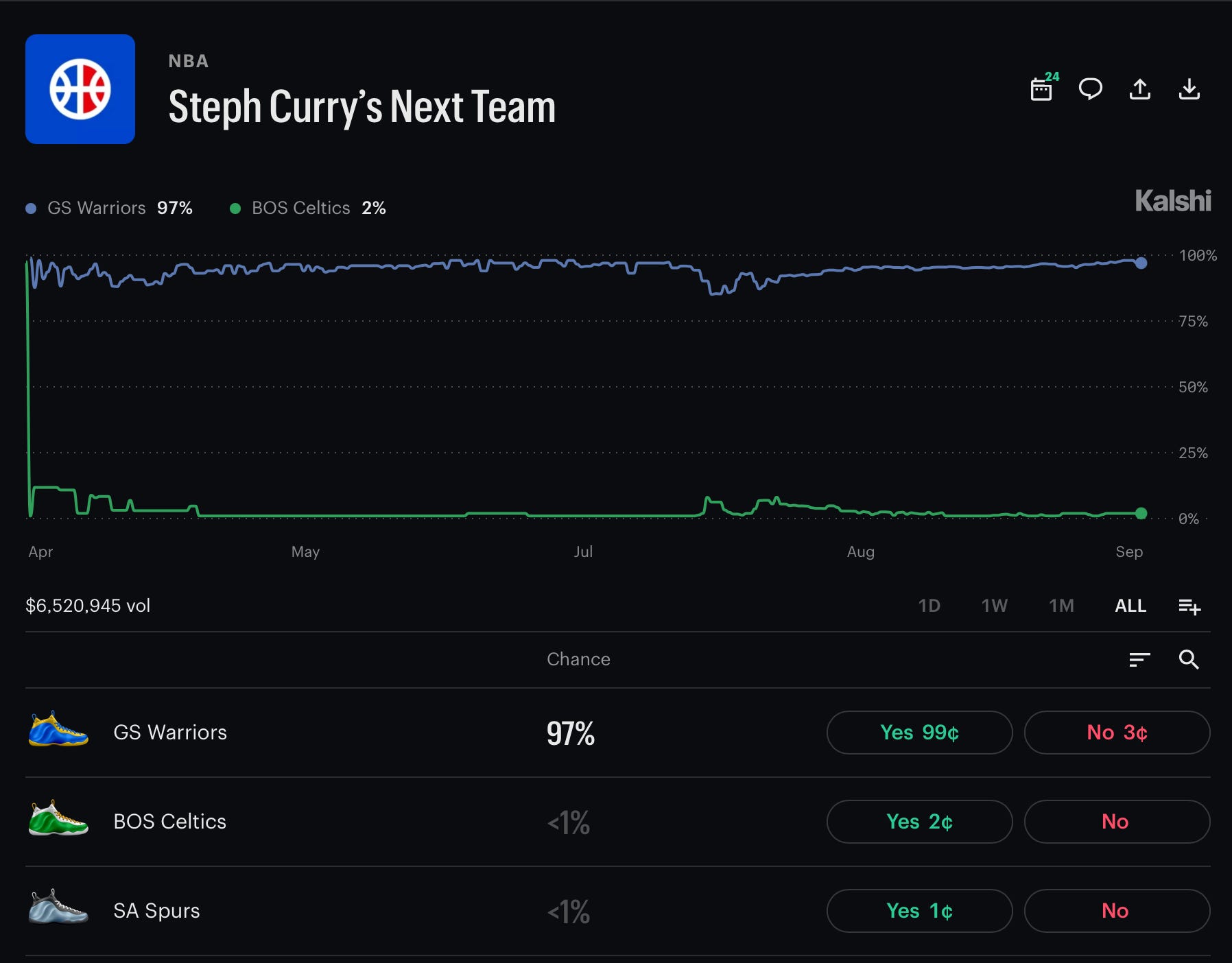
These kinds of markets are nothing new, of course; hundreds of millions of dollars were traded on LeBron James’ next team this summer, for instance. That’s a market that the NBA has said shouldn’t exist.
Regardless, Kalshi continues to offer and post these types of markets — despite leagues’ objections — which seems odd! That’s especially true with a deal between the NBA and a prediction market possibly coming before the start of the season.
The NFL has expressed frustration with similar markets, even though markets tied to player injuries have seemingly been sidelined. But markets about players’ next team and coaches’ fates persist:
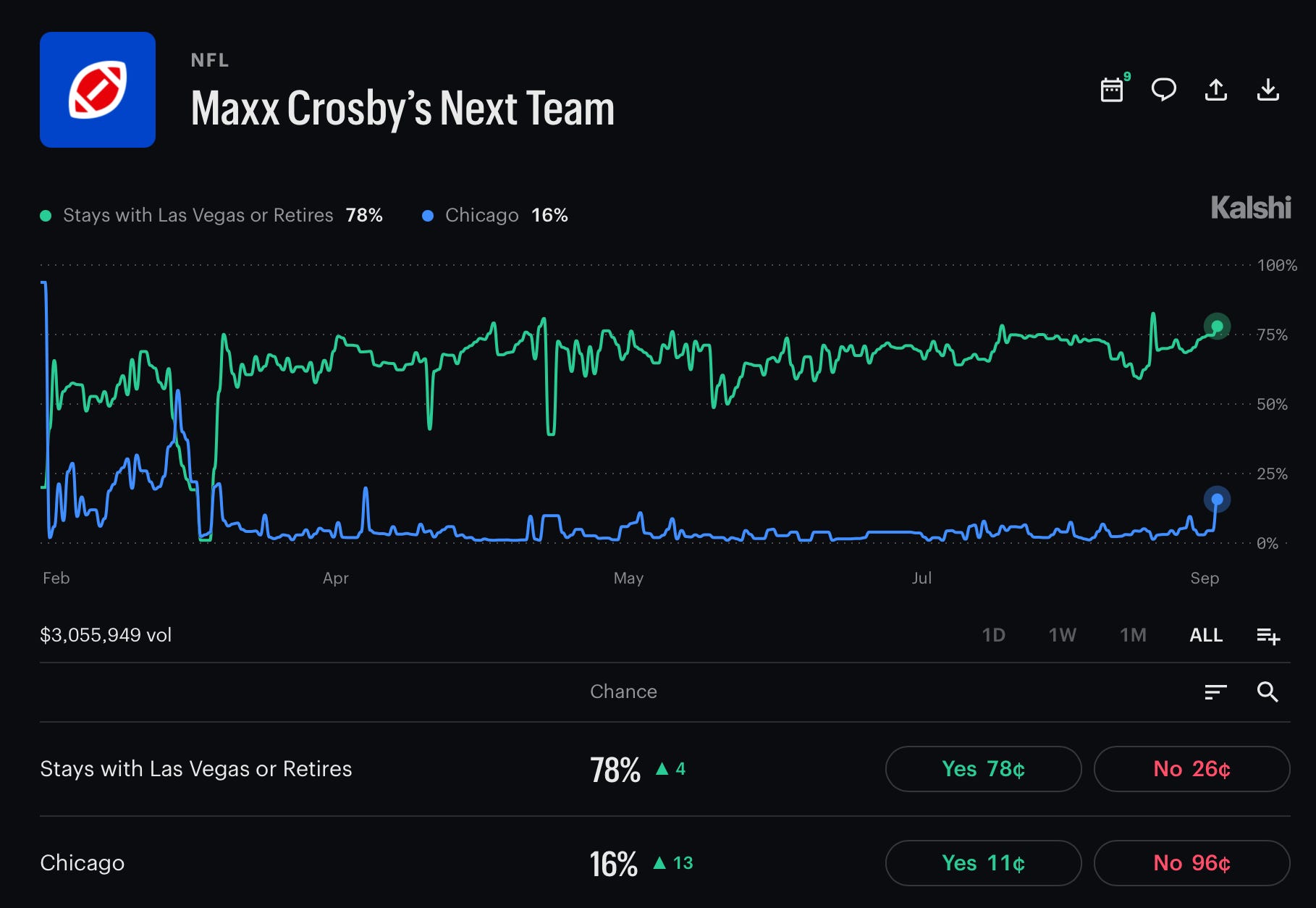
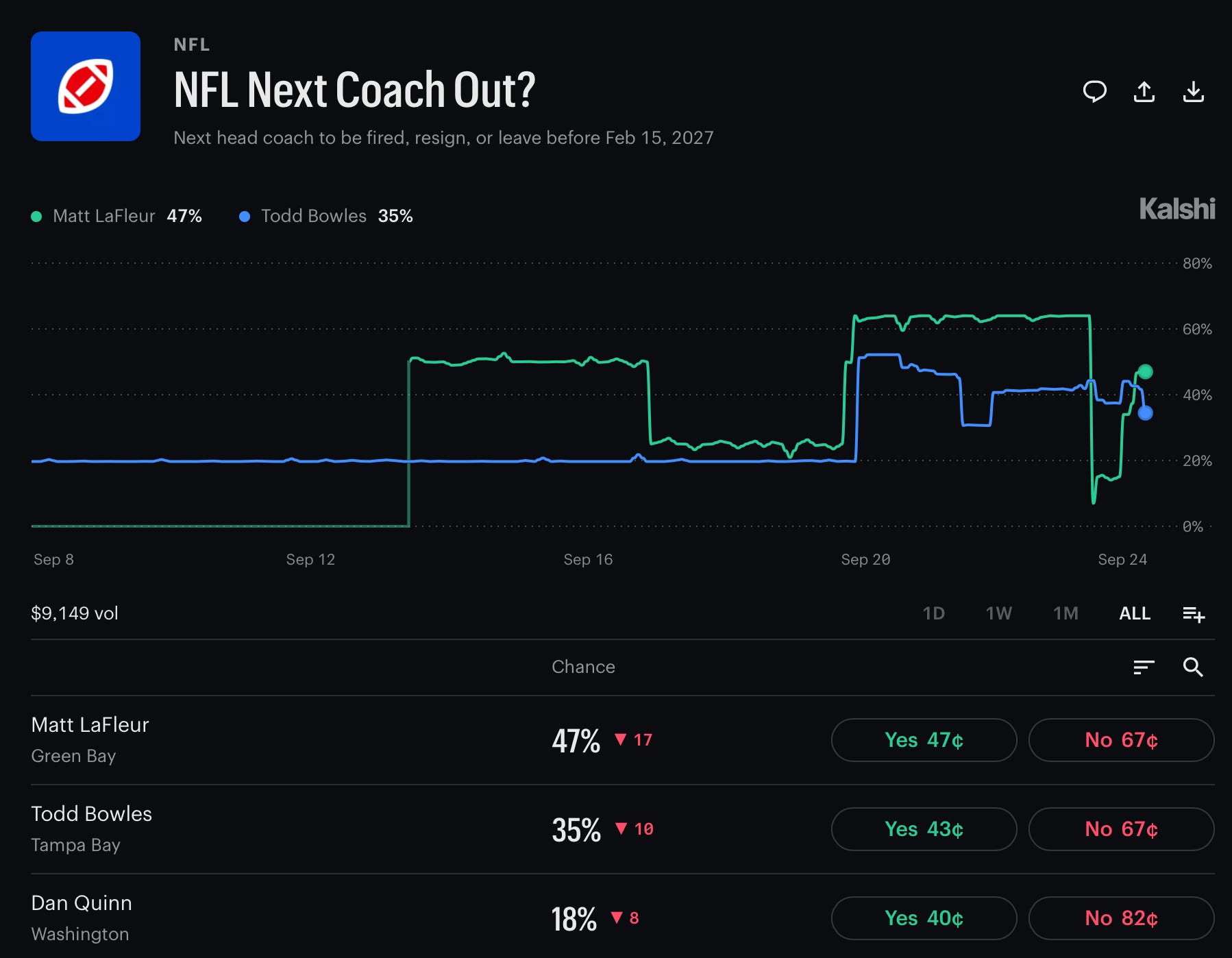
Will any of this give the NBA any pause about a potential deal? Given the dollar signs in front of the league, conventional wisdom says probably not.

You can’t pause current events when your payments can’t keep up. With every failed deposit or lengthy withdrawal process, customers lose trust in your brand. And when money doesn’t move fast enough, your liquidity suffers. PayNearMe’s PayXMTM platform is purpose-built for Payment Experience Management, giving you the fast, familiar payment options your customers want while streamlining back-end operations for your team. Get real-time payments for real-time events—from one simple integration.
The Event Horizon briefing
A quick look at what matters most in prediction markets.
📍 The Big Story
New York Attorney General Letitia James and Governor Kathy Hochul today announced a lawsuit against QCX LLC d/b/a Polymarket US (Polymarket) for running an illegal gambling operation in New York through its prediction market platform. Polymarket launched in the United States in December 2025 as a service that allowed users to bet money on the outcome of sporting events, promising users “sports – followed by markets on everything.” An investigation by the Office of the Attorney General (OAG) found that Polymarket’s prediction market is an illegal, unlicensed gambling operation that exposes New Yorkers – including those under the legal gambling age of 21 – to serious personal and financial risk. The lawsuit is seeking a court order stopping Polymarket from operating as an unlicensed gambling business in New York state and requiring the company to pay fines, forfeit all illegal gains, and pay restitution to users.
“Our gambling laws exist to protect New Yorkers, prevent the potential harms of problem gambling, and ensure funding for educational and public benefit programs,” said Attorney General James. “By skirting New York’s laws, Polymarket is targeting the most vulnerable and depriving New York families of critical services and support. My office will never hesitate to take action to defend our laws and keep New Yorkers safe.”
“I will always stand up for New Yorkers when bad corporate actors prey on consumers and threaten tax dollars that fund schools and critical public services,” said Governor Hochul. “By running an unlicensed gambling operation, Polymarket has done more than just knowingly violate state law, they have put New Yorkers at risk, especially those underage who are most vulnerable to problem gaming. Nobody is above the law in our state, and working with Attorney General James, we are fighting to protect New Yorkers and put this illegal operation to an end.”
🔍 New York is, of course, already suing Kalshi as well.
🔭 What To Watch For
Kalshi random bonuses appear to be back
Kalshi at one point had a promotion where users would get a bonus at random:

Then the CFTC issued this guidance, which seemingly would preclude this type of customer acquisition, and the promotion seemingly went away:
Similarly, selectively offering retention bonuses or providing non-cash incentives of unspecified or varying value are likely to have exclusionary effects inconsistent with Core Principles and a DCM’s obligation to provide fair and nondiscriminatory access to its services. Sweepstakes-like or randomized rewards programs or prizes based, in whole or in part, on pure chance, rather than pre-defined performance metrics, likely run afoul of Core Principle 2 because they introduce unequal and non-objective benefits that treat market participants within the same category differently.
Now, Kalshi is offering a bonus of “up to $2,000,” which appears to have some of the same dynamics.


I find it crazy that Kalshi and its marketing partners are not listing the odds of the $2,000 bonus, which are seemingly very small.


The FAQ in my tweet does say most prizes will be awarded at $25 and below, but I had to click through to the FAQ just to get that amount of information. It is not included at the top level of the promotion, nor do I see exact odds of prizes listed anywhere. Not great.
Are random bonuses back again, or is this a problem? I guess we’ll see.
🔥 Hot Market
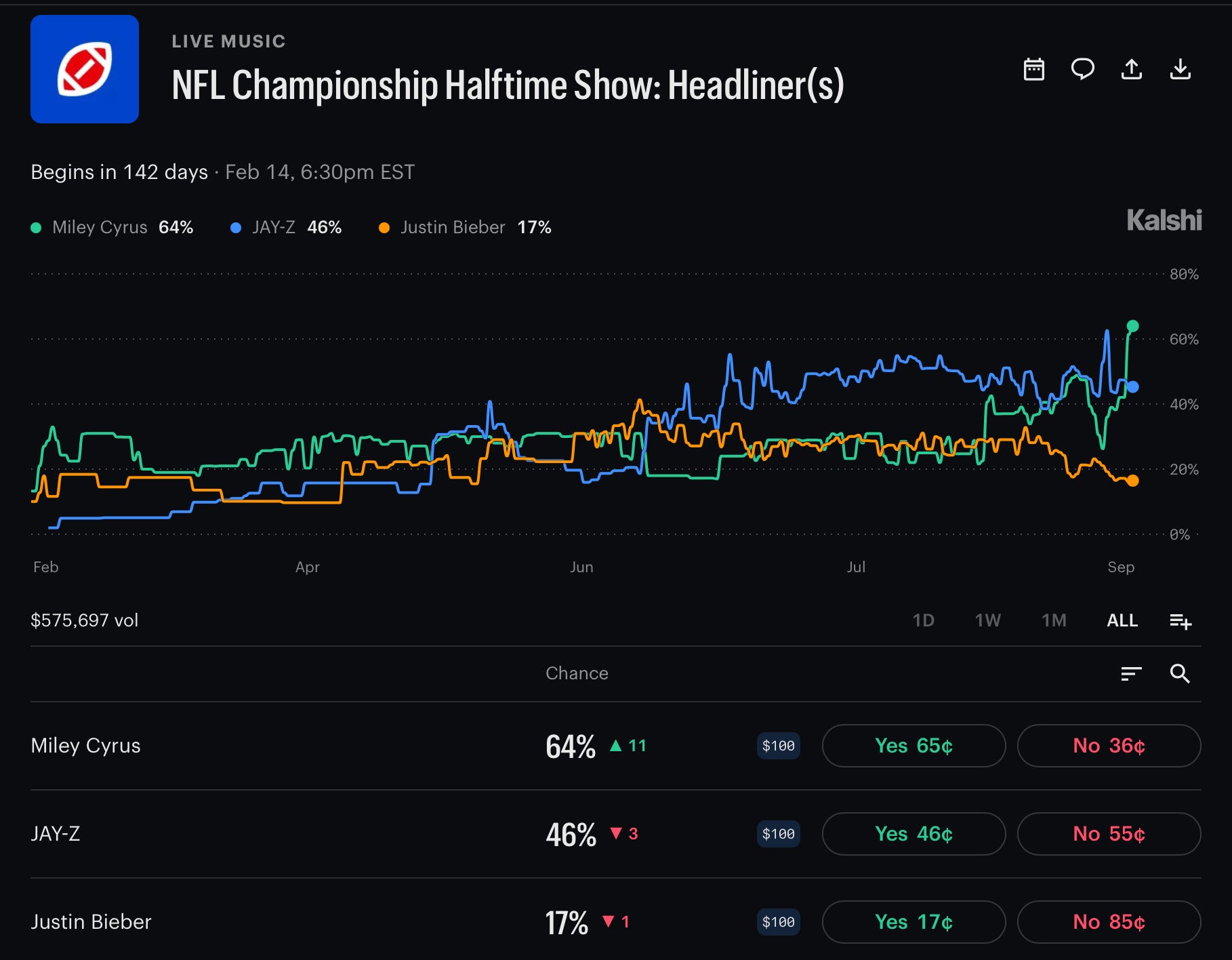
Super Bowl halftime show headliner
There’s a bit of steam behind Miley Cyrus:
📝 New Markets
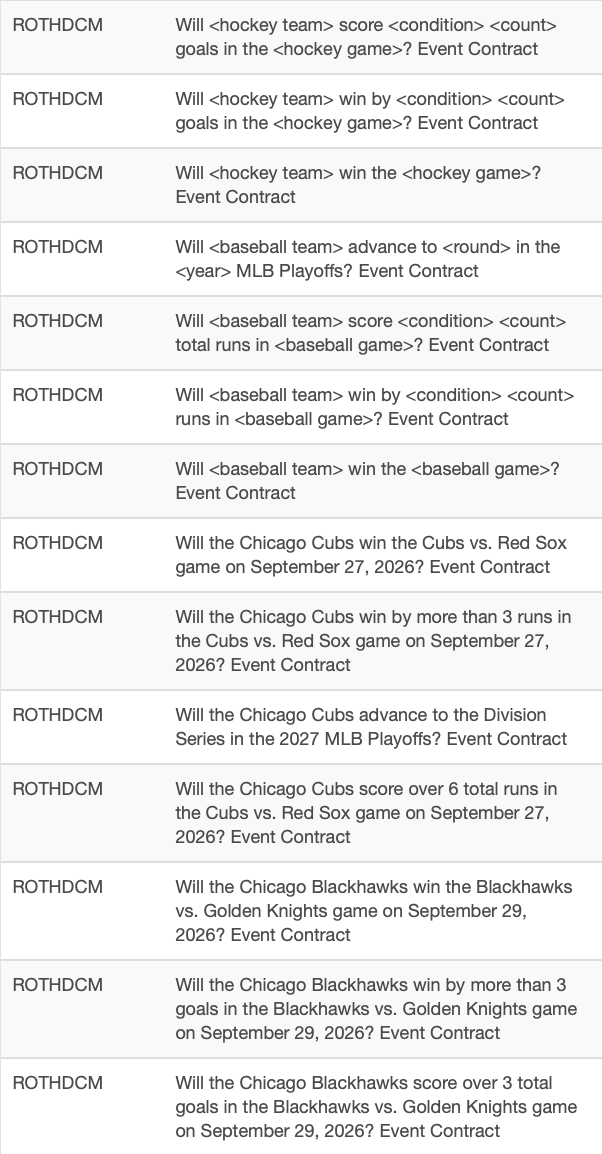
Filing for new markets listed with the Commodity Futures Trading Commission:
Sports at Rothera
💬 Quote Of The Day
And our message is, we want more guardrails, and I think this is what they should look like.
—Kalshi CEO Tarek Mansour, speaking with PBS
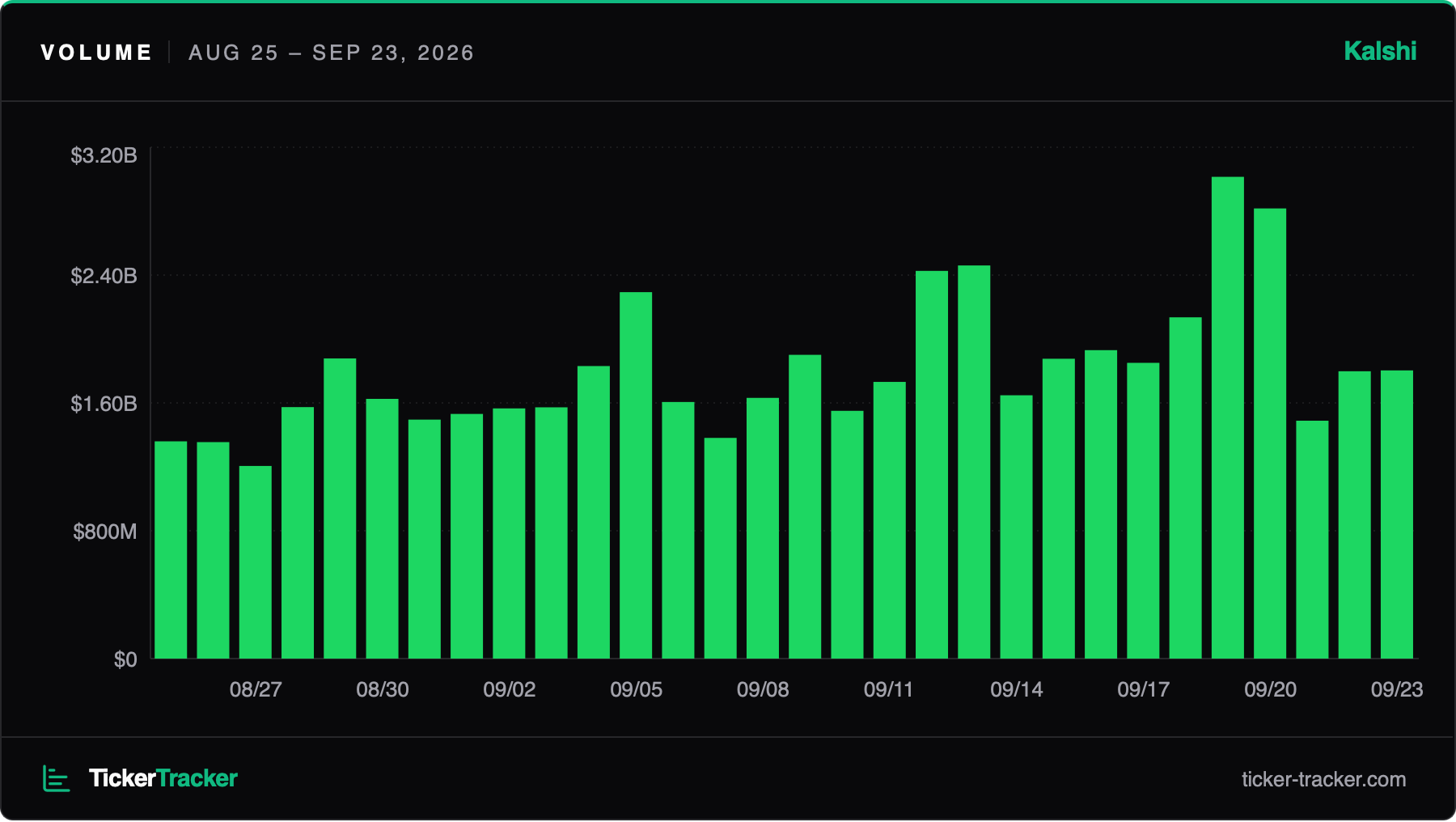
📊 Volume Tracking For Wednesday, Sept. 23
Kalshi volume: $1.8 billion
Parlays: 57.7% of volume
Sports: 21.1% of volume
Crypto markets: 17.6% of volume
Trend line:
Trailing seven-day volume on exchanges:
Kalshi: $14.9 billion
Polymarket US: $2.5 billion
DraftKings’ DKeX: $531 million
Crypto.com Derivatives North America: $516 million
Novig: $388 million
Rothera: $259 million
Underdog’s exchange: $184 million
ProphetX: $69 million
Notes: Underdog has launched a data site that includes both its own exchange and volume that flows through it via other exchanges. You can see it here.
Data is provided by Ticker Tracker

News roundup
Everything else important that happened in or was written about prediction markets:
🚨 Important stuff
The ‘first prediction-market election’ scrambles the midterms (CNN): “All this wagering is scrambling nearly every aspect of the midterms — from campaigns to election officials, voters, donors and traders — according to interviews with 20 people involved in elections and prediction sites. Many have dubbed it the ‘first prediction-market election.’”
“Multiple election officials told CNN prediction platforms are fostering a new wave of disinformation and creating risks for possible insider trading within their own offices.”
🔍 Everyone should read this. I don’t think we have fully appreciated all the potential knock-on effects of election markets in a polarized environment.
Public Partners with Kalshi to Launch Prediction Markets and Bring Event Data to AI-Powered Investing (press release): Public, the world’s first agentic brokerage, today announced the launch of AI Agents for Prediction Markets, enabling members to trade on events that can shape financial markets and connect them with the rest of their portfolio. Through the partnership, Public’s users will be able to access Kalshi event contracts through the same infrastructure they already use for other financial products. Members can trade events directly or have built-in AI agents trade on their behalf. For example, Public’s AI agents can use prediction market data as a signal for a stock or bond trade. …
Public members will have access to a broad range of predictions markets across key areas of the economy and financial markets, and use Kalshi data as an input for user-defined AI strategies across their portfolios.
The partnership introduces Kalshi’s infrastructure to Public, with a focus on events that move the markets. Categories include crypto, commodities, climate, economics, corporate events, markets, indices, tech & science, and politics and elections. Each category is designed to give investors another way to assess potential risks and opportunities relevant to their portfolios — whether that means evaluating the potential impact of a Federal Reserve rate cut, anticipating bitcoin price movements, or assessing the likelihood of a corporate event.
“Public is built for investors who take an active hand in constructing their portfolios, and our AI agents let them automate those strategies,” said Leif Abraham, Co-CEO and Co-Founder of Public. “Prediction markets give those agents a new input: real-world events. Members can take a position on the event directly, or use the market’s data as the signal that triggers a trade anywhere else in their portfolio.”
"This partnership broadens how investors can engage with prediction markets and the data they generate," said Max Crowley, Vice President of Business Development at Kalshi. "In addition to trading event contracts directly, Public members can now use the probabilities our markets produce as a signal alongside stocks, bonds, crypto and other assets. Bringing this data into Public's AI agents shows how prediction markets are increasingly being used to assess risk, inform investment views and support trading strategies."
🔍 I spoke with Abraham for the podcast; tune in Monday!
NFL Betting App Downloads Grow, But Prediction Markets Extend Early Lead (Legal Sports Report): “NFL betting app downloads climbed 28% year over year in Week 2, driven largely by prediction markets as traditional sportsbooks continued to struggle with customer acquisition ahead of Thursday night’s start to Week 3. The 2.8 million NFL betting app downloads recorded during the week ending Sept. 21 brought growth through the first two weeks of the season to 19%, according to Sensor Tower data quoted by Citizens. Nearly half of that total, 1.33 million downloads, came from Kalshi and Polymarket combined.”
I wrote about a new study about gamblers over at The Closing Line:
On prediction markets, the study says:
“Prediction market users present a noticeably different profile. They scored roughly at the same level as non-gamblers on objective numeracy, squarely in the middle of the distribution, yet reported subjective numeracy scores comparable to sports bettors. They feel as confident about numbers as the highest-performing group, without demonstrating equivalent mathematical ability.”
“This distinction carries direct consumer protection implications. A consumer who is genuinely strong at mathematics and is aware of that fact is better positioned to evaluate risk accurately and remain within their means. A consumer who feels equally confident but performs no differently from the average adult may believe they have identified an analytical or mathematical edge that does not actually exist. High financial literacy combined with overconfidence in numerical ability creates conditions in which prediction market users may take on more risk than their mathematical capabilities justify.”

⚖️ Legal and regulatory
Kalshi Takes Prediction Markets Out of Three Tribes’ Lands (Bloomberg Tax): “Kalshi Inc. has voluntarily disabled its prediction market content on three California tribes’ lands, it told a federal court Thursday after recently receiving an adverse appellate ruling.”
“The action, Kalshi’s first voluntary “geofencing,” resolves the next steps in the tribes’ case for now, following the US Court of Appeals for the Ninth Circuit’s approval Sept. 16 of a preliminary injunction sought by the tribes.”
The CFTC Is Tying Its Own Hands on Prediction Markets (Lawfare): “Agencies are supposed to serve the public interest, not entrench the preferences of whoever captured them last. Congress gave the CFTC authority to review prediction market contracts for a reason: Unregulated wagering on elections, war, and human life raises serious questions about perverse incentives, morality, and national security that the market will not answer on its own. The proposed rule abdicates that responsibility and then tries to lock in that abdication for years to come, regardless of whether a future administration takes a more pro-regulatory stance on prediction markets. The CFTC should not finalize the proposal, and if it does, courts may review it with a skeptical eye.”
KALSHI-LIGA MX LAWSUIT REVIVES GAMBLING LOGO-USE DEBATE (Sportico): “The Federación Mexicana de Fútbol Asociación (FMF) has accused Kalshi of illegally using ‘Liga MX,’ the name of Mexico’s top professional soccer league, and Liga MX club logos to promote bets.”
“FMF, which sued Kalshi this week for trademark infringement, presents the first known case assessing the prediction market operator’s right to reference wordmarks and imagery that belong to sports leagues. Expect Kalshi to argue that its activity is protected by fair use, the same type of defense used by DraftKings as it defends against an NCAA lawsuit over its use of the association’s trademarks.”
Kalshi’s Embrace of Sports Betting Tests Rules for Prediction Markets (WSJ): “It has been eight years since the Supreme Court effectively opened up the nation to sports betting, giving hundreds of millions of Americans the ability to gamble at home. With the rise of prediction markets, it will soon face the question of whether to upend the landscape again.”
Kalshi’s Sports Push ‘Really Undermines’ Case Against States, Former CFPB Adviser Says (Yahoo/Benzinga): “Lipton said Kalshi’s case is strongest when prediction markets look like financial products used by firms and sophisticated investors. Sports makes that harder: a product built around ‘some guy on his couch placing a bet’ simply ‘looks like gambling’ and ‘really undermines the argument’ that the contracts are financial instruments rather than bets.”
Prediction markets threaten tribal sovereignty and critical funding, lawmakers hear (New Mexico In Depth): “Prediction markets – online platforms where users earn or lose money by predicting outcomes of real-world events, from sports games to elections and economic indicators like inflation reports – are threatening the ability of tribes and states to decide how gambling works within their own borders, along with funding for essential services, a panel told lawmakers on New Mexico’s Indian Affairs Committee on Tuesday.”
Regulators should hold the line on prediction markets, FAIR Canada says (press release): Canadian securities regulators currently limit the types of prediction market contracts that dealers may offer to retail investors. In a recent white paper, Wealthsimple has argued that regulators should remove those restrictions so firms can sell a much wider range of event contracts. FAIR Canada says the existing restrictions should remain unless broader access is shown to benefit investors and serve the public interest.
In its response, Prediction Markets in Canada: Drawing the Regulatory Line, FAIR Canada challenges Wealthsimple’s analysis and conclusions. The central issue is not simply whether an event contract can be structured as a derivative. It is whether the product serves a legitimate capital-market purpose, can be offered without compromising investor protection or market integrity, and belongs in Canada’s retail investment market. Wealthsimple has not made that case.
“An event contract may be a derivative in legal form, but in substance it can still be a wager,” said Jean-Paul Bureaud, CEO of FAIR Canada. “If legal form alone justified access to our capital markets, the line between investing and gambling would disappear. Where regulators draw that line matters. Retail investors may bear the losses, but public confidence in our capital markets is ultimately what is at stake.”
📣 Industry news
How much is Kalshi really worth? A detailed report says as much as $42 billion—if everything goes right (Fortune): “The detailed report by analyst Franco Granda parses financial metrics and examines the legal landscape confronting prediction markets, and ultimately concludes Kalshi should be valued at $30.4 billion based on expected 2028 adjusted earnings. The report qualifies that figure by forecasting that assigns a $22.8 billion valuation to the company in the event of a bear case scenario, and a $42.1 billion figure for a bullish scenario.”
Kalshi Joins NetChoice as Coalition Expands Into New Sectors of the Digital Economy (press release): Kalshi, the federally regulated financial exchange, has joined NetChoice, a national technology trade association focused on promoting free enterprise, free expression, and innovation across America’s digital economy. Together, Kalshi and NetChoice will work to champion an environment where prediction markets can thrive as a part of the digital ecosystem.
“America has always been at its best when entrepreneurs have the freedom to innovate and consumers have the freedom to choose,” said Kalshi CEO Tarek Mansour. “That’s why we’re proud to partner with NetChoice to protect those principles and ensure Americans can participate in the next generation of financial markets.”
“We are excited to welcome Kalshi as a member as we expand into new sectors of the digital economy,” said Steve DelBianco, President and CEO of NetChoice. “NetChoice works to make the internet safe for free enterprise and free expression — prediction markets sit at the intersection of both. We look forward to working together to defend the freedom to innovate and compete.” …
The organization educates policymakers at the federal, state, and local levels about the digital economy and advocates for a policy and legal environment that protects the rights of consumers, promotes competition, and allows innovators to thrive.
PrizePicks Launches New Product Slate For Football Season (press release): PrizePicks, a leading sports entertainment operator in the United States, announced today the launch of new product features, highlighted by multi-athlete and multi-team combo picks, all in the PrizePicks app. PrizePicks players can now combine picks from traditional daily fantasy sports with game outcome predictions.
“We’ve been heads-down building new ways to make the PrizePicks platform even more engaging,” said Dylan Cooper, SVP of Product. “With our player-first mindset, innovation isn’t a once-a-year push for us – it’s constant. These product updates will continue to deliver a best-in-class sports entertainment platform for our players this football season.”
Multi-Player & Multi-Team Combos
For the first time, PrizePicks players can build single lineups combining game winners, point spreads, and totals, along with the traditional daily fantasy sports model of picking more or less on multiple athletes’ stat projections.
Players can also pick multiple game outcomes all in one entry, creating a holistic experience that deeply engages fans across every stat, play, and matchup of the game.
Optimove Partners with Plaee to Bring Prediction Markets to Its Global Operator Network (press release): “Optimove, the creator of Positionless Marketing and the #1 Player Engagement Solution for iGaming and sports betting operators, today announced a partnership with Plaee, the leading prediction market infrastructure provider for the prediction economy. The partnership gives Optimove customers a turnkey route into prediction markets without needing to build exchange infrastructure from scratch. …
Through this partnership, Optimove customers can launch a fully branded prediction market with Plaee’s white-label prediction market infrastructure including trading interface, back-office systems, liquidity access and regulatory approvals. Optimove continues to power the customer intelligence layer, using behavioral data to personalize onboarding, target promotions and build retention journeys around how each user engages with the market.
“In conversations with iGaming operators and industry leaders, we keep hearing the same thing: they see real opportunity in prediction markets, but they want to enter the category the right way — with the patience and scrutiny regulation demands. Historically, that meant eighteen months standing up an exchange before you could even launch.” said Meryl Serouya, Senior Director, Global Partnerships at Optimove. “Plaee addresses those issues. What we add is everything that happens after launch. A new vertical only pays off if you know who to bring into it, how to onboard them, and what brings them back. That’s the part sophisticated operators do not improvise.”
Underdog leverages Eventus Validus platform for trade surveillance across its markets (press release): Eventus, a leading provider of comprehensive, at-scale trade surveillance and financial risk solutions, and Underdog, the sports prediction market and fantasy sports pioneer, today announced that Underdog is using the Eventus Validus platform for trade surveillance on its designated contract market (DCM). Surveillance and monitoring procedures are actively running across Underdog’s markets, and the marketplace is continuing to expand its use of Validus capabilities.
In July, Underdog announced the launch of its own federally licensed prediction market exchange, wholly owned and operated by Underdog and licensed by the U.S. Commodity Futures Trading Commission (CFTC), which provides customers even more ways to express their opinions on sports, culture and beyond, all within the existing Underdog app.
Nick Thompson, Chief Compliance Officer (CCO) at Underdog Exchange, said Eventus’ standing as a known, trusted platform among regulators, including the CFTC, and experience across exchanges, futures commission merchants (FCMs) and broker-dealers helped Underdog hit the ground running on surveillance infrastructure.
He said: “Underdog’s mission is to build markets people can trust, and that starts with rigorous oversight. Robust trade surveillance isn’t a compliance checkbox for us; it’s core to maintaining a fair, orderly market as we scale. We take very seriously our responsibilities as a market operator, and we’re investing in institutional-grade surveillance infrastructure proactively.”
📖 Everything else you should know/read
The future looks scary as Trump gives prediction markets free rein (Daily Kos): “It’s a pretty sweet deal to have a federal government hellbent on helping you push your insider trading/gambling juggernaut into every state—even those with laws explicitly banning it. But that’s exactly what the Commodity Futures Trading Commission has been doing.”
This video has 3 million views:
Small businesses roll the dice on Kalshi to manage their risks (CBS News): “Since Kalshi launched its prediction market in 2021, the New York company has enabled users to bet on the outcome of sports, elections, weather, government policy, celebrity news and many other events. Now, Kalshi is also inviting small businesses to use the ‘event contracts’ traded on its platform to protect themselves against financial risk.”
 Nicolas Hull@Nhull28Brenden Theaters runs 7 movie theaters across 4 states. Their revenue lives and dies on one thing they can't control: how many movies the studios decide to release. Big slate, full theaters. Thin slate, empty seats. So COO Robert Lytle asked us to list a market: "How many wide…7:08 PM · Sep 24, 2026 · 167K Views8 Replies · 12 Reposts · 93 Likes
Kalshi draws backlash after a creator accuses it of ripping off his video — and changing his race (Business Insider): “Kalshi is drawing major heat online after creator Elliot Choy accused the company of ripping off one of his videos for an ad — and making his face look like a white man’s. Choy posted side-by-side stills that show the clear similarities between the appearance of the ad and his video, which depicted him moving into his New York apartment, with his computer and books in the background. …”
“A Kalshi spokesperson said in a statement that the ad was about four months old and made by an agency that supplied the video. The spokesperson said it no longer uses AI-generated content that depicts people and that it's reviewing its relationship with the agency. They declined to identify the agency.”
Kalshi CEO Tarek Mansour is speaking…: …with GSB finance professor Darrell Duffie at Stanford University on Friday, Oct. 2, 12-1 pm:
On Substack:
The Prediction Market Boom Is Getting ‘Udderly’ Ridiculous (InGame): “And now, there was more notional volume traded in sports and combo contracts over the weekend than in a typical day of … live cattle trading….”
“It’s roughly apples to apples, it’s just that we’re kind of counting both the long side and the short side with the prediction market,” said Eric Zitzewitz, an economics professor at Dartmouth College. “So with the prediction market we’re counting both sides of the trade, both the long side and the short side. With cattle futures we’re only counting the long side.”


Prediction markets like Polymarket and Kalshi are marketed as the ultimate democratization of finance. In reality, they are a structural trap.
Retail traders are fed a steady diet of diplomatic theater and "imminent" peace deals by the legacy media. When the algorithmic momentum spikes, institutional insiders—armed with physical logistics data—quietly take the opposite side of the trade at a massive discount.
You aren't trading the news. You are their exit liquidity.
Stop gambling on press conferences. Learn how we use physical data to beat the rigged casino:
https://triggledger.substack.com/p/the-informational-wealth-transfer?utm_source=share&utm_medium=android&r=8gc1qf
While Wall Street macro desks celebrate an 8% annual return, our geopolitical matrices consistently yield 70% to 138% unleveraged returns in a 4-week window.
How? We don't trade political speeches. We trade thermodynamic constraints, the expiration of military blood pipelines, and the hard limits of the Strategic Petroleum Reserve.
The legacy media is currently selling a narrative of diplomatic de-escalation in the Middle East. Meanwhile, the physical architecture for an October kinetic event is fully locked.
Stop trading the noise. See the exact prediction market execution matrix we use to front-run the physical reality:
https://triggledger.substack.com/p/the-informational-wealth-transfer?utm_source=share&utm_medium=android&r=8gc1qf