Kalshi was promoting “Kalshi U” clubs on college campuses for a short time before deleting the references on social media and its own site.
Here is the now-deleted post on X/Twitter:
"Excited to welcome Yale, Harvard, Berkeley, Penn, Cornell, UVA, Michigan, Texas, Stanford, and NYU clubs into our ecosystem to both trade and build.
"College campuses are the best place to spark new financial movements and will play a key role in bringing the next 100M users to prediction markets."

While facing pushback on a variety of fronts, Kalshi’s prediction markets are legal in all 50 states, for all users 18 and over, as of today. The legal age to gamble on sports is 21 in most states that have legalized online sports betting.
Currently, Kalshi is mostly a sports betting site, with more than 80% of all trading on sports events in recent weeks. You can also trade/bet on the outcomes of political, financial and entertainment events.
Notably, sports betting is not legal at the state level in California (Stanford) or Texas. Kalshi allows betting on college football and basketball in every state.
A page allowing people to sign up to be ambassadors and creators on behalf of Kalshi, including on college campuses, is also now blank. The page is still indexed on Google:

It’s not clear why either the post or the page on Kalshi’s site was deleted. Kalshi did not respond to multiple requests for comment from The Event Horizon. More coverage here from Gambling Harm.
It’s also not clear if the “Kalshi U” clubs listed on the X post either 1. exist already or 2. will continue to exist moving forward.
This post by a Kalshi employee is still up, saying “Please reach out if you are a college student interested in joining.”


PayNearMe has developed the gaming industry’s first platform that is purpose-built to dramatically improve the end-to-end payment experience. It enables operators to manage the entire payment journey, for all major forms of payment and through the most popular channels. With PayNearMe, operators gain full control of the payment flow, promoting acquisition, retention and efficiency. One platform, one integration—built to solve gaming’s toughest payments problems.
Prediction markets news roundup
PrizePicks Wins CFTC Approval, Could Enter Prediction Markets Soon (The Closing Line): Fantasy sports company PrizePicks was approved as a futures commission merchant (FCM) on Monday, potentially paving the way for it to offer sports betting via prediction markets. As an FCM registered with the Commodity Futures Trading Commission, PrizePicks can work with a designated contract market (DCM) such as Kalshi or Crypto.com to offer prediction markets. Robinhood, for instance, is a registered FCM and offers Kalshi’s markets — both sports and otherwise — via that status.
The entity that won approval is Performance Predictions II LLC. As reported by SBC Americas earlier, this entity is under the PrizePicks umbrella.
The National Futures Association shows Performance Predictions II LLC as an “approved” member and a “CFTC Registered Futures Commission Merchant.” The entity is “doing business as” PrizePicks Predict. The NFA processes FCM applications on behalf of the CFTC.
I posted that overnight, then a PrizePicks press release came in the morning: “PrizePicks announced today that Performance Predictions II, LLC, a subsidiary of its parent company, SidePrize LLC, has become the first company affiliated with a fantasy sports operator to be registered as a Futures Commission Merchant (FCM) by the National Futures Association (NFA). This designation allows PrizePicks to accept orders from its members to buy and sell futures contracts offered by Designated Contract Markets (DCMs) that are regulated by the Commodity Futures Trading Commission (CFTC).
“The honor of being the first sports entertainment platform to receive a FCM registration from the NFA is a testament to our industry-leading compliance and consumer protection programs that both the NFA and CFTC demand,” said Mike Ybarra, CEO of PrizePicks. "Acting Chairman Caroline Pham’s vision for the CFTC promotes innovation while reinforcing the importance of strong regulatory standards. Her leadership has set a thoughtful tone for the agency and our industry."
Jason Barclay, Chief Legal Officer and Head of Public Policy for PrizePicks said, “As the nation’s leader in predictions, this is a defining moment for us. We are grateful to the NFA for its thoughtful process and diligent work on our application.”
“PrizePicks looks forward to continuing its collaboration with the CFTC and NFA to bring new, consumer-friendly solutions to the industry and ensure the company meets the highest standards of regulatory compliance. This FCM registration solidifies PrizePicks’ ongoing dedication to providing secure, responsible, and enjoyable predictions experiences for its members nationwide.”
I am told we should look out for more news on the FCM front this week, although not related to PrizePicks. But it also wouldn’t shock me if PrizePicks announced a DCM partner soon.
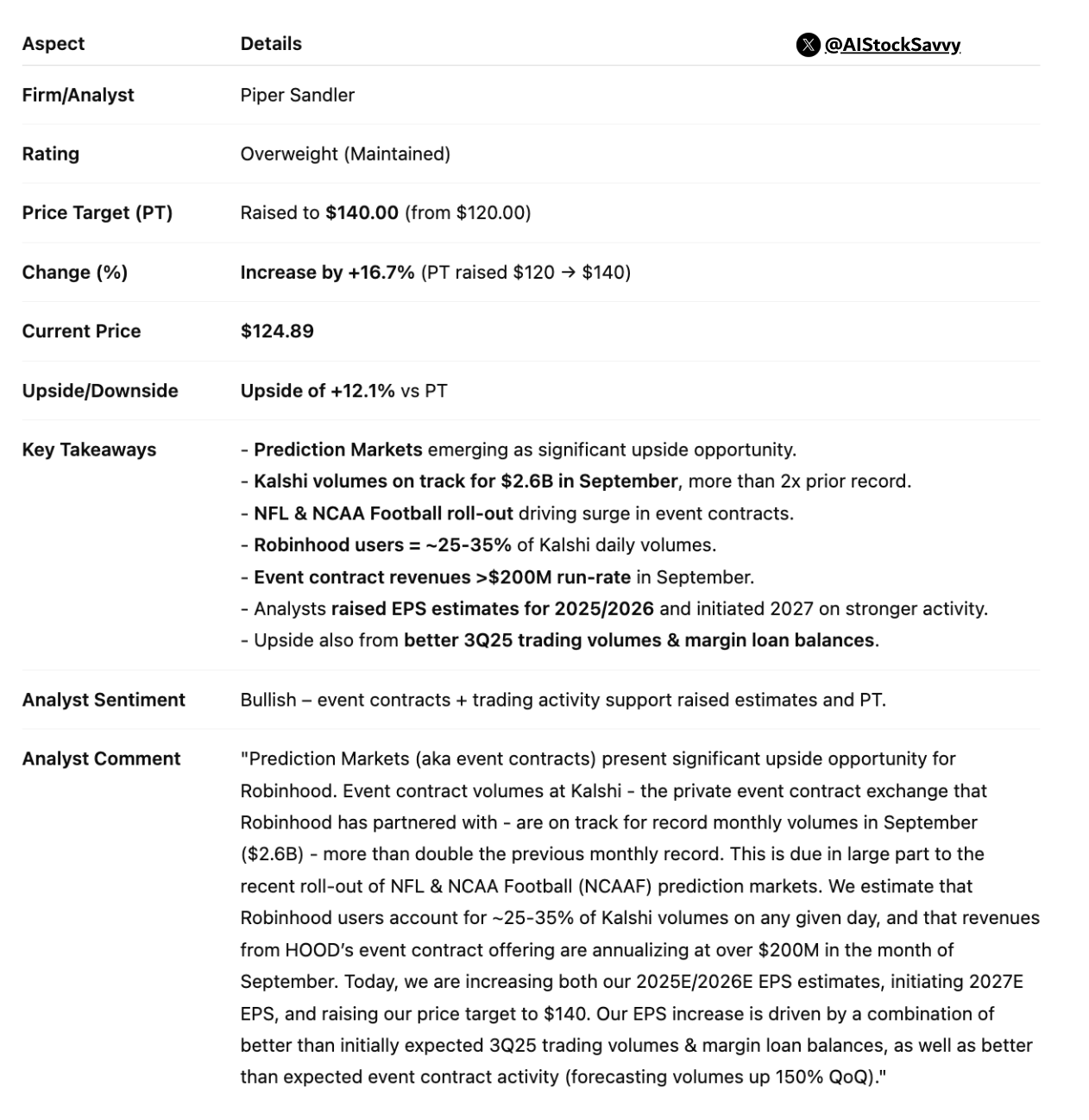
Prediction markets for NFL and other events are already a $200 million business for Robinhood, says Piper Sandler (CNBC, paywall): Post is paywalled, but Piper Sandler raised its price target on Robinhood to $140 (from $120) on the strength of its prediction market business. Piper also notes that Robinhood is accounting for about 25-35% of Kalshi daily volumes. Here’s more from Twitter:

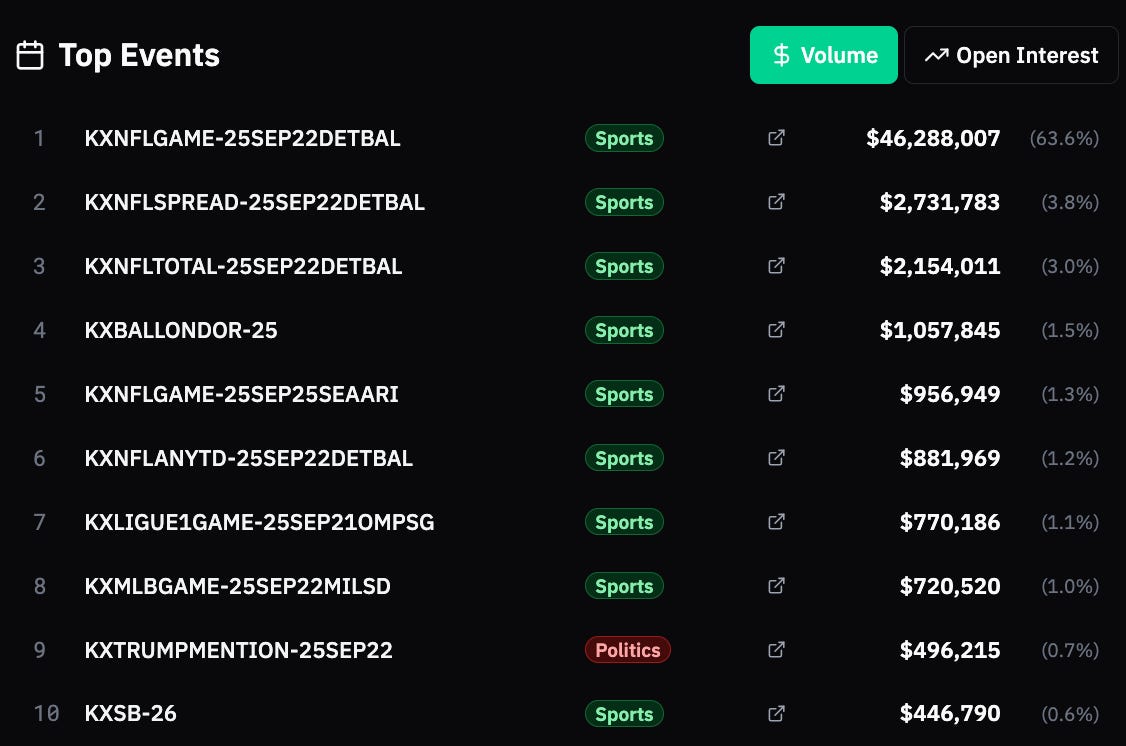
Kalshi data dump from Monday:
Trading volume of $72 million; that’s down from $82 million the previous Monday, but there were two NFL games that day.
More than $50 million was traded on markets related to the game between the Detroit Lions and the Baltimore Ravens.
88% of all volume was sports, and 79% of all volume was football.
Top ten markets on Monday:

Crypto Industry Frets That Delay in Quintenz Vote May Imperil the Clarity Act (Unchained): “Palace intrigue is dominating Washington, D.C., as to the future of Quintenz’s nomination, but the crypto industry has bigger stakes at hand than just who runs the agency. This uncertainty is coming at a time when Congress is negotiating the long-awaited Clarity Act, a critical piece of market structure legislation for the crypto sector. Industry leaders reached by Unchained say the holdup in Quintenz’s confirmation could stall, or even jeopardize, progress on the Clarity Act, which is set to make the CFTC the primary regulator for digital assets.”
“How does a market structure bill work if the vast preponderance of crypto lands in the jurisdiction of the CFTC…but there’s nobody home?” said Chris Perkins, president of CoinFund.
Kalshi pricing vs. sportsbooks: Good spotting this by Steve Ruddock at the Straight to the Point newsletter:
“Per The Bear Cave Substack newsletter, at least in some cases, Kalshi is now offering better odds: ‘On Tuesday evening, The Bear Cave reviewed prices for all upcoming Sunday NFL games and found in many cases Kalshi offered better odds than DraftKings. For example, for the Kansas City Chiefs at New York Giants, DraftKings will pay $157.50 for a $50 bet on the underdog Giants, while the Kalshi market offers $170, after fees, for the same bet.’”
“Citizens, which has been tracking Kalshi’s pricing for several weeks, also noticed the gap closing, but its larger sample size shows Kalshi still behind DraftKings and FanDuel: ‘We tracked pricing on Friday (9/19) afternoon, whereby pre-game odds across these games had worse pricing on Kalshi when adding in the transaction fee compared to the traditional sportsbooks, on average, although closing the gap.’”
My take: Pricing will swing toward prediction markets sooner rather than later for a variety of reasons, including increased liquidity and competition. Casual sports bettors have proven time and again they don’t really care about pricing that much; would exchange betting via prediction markets change that at scale? It’s possible, but history tells us that alone might not be enough. it does remain a compelling offer in the states that don’t have state-regulated sports betting.
Kalshi is bigger than Polymarket?: I have seen a series of stories and tweets about Kalshi surpassing Polymarket by trading volume. Example here. Is that true on the surface level? Absolutely! Is it an apples-to-apples comparison? No. Yes, Polymarket serves an international market, but it doesn’t technically serve the US (although it’s certainly possible to bet using crypto and a VPN). Kalshi, meanwhile, is offering legal sports betting in 50 states and is in the App Store. The comparisons are bound to happen, and have happened during the rise of both companies. Until recently, those comparisons have benefited Polymarket, which had a much larger volume. These comparisons become a lot more interesting and useful once Polymarket is in the US as a regulated entity and we actually have apples-to-apples numbers.
This, for instance is straight up hyperbole: Online sportsbooks look to get back on track with Kalshi and Polymarket breathing down their neck. Sure, Kalshi, Polymarket etc. are and will be competitors, but they are nowhere near the scale of regulated sports betting. Right now, Kalshi’s trading volume (WHICH IS NOT THE SAME AS HANDLE) makes it comparable to the numbers in a large state that has legalized online betting.
Kalshi Rolls Out Volume Rewards To Mixed Reviews (Prediction News): “While traders were sweating blocked kicks and trying to figure out if and when Jimmy Kimmel Live! will return to television, Kalshi quietly turned on a new volume incentive program that pays traders pro‑rata rebates for driving activity in specific markets, a bid to deepen liquidity and boost pricing efficiency. Kalshi filed the framework with the Commodity Futures Trading Commission (CFTC) on Aug. 31 and said the program would take effect upon exchange notice. On Sept. 18, Kalshi announced the program’s launch by sharing a PDF with rules in the company’s Discord, and over the weekend eligible markets began displaying in‑product indicators highlighting active reward terms.”