

Kalshi’s quest to replicate sportsbooks’ offerings marched on with the launch of a new set of player props for NFL games.
Users can now bet on how many yards quarterbacks will throw for, as well as receiving and rushing yards.
Here’s what it looks like for Thursday Night Football between the Philadelphia Eagles and New York Giants:
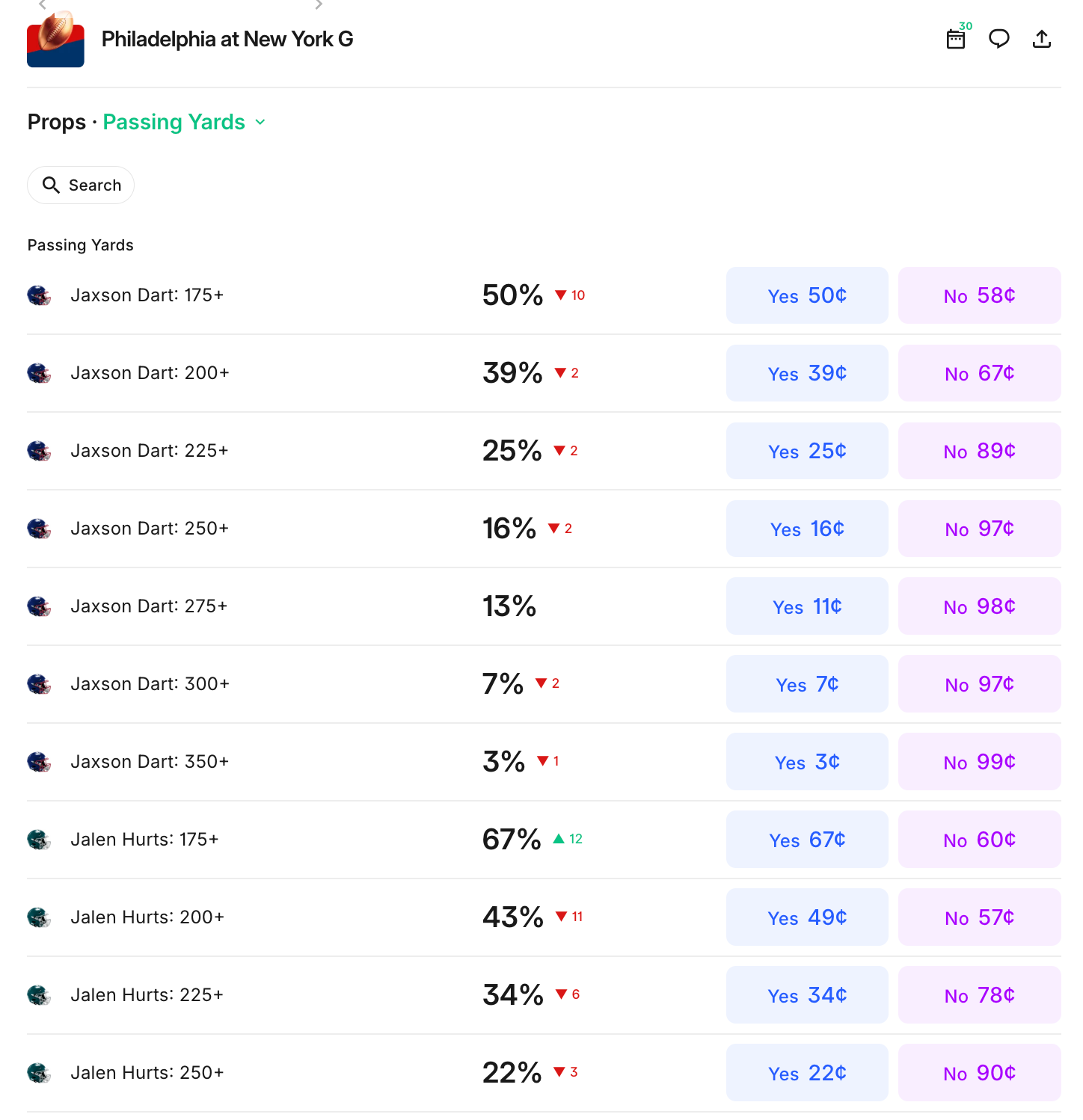
Similar bets are not available for college football. It’s not clear if these props will be available for parlays, as this game and others currently don’t have the parlay function.
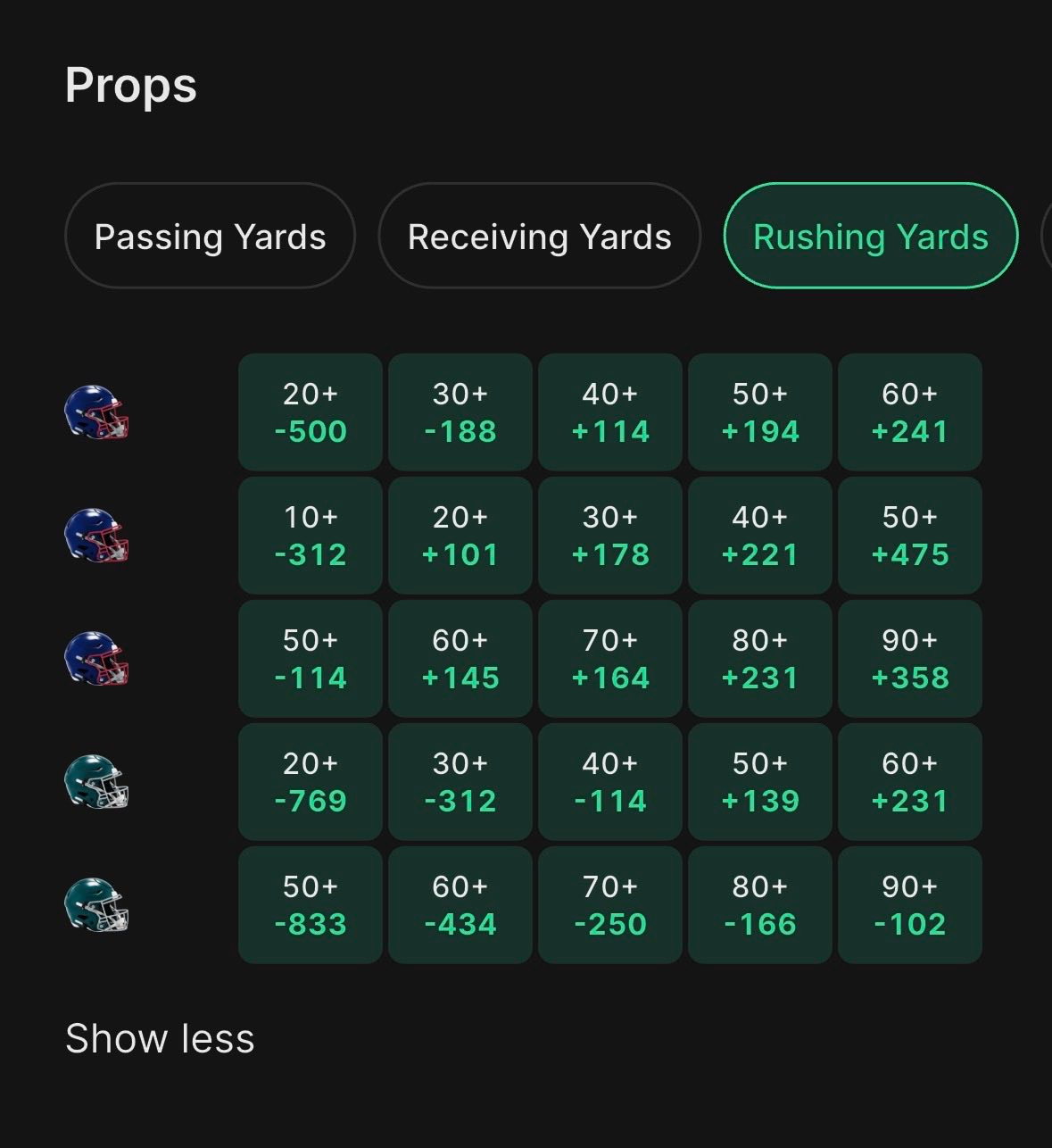
The UX leaves something to be desired on the app compared to the website. You can’t see the name of the player you are betting on until you select a bet:

PayNearMe has developed the gaming industry’s first platform that is purpose-built to dramatically improve the end-to-end payment experience. It enables operators to manage the entire payment journey, for all major forms of payment and through the most popular channels. With PayNearMe, operators gain full control of the payment flow, promoting acquisition, retention and efficiency. One platform, one integration—built to solve gaming’s toughest payments problems.
Prediction markets news roundup
Polymarket CEO Shayne Coplan Is Youngest ‘Self-Made Billionaire,’ Bloomberg Says (Decrypt): “Shayne Coplan, the founder and CEO of premier prediction market Polymarket, is the youngest self-made billionaire at 27-years-old, according to Bloomberg. Coplan’s ascent comes after Polymarket was valued at $9 billion following a $2 billion investment from the NYSE owner, Intercontinental Exchange, also referred to as ICE. Coplan joins a prestigious list of crypto billionaires, which includes Binance co-founder Changpeng ‘CZ’ Zhao, Strategy CEO Michael Saylor, and Coinbase CEO Brian Armstrong. Wallets linked to the elusive Bitcoin creator, Satoshi Nakamoto, are valued at $134.5 billion, according to Arkham Intelligence, which would make him the world’s 12th richest person, per the Bloomberg Billionaires Index.”
Prediction Market’s Legality Will Require ‘Patience’ (Covers): “Gambling corporate stakeholders and state-level regulators at an industry conference this week reaffirmed their position that prediction market event contracts on sports constitute illegal gambling. The determination in the eyes of the U.S. legal system likely won’t be settled for years to come. Twelve months after prediction markets were hardly discussed, industry speakers at this year’s Global Gaming Expo (G2E) used much of the conference to discuss these platforms’ sports event contracts, considered by many of the same stakeholders to be illegal gambling. As consensus from major gaming operators and the officials that regulate them maintain these sites operate illegally, there remained uncertainty about their fate as they undergo legal battles in more than a half-dozen states.”
I was on a panel at G2E on this:
Expect Prediction Market Lawsuits To Reach Supreme Court, G2E Panelists Say, But It May Take Years (Ingame): “The legal status of sports event contracts will ultimately be decided by the Supreme Court, but likely not until 2027 or 2028, according to speakers on arguably the most hotly anticipated panel of G2E 2025. In a standing-room-only panel Wednesday in Las Vegas, consultant and journalist Dustin Gouker of The Closing Line, Covington & Burling LLP Partner Kevin King, and Arizona Department of Gaming Director Jackie Johnson discussed the rise and future of prediction markets.”
Here’s why Wall Street is betting against DraftKings and FanDuel — and going all in on Polymarket and Kalshi (MarketWatch): “Some short sellers think we’re in the early days of a takeover by prediction markets. They think prediction markets have access to greater distribution and offer bettors better value than sports-betting platforms. On top of that, prediction markets are challenging what was seen as a gambling duopoly, which could mean the likes of DraftKings and FanDuel have a fair amount to lose.”
Nevada Gaming Control Board: The prediction market ‘gig is up’ (CDC Gaming): “A member of the Nevada Gaming Control Board Wednesday said that prediction market operators will lose out in the end in their bid to take market share away from licensed operators in the state and elsewhere. During the opening of Wednesday’s board meeting, George Assad cited last week’s ruling from U.S District Court Judge Andrew Gordon of Nevada, who denied Crypto.com’s request for a preliminary injunction against the Board. In his ruling, Gordon said the sports event contracts touted by prediction markets don’t qualify as legal financial vehicles under the Commodity Futures Trading Act, as operators argue.”
“I would like to comment on the recent case by Judge Gordon,” Assad said. “It got very little publicity, but as a public-service announcement, I would like to inform all those participants like Kalshi, Crypto.com, Polymarket, etc. that the gig is up. These judges are starting to wake up and see that this word salad they’ve been producing is nothing more than a word salad. A derivative contract or whatever you want to call it is nothing more than a sports wager. A sports wager is a sports wager. Every bet made in this town is a contract. You can call it a derivative contract or a credit default swap like they did during the housing bubble. Whatever, you call it, it’s still a sports bet. Therefore, it’s under the jurisdiction of the Nevada Gaming Commission and Nevada Gaming Control Board.”
What happens when you can bet on anything? (WBUR, podcast): “Prediction markets have long been an under-the-radar way to bet on politics, sports and pop culture. Now, platforms like Kalshi and Polymarket are going mainstream. Why are they getting so popular, and how could they impact the way we predict the future? Guests:
Robin Hanson, economics professor at George Mason University. A long-time scholar, advocate and inventor in the world of prediction markets.
Ben Schiffrin, director of Securities Policy at Better Markets, a nonprofit advocating for consumer protections and greater accountability for financial institutions.”
Kalshi Accused Of Violating SC, Federal Gambling Laws (Law360, paywall): “Trading platforms Kalshi and Robinhood are being sued in South Carolina on allegations that they violate the state’s strict anti-gambling laws by offering sports betting and operating a “prediction market” for state residents.”