



The Ninth Circuit delivered bad news to Kalshi on Friday, as the prediction market company lost its appeal against Nevada. Where does the legal battle for prediction markets go from here? The US Supreme Court is definitely in play.
Daniel O’Boyle of InGame and I break down that news and everything else that happened last week in prediction markets.
Show notes and more reporting/context on the decision:
Nevada reacts: “We are pleased with the Ninth Circuit’s ruling today in favor of Nevada. This completely vindicates what we have been saying all along. This is sports betting and needs to be properly regulated by the state. The Nevada Gaming Control Board has been regulating gaming in the state of Nevada for more than 70 years in accordance with the highest standards and best practices. We will continue to vigorously enforce Nevada law to safeguard gaming in our state,” stated Nevada Gaming Control Board Chairman Mike Dreitzer.
“Prediction markets offering sports-event contracts constitute gambling and must comply with Nevada’s gaming laws and regulatory framework. I commend Chairman Dreitzer and the Nevada Gaming Control Board for their diligent work to uphold Nevada’s longstanding regulatory standards, safeguard the integrity of our gaming industry, and ensure the public can continue to have confidence in its oversight,” said Nevada Governor Joe Lombardo.
The rest:
Clash Between Prediction Markets and States Sets Off a Furious Political Battle (New York Times): “In early March, Donald Trump Jr. made a pitch to a crowd of Republican state attorneys general who had gathered for a three-day retreat at the Ritz-Carlton hotel in New Orleans. …”
“Sitting onstage for a question-and-answer session with Montana’s attorney general, Mr. Trump suggested that state leaders were being led astray by a ‘vested interest’ — gambling firms that wanted to protect their ‘monopolies’ by attacking prediction markets, four people familiar with his remarks said. In reality, he said, the markets already had robust oversight, describing them as a sophisticated financial tool overseen by federal officials, not state attorneys general.”
CFTC Orders Gabriel Perez to Pay $172,000 for Insider Trading of Mention Market Event Contracts (press release): The Commodity Futures Trading Commission today announced an order filing and settling charges against Gabriel Perez for misappropriating material, nonpublic information obtained through his federal government employment in order to trade event contracts (i.e., swaps) on a prediction market platform for his personal benefit.
Under the order, Perez must disgorge the profits he made from his unlawful trading totaling $107,539.02 and pay a civil monetary penalty of $65,000, representing a substantial discount under the Division of Enforcement’s new cooperation advisory because of Perez’s exemplary cooperation with the CFTC.
LSU Football Coach Kiffin’s Bonuses Hedged Using $3 Million Kalshi Trades Placed By Outside Firm (InGame): “A third party helping Louisiana State University hedge against potential bonus payments to football coach Lane Kiffin used bets on the team’s performance on Kalshi to offset exposure. Similar trades were placed last month on South Carolina’s football team, again from a third party rather than the university, though the exact risk being hedged for those trades is less clear. Two weeks ago, five ‘block’ trades — trades negotiated off exchange — were placed on LSU to have a successful college football season, worth a combined $3 million.”
The Event Horizon briefing
A quick look at what matters most in prediction markets.
📍 The Big Story
Polymarket is raising
Bloomberg: Venture capital firm 1789 Capital is leading a new funding round for Polymarket that will give the prediction-markets platform a $21 billion post-money valuation.
Polymarket will raise $1 billion, with 1789 set to contribute around $300 million, according to people familiar with the matter. Bloomberg reported earlier this month that the firm was in early talks to raise capital at a valuation of more than $20 billion.
Polymarket was most recently valued at $15 billion.
Trump Jr. is a partner at 1789. Just last week, Jamie Raskin, ranking member of the House Judiciary Committee, launched an investigation into 1789.
This news comes on the heels of a story at The New York Times relating how Trump Jr. advocated for Republican attorneys general to back off prediction markets.
Much has been made of Trump Jr.’s involvement with both Polymarket and Kalshi. That attachment was perhaps easier to wave off previously, but that’s becoming more difficult to ignore in recent days.
🔭 What To Watch For
For at least the next few days, it’s all eyes on New Jersey and if it appeals its loss to Kalshi in the Third Circuit.
A deadline to appeal to the Supreme Court looms on Sept. 3.
🔥 Hot Market
Parlays, or combos, baby
As football nears, we are getting way more parlay action as a function of total volume at Kalshi:

More from me at The Closing Line (paywall):

It’s going to be interesting to see how Kalshi messages on volume moving forward.
Good: Volume up!
Not as good: This volume is gonna dwarf everything else at Kalshi.
The nature of tracking notional volume means parlays will likely now be the biggest category at Kalshi moving forward. The small trades made by retail for potential big payouts from market makers mean volume inflates quickly.
📝 New Event Contracts
New self-certifications listed with the Commodity Futures Trading Commission:
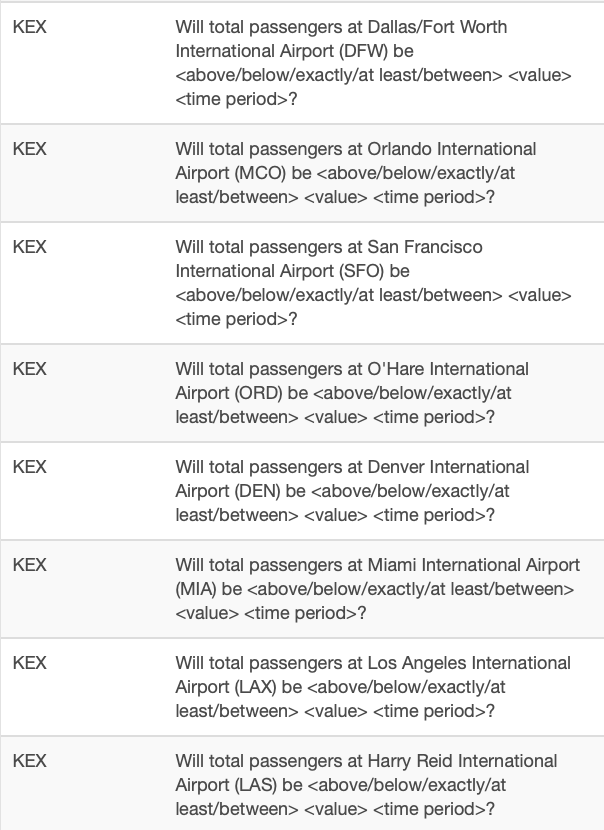
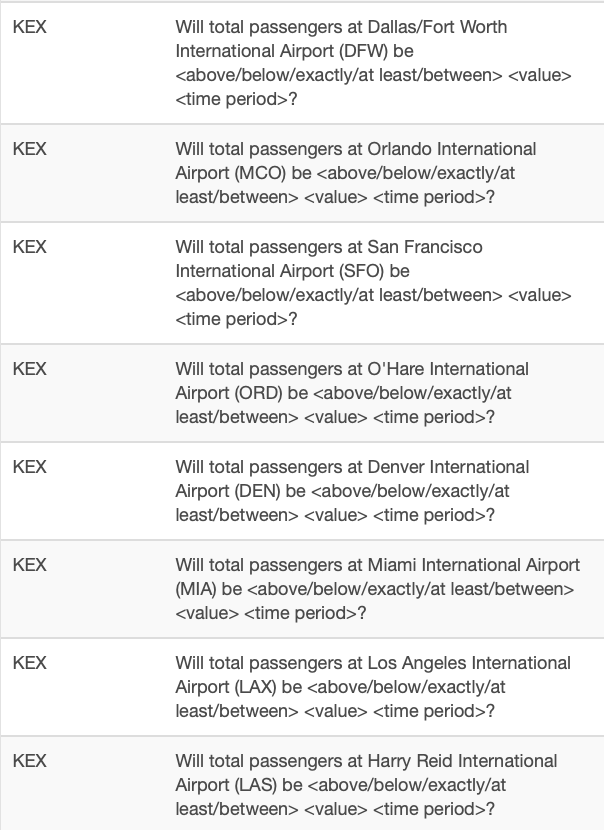
Kalshi seems to be moving ahead with more airline markets, this time on total number of passengers at an airport:
ForecastEx filed for flight cancellation markets:


💬 Quote Of The Day
“Reached by phone Monday, Santos said he needed to get a facial and didn’t ‘want any stress’ before hanging up.”
—Bloomberg, reporting on Kalshi’s enforcement action against George Santos. More on that below.
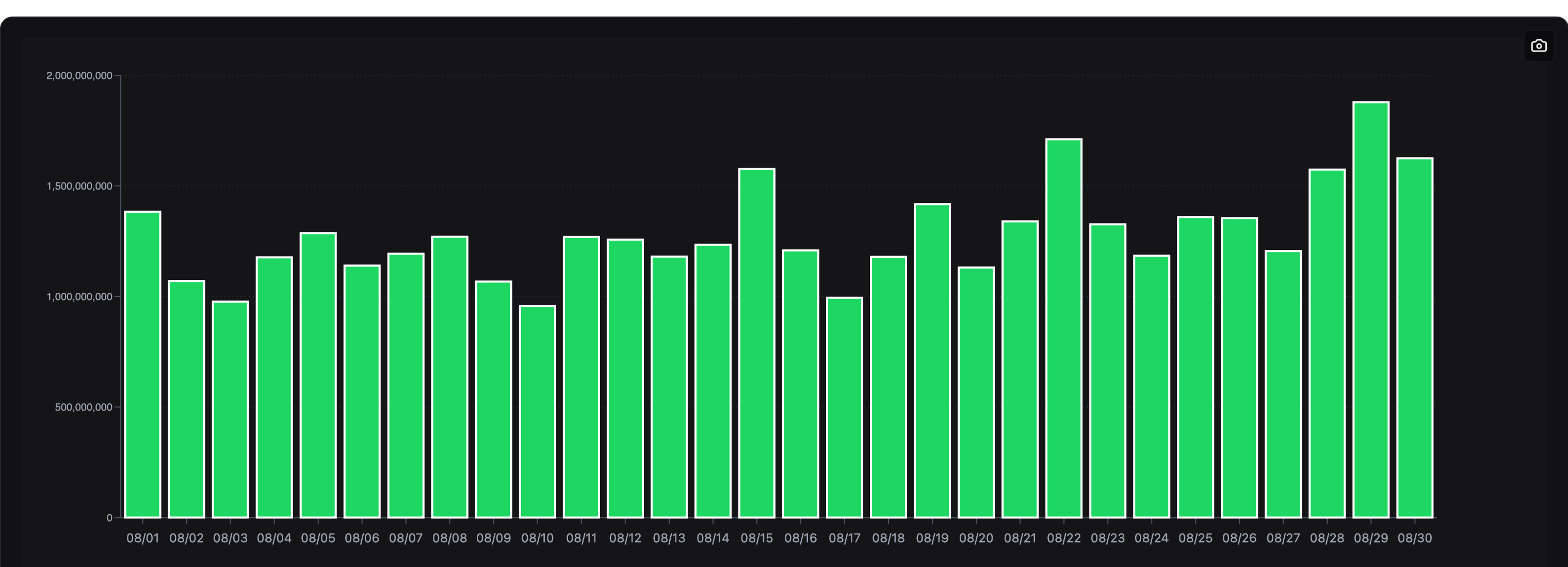
📊 Volume Tracking For Sunday, Aug. 30
Kalshi volume: $1.58 billion
Sports markets: 31.5% of volume
Parlays: 51.3% of volume
Crypto markets: 16.2% of volume
Trend line for the trailing 30 days from Ticker Tracker:
Volume on other platforms:
Polymarket US: $153.3 million
Novig: $25.9 million
Underdog: $13.3 million
Rothera: $11.8 million
DraftKings Exchange: $4.9 million
ProphetX: $3.3 million

Cash still has a place in a digital world. Besides being preferred by 63% of gaming app users, cash provides increased security and compliance for operators. With PayNearMe, you can offer a seamless, guaranteed cash-at-retail solution alongside all the popular digital payment methods like Cash App, Apple Pay, Google Pay and more—all from a single integration.
News roundup
Everything else important that happened in or was written about prediction markets:
🚨 Important stuff
Kalshi bans George Santos, takes four more enforcement actions: Kalshi announced the results of five new enforcement cases. The biggest was George Santos, who allegedly traded on and manipulated a market about whether he would attend the State of the Union address.
Santos faces a lifetime ban at the prediction market — the first ever imposed by Kalshi — and a penalty of more than $71,000. Notably, Santos did not cooperate with the investigation:
 robertjdenault@robertjdenaultToday we are posting five new enforcement cases. The majority involve prohibited trading activity that violates our CFTC-approved exchange rules. All but one individual (George Santos) cooperated with our Compliance Department inquiries and will be banned temporarily. Mr. Santos…1:42 PM · Aug 31, 2026 · 8.96K Views10 Replies · 9 Reposts · 50 Likes
From the Kalshi filing: The Kalshi Compliance Department has established reasonable cause to believe that George Santos engaged in trading activity in certain markets related to his attendance at the State of the Union address. As a person capable of influencing the outcome of the underlying event, Santos was prohibited from trading in this market under Kalshi Exchange Rule 5.17(z). Despite this, between February 2 and February 25, 2026, Santos placed a series of large trades in a market where the underlying contracts depended upon his own attendance at the event. He then began making a series of public statements regarding his attendance at the event in an attempt to influence the price of Yes and No contracts, respectively.
Some of these included false or misleading statements. The Compliance Department found that Santos made these statements with the intent to manipulate the price of the Yes or No contracts that he intended to purchase. Ultimately, these statements did in fact manipulate the price of said contracts. Furthermore, The Department found that Santos materially benefited from his trading activity, profiting $17,839.57 in the Target Markets. Accordingly, Santos engaged in conduct violating Kalshi Rule 5.17(n), prohibiting any activity that is intended to, or has the effect of, manipulating the market in violation of Sections 6(c) and 9(a)(2) of the Commodity Exchange Act. This conduct further constitutes violations of Kalshi Rule 5.17(cc)(a), prohibiting the use or attempt to use any manipulative device, scheme, or artifice to defraud in connection with trading activity, and Kalshi Rule 5.17(cc)(c), which prohibits any Kalshi member from engaging, or attempting to engage, in any act, practice, or course of business, which operates or would operate as a fraud or deceit upon any Person.
The Compliance Department has issued a penalty permanently suspending Santos from direct or indirect access to Kalshi and has imposed a penalty of $71,356.
🔍 Good that Santos was caught and faces penalties. It’s still not clear to me that we need to be able to trade on who attends the State of the Union, however.
The other cases, quoted material from Kalshi:
Stephen Cloobeck, who “was briefly a candidate for California governor. Kalshi says he bought approximately $10,000 of contracts related to his own candidacy…”
He got a three-year ban and a $31,770 penalty
Laurie Buckhout, a Republican candidate for Congress in North Carolina, “purchased less than $1000 worth of contracts related to her own candidacy.”
Three-year ban + $2,589.96 penalty
Ben Midgley, a former candidate for the Republican nomination for governor in Maine, also “purchased less than $1000 worth of contracts related to his own candidacy. … Midgley says he didn’t realize candidates were prohibited and says he had no winnings.”
Three-year ban + $5,434.30 penalty
Eric Park, whom Kalshi found “(i) improperly accessed another user’s account and (ii) engaged in prohibited trading activity with his own account.”
Kalshi named the official prediction market partner of the US Open (Kalshi blog): The USTA and Kalshi today announced a partnership that makes Kalshi the Official Prediction Market Partner of the US Open. The multi-year agreement begins with the 2026 US Open Singles Main Draw, which starts today. Kalshi will have a presence throughout the 2026 US Open across US Open digital platforms and on-court signage.
“We’re relentless about keeping tennis at the cutting edge of global sports innovation and fan connection,” said USTA CEO Craig Tiley. “Partnering with Kalshi gives us an opportunity to pioneer that next generation of fan engagement while ensuring the integrity of our sport.”
The partnership comes amid the rapid growth of prediction markets across tennis and professional sports. Kalshi has millions of users, and tennis-related trading volume on the platform is up 25x YoY.
“Every summer the US Open takes over New York, and as a New York company, we’re proud to be part of it. Tennis is one of the fastest-growing sports on Kalshi, with fans using our markets to understand what’s happening throughout the tournament,” said Kalshi co-founder and CEO Tarek Mansour. “We’re proud to partner with the USTA to give fans even more ways to engage with the game they love.”
Together, the USTA and Kalshi have established a comprehensive integrity framework for the US Open, designed to protect competitive fairness in an evolving market landscape. Under the agreement, markets that present an integrity risk — such as umpire decisions and code violations — will be restricted. Kalshi has also executed a confidential data-sharing agreement with the International Tennis Integrity Agency (ITIA) for real-time market surveillance, complementing the USTA’s multi-layered strategy of proactive monitoring, stakeholder education and strict compliance enforcement.
One aside…the US Open announcement is slightly different, adding player injuries as restricted markets. “Under the agreement, markets that present an integrity risk—such as umpire decisions, player injuries, and code violations—will be restricted.”
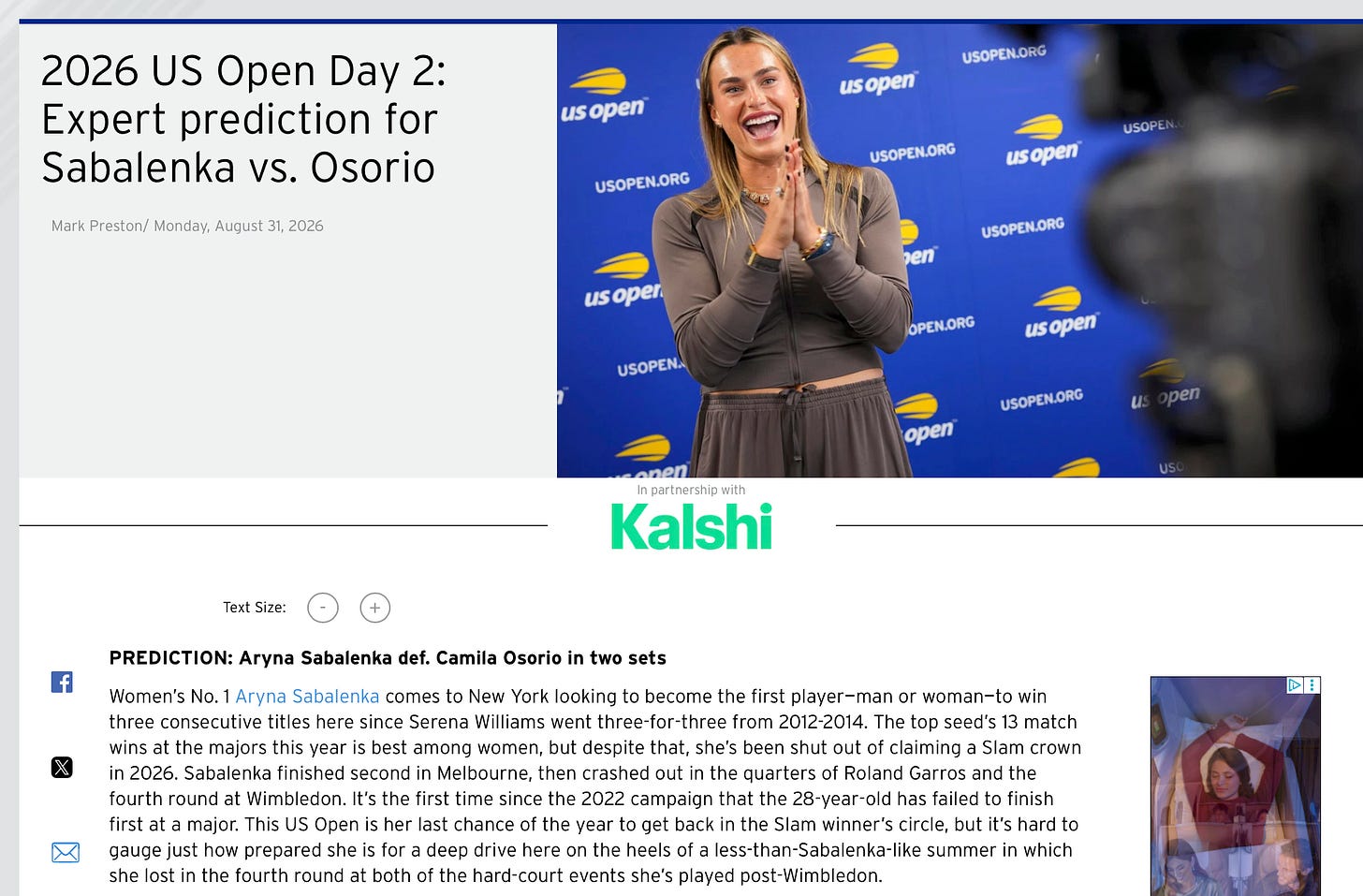
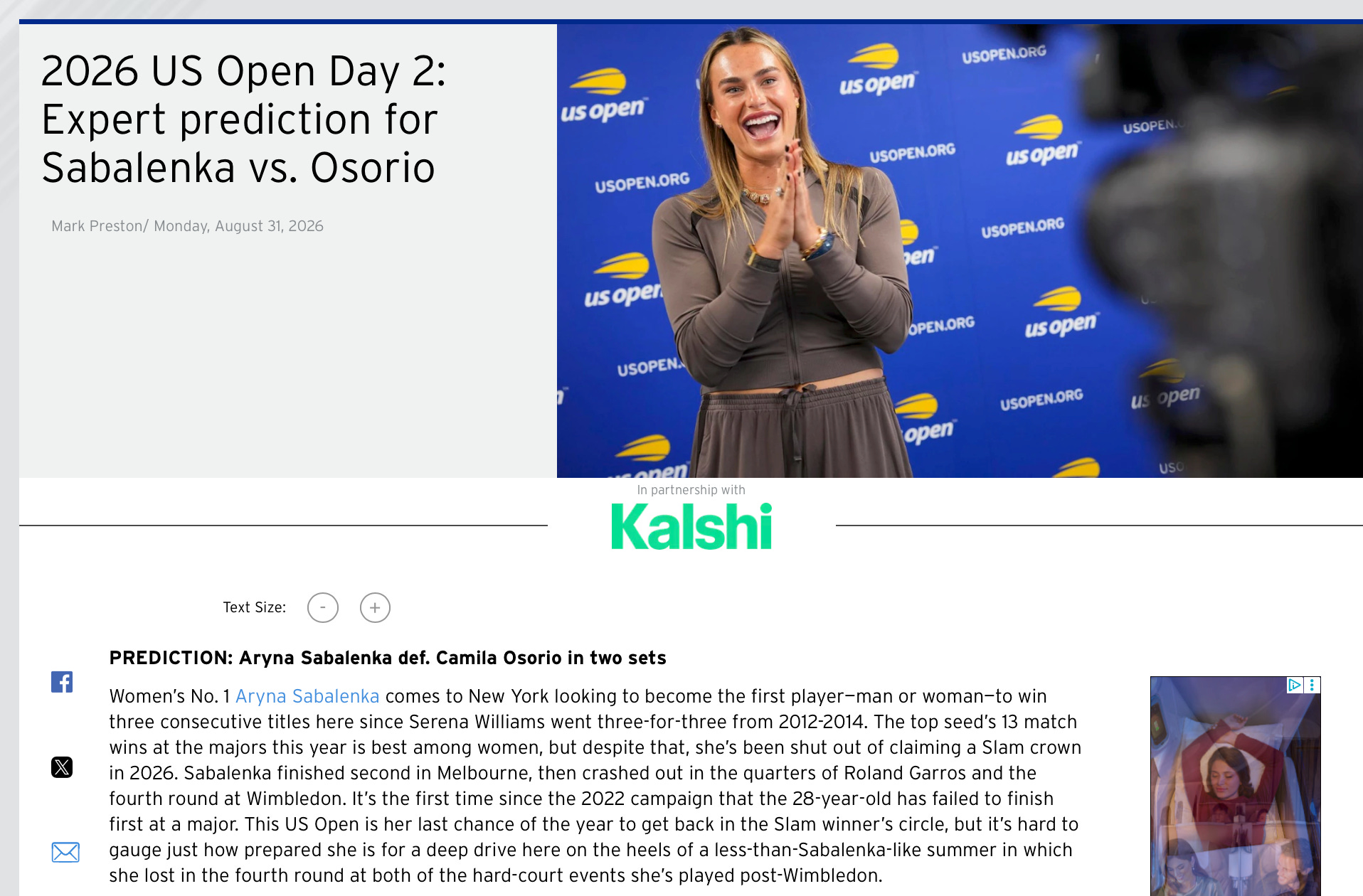
On the US Open website, the tournament is apparently posting “expert predictions” in partnership with Kalshi:
Also:



⚖️ Legal and regulatory news
Kalshi filed to offer FX perps: Kalshi wants to offer foreign-exchange perpetual futures, per a filing with the Commodity Futures Trading Commission. This is not like the self-certification process for event contracts, and is still pending CFTC approval.
The FX market is the largest financial market in the world by trading volume. Perps would allow easier access with a simpler instrument and no expiration.
Devil Is In The Details Of New North Carolina Prediction Tax (InGame): “North Carolina’s latest budget bill went into effect July 1, but the new tax on prediction markets won’t go into force until Jan. 1, 2027 — and the first payments won’t be due from operators until Jan. 31, 2028.”
“In addition, unlike traditional sportsbooks, prediction markets will only pay taxes for trades made from accounts registered with a North Carolina address. Traditional sportsbooks pay taxes on any bet made in the state, whether by a resident or visitor.”
Kalshi comment to the CFTC after last week’s meeting of the Innovation Advisory Committee: You can see the filing below.
The letter starts off with some pretty standard fare: That the answer to manipulation of markets is not banning them, but enforcement. That’s a common refrain.
More interestingly, Kalshi mounts a pretty vigorous defense of mention markets after some comments from Robinhood CEO Vlad Tenev wondering aloud if they need to be reined in:
“Mention markets–especially in political contexts–can aggregate dispersed information about the direction of public policy and allow participants to hedge exposure to statements that move markets. The Commission should weigh those benefits and adopt tailored insider trading guardrails that address the manipulation risk directly.” And later, it offers those guardrails:
Prohibition on Trading by Referenced Individuals.
Prohibition on Trading by Persons with Advance Knowledge.
Surveillance and Enforcement Mechanisms.
🔍 I can buy that some mention markets have value to the world. But certainly not every market — nor every strike — that Kalshi lists on what people will say qualifies. On top of those guardrails, it would be nice to see more careful curation of what markets are allowed and what words can be traded on.

📣 Industry news
ProphetX and Boom Sports Partner to Bring CFTC-Regulated Prediction Markets to Boom Users (press release): ProphetX, America’s first federally regulated sports-native prediction market, and Boom Sports, which operates the popular daily fantasy sports product of the same name, today announced a strategic partnership to bring federally regulated sports prediction markets directly to Boom’s user base.
“Boom has built a loyal community around fast, intuitive, interactive formats — and that same instinct for clear, fast decisions is exactly what makes prediction markets click for a user base like this,” said ProphetX Co-Founder and Chief Commercial Officer Jake Benzaquen. “Partnering with Boom gives their users direct access to a federal exchange where the crowd sets the price and every participant competes on a level playing field, instead of against the house.”
“At Boom Sports, we’re creating a destination where sports fans can engage with their favorite players and teams in a variety of ways,” said Boom Sports CEO Stephen A. Murphy. “We’re excited to add prediction markets and partner with ProphetX to bring these offerings to the Boom community.”
Under the agreement, Boom Sports will integrate ProphetX’s prediction market exchange, giving Boom’s users, who are already familiar with quick, decision-based sports experiences, a direct, in-app path to trade event contracts on real-world sports outcomes, from game results to individual performance markets and season-long futures. The markets will be powered entirely by ProphetX’s CFTC-regulated infrastructure.
Alpaca Partners with Kalshi to Expand Prediction Market Access Through Its Global Brokerage Infrastructure (press release): “Alpaca, a global leader in agent-first brokerage infrastructure, today announced a partnership with Kalshi, the world’s largest prediction market exchange, to bring prediction markets to Alpaca’s brokerage infrastructure.
The move marks Alpaca’s expansion into prediction markets with plans to add event contracts to the range of asset classes available through its API-first brokerage infrastructure. Through the partnership, Alpaca’s partners and users will be able to access Kalshi event contracts across categories including economic indicators, financial markets, weather, sports, and cultural events through the same infrastructure they already use for other financial products.
The expansion follows growing demand from Alpaca’s partners and users for access to more asset classes through a single integration. Alpaca supports more than 300 financial institutions, many of which use its infrastructure to build and offer financial products to millions of end customers. That demand comes as prediction market activity has surged, with over 40 billion dollars in trading on Kalshi in July, according to Kalshi data. …
“Alpaca’s partners and users want to access more markets without having to build and manage a separate infrastructure stack for every asset class,” said Tony Lee, Chief Brokerage Officer at Alpaca. “Bringing Kalshi’s event contracts to Alpaca is a natural extension of that model, allowing access to more asset classes through the same infrastructure they already use.”
“Partnering with Alpaca is a significant step in expanding access to Kalshi markets in the US and around the world,” said Max Crowley, VP of Business Development at Kalshi. “Alpaca powers a fast-growing ecosystem of financial platforms, and together we can bring prediction markets directly into the products investors already use to trade and manage their money.”
📖 Everything else you should know/read
Polymarket stands ready to fight misconduct as US midterms loom, intel chief says (Reuters): “Polymarket is also working to keep U.S. users off its international platform, as required by an enforcement settlement it reached with U.S. regulators in 2022, said Shana Bautista, a former Coinbase analyst and FBI investigator.”
“I’m confident that I’m able to get the resources and the support I need,” Bautista told Reuters in her first interview since joining Polymarket in June. “I can tell you that we have the systems in place to be able to identify anomalous activity when the midterms do come.”
Notable, regarding a Twitter account that gets a lot of engagement:
 Arrest Epstein’s Clients!!!@SandK123This is hilarious, Twitter is forcing them to announce their paid partnership.
 10:48 PM · Aug 30, 2026 · 500K Views102 Replies · 1.5K Reposts · 34K Likes


